📝 Paper Summary
Agentic AI for Hardware
EDA (Electronic Design Automation)
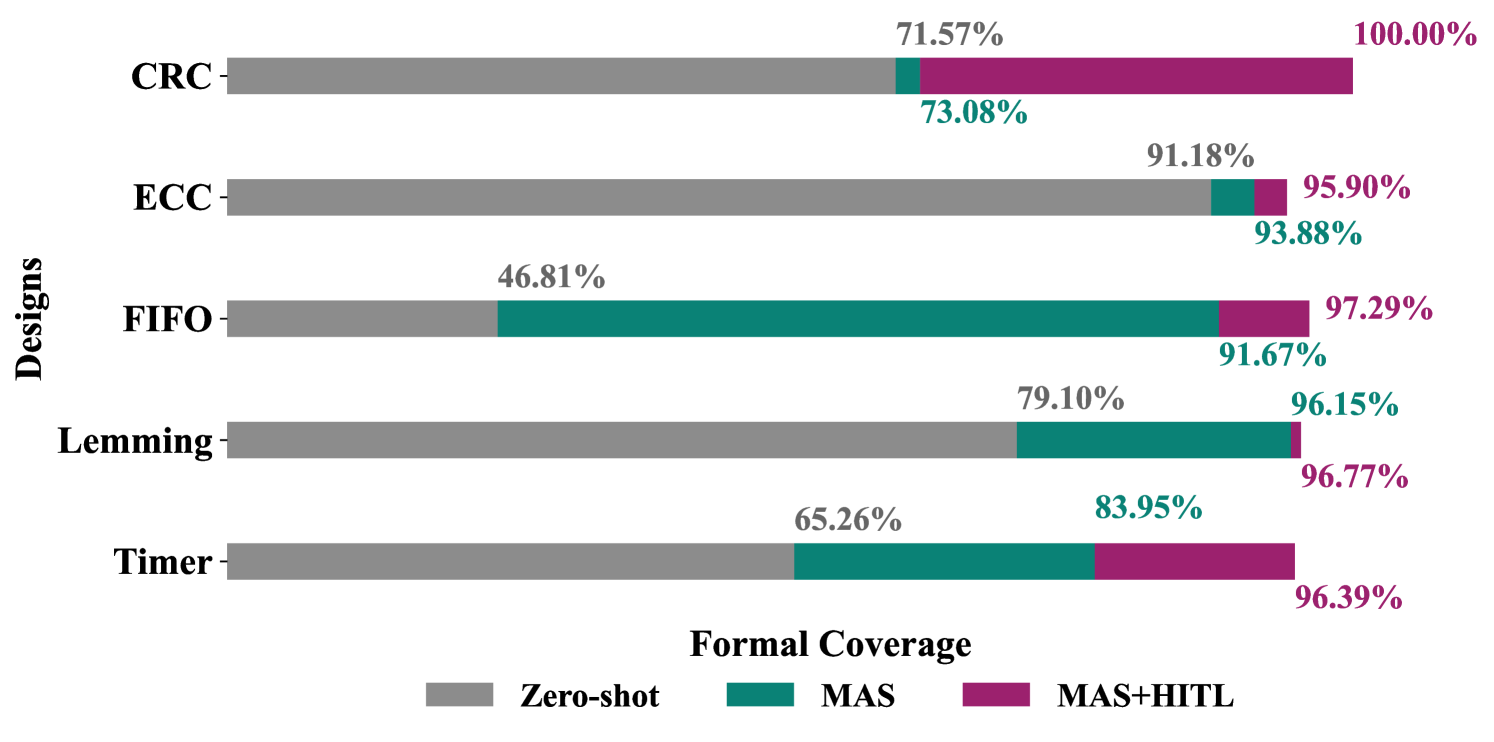
A multi-agent system collaborates with human experts and industry EDA tools to automate hardware code generation and formal verification, achieving over 95% coverage where zero-shot methods fail.
Core Problem
RTL design and verification are bottlenecks consuming 60% of chip development time; existing LLM approaches suffer from high failure rates (~60%) and cannot interact with verification tools.
Why it matters:
- Simulation-based verification is computationally expensive and slow as IC complexity scales
- Zero-shot LLMs often generate non-synthesizable code or hallucinations, lacking the iterative refinement needed for functional correctness
- Manual translation of specifications to properties is error-prone and labor-intensive
Concrete Example:
In the ECC (Error Correction Code) design, a zero-shot LLM approach generated code with severe lint errors and functional placeholders. The proposed agents identified these issues via tool feedback, and a human expert intervened for under 30 minutes to fix logic gaps, achieving functional RTL.
Key Novelty
Agentic Hardware Design with Tool-in-the-Loop
- Decomposes hardware creation into Planning, Development, and Execution phases handled by specialized agents (Design Lead, Verification Engineer, Critic)
- Integrates agents directly with industrial EDA tools (SpyGlass, JasperGold) to validate code and assertions autonomously
- Incorporates a structured Human-in-the-Loop protocol where agents escalate specific ambiguities or persistent errors to humans rather than failing silently
Architecture
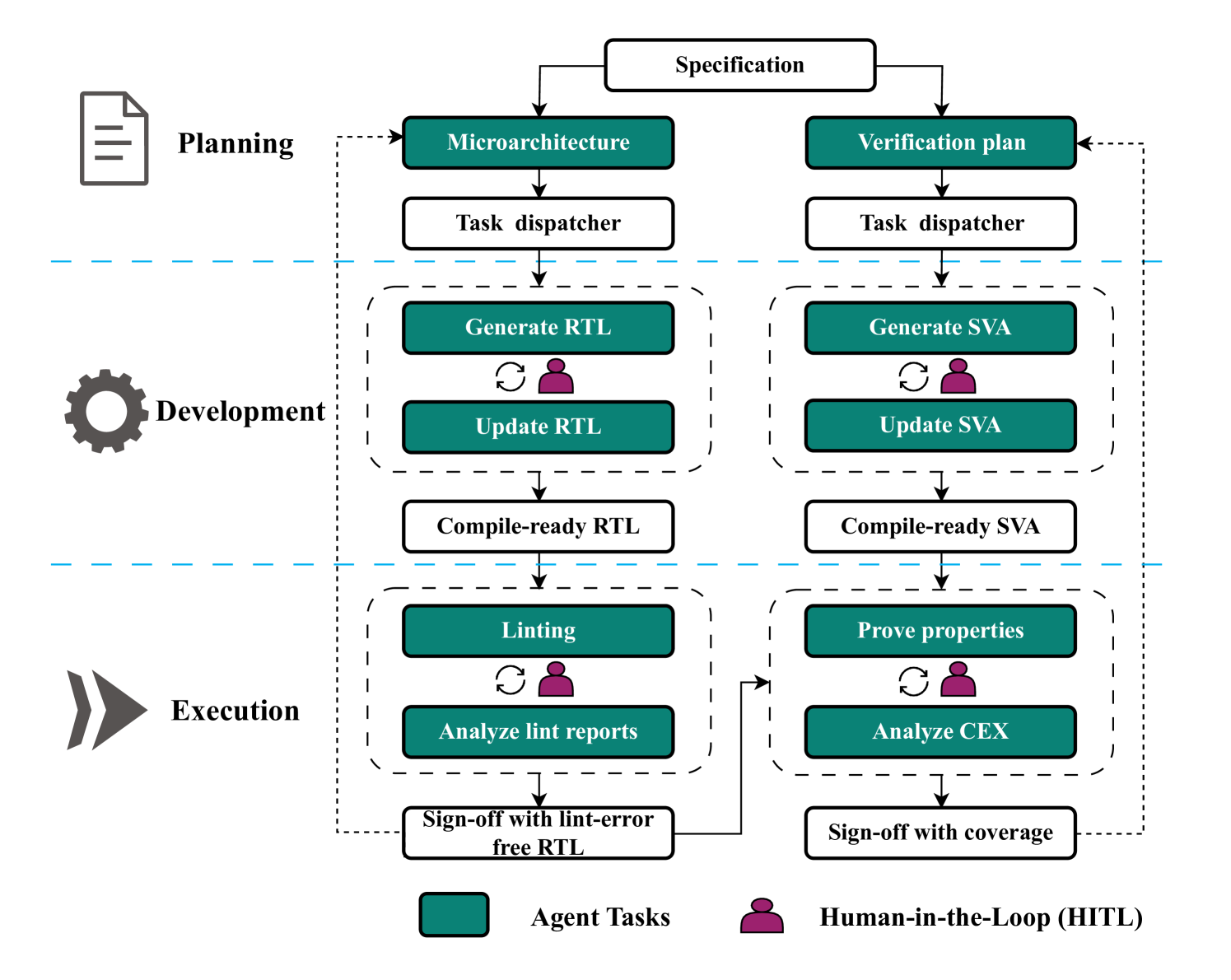
The 3-phase Agentic AI Hardware Design Methodology (Planning, Development, Execution).
Evaluation Highlights
- Achieved average formal coverage of 97.73% across five open-source designs using MAS + HITL, compared to ~69.85% for zero-shot baselines
- Attained 100% assertion pass rate on all benchmarks after iterative refinement
- Reduced manual verification effort significantly, requiring only 15–40 minutes of HITL intervention per design to reach sign-off quality
Breakthrough Assessment
8/10
Significant step in applying agentic AI to hardware by integrating real EDA tools and formal verification loops, moving beyond simple code generation to rigorous validation.