📝 Paper Summary
Multi-agent systems
Agentic workflow orchestration
Generalist agents
Magentic-One is a multi-agent system where a central Orchestrator dynamically plans, tracks progress via structured ledgers, and routes subtasks to specialized agents (Web, File, Code) to solve complex, open-ended problems.
Core Problem
Existing agentic systems often lack the generality to handle diverse, multi-step tasks that require planning, error recovery, and dynamic tool usage across both web and local file environments.
Why it matters:
- Monolithic single-agent approaches struggle with complex, long-horizon tasks requiring distinct skills (e.g., coding vs. browsing)
- Rigid workflows cannot adapt to novel errors or changing environments, limiting real-world utility
- Evaluation of agentic systems is difficult due to side-effects and stochasticity, requiring rigorous containment and repetition controls
Concrete Example:
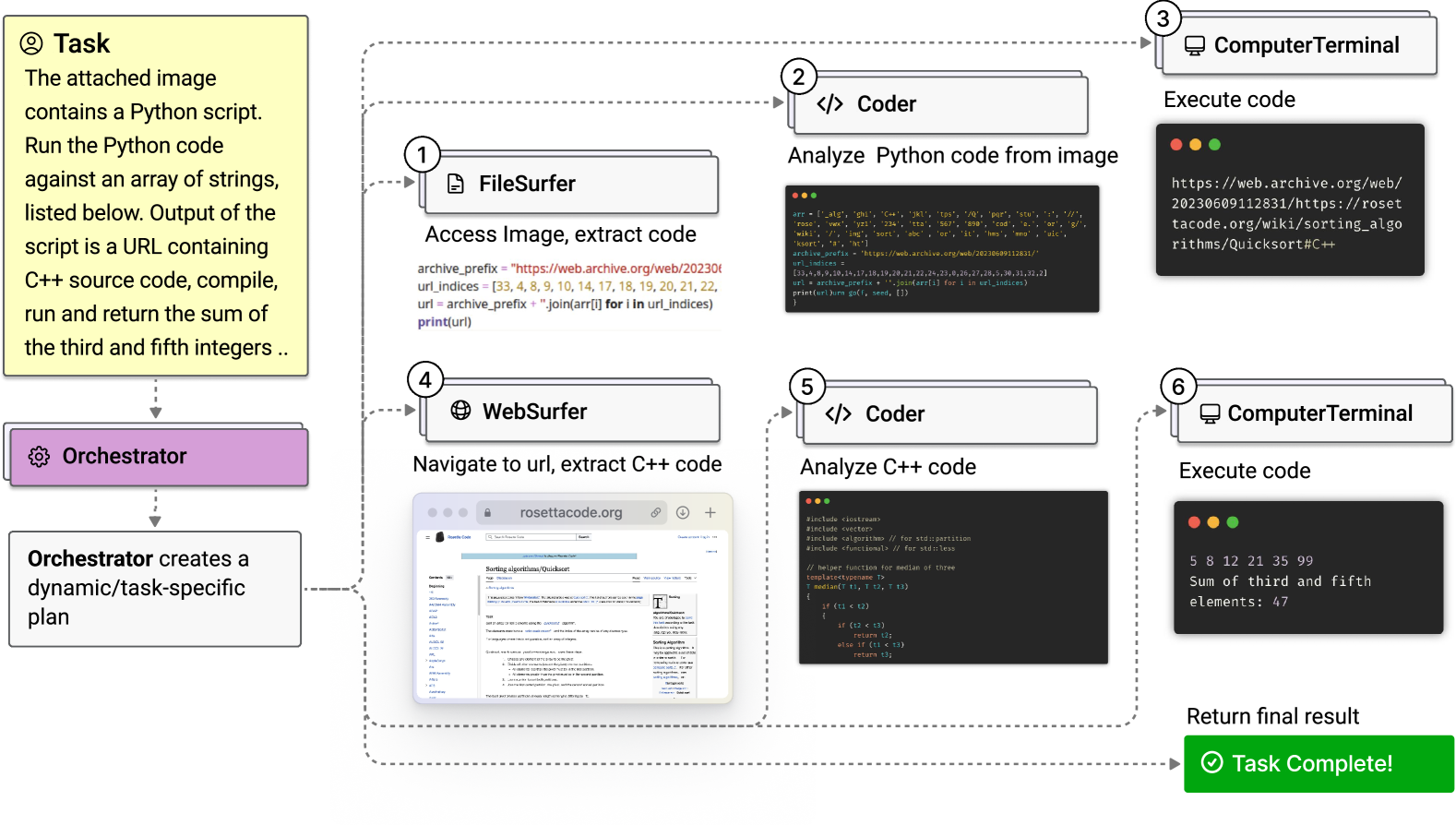
A user asks for a survey and slide deck of recent AI safety papers. A single agent might fail to navigate the web, download PDFs, read them, *and* write code to generate slides in one context. Magentic-One splits this: WebSurfer finds papers, FileSurfer reads them, Coder writes the slide-generation script, and ComputerTerminal executes it.
Key Novelty
Ledger-based Orchestrator for Multi-Agent Dynamic Routing
- Uses a central Orchestrator that maintains two structured ledgers (Task Ledger for overall plan/facts, Progress Ledger for immediate history) to manage short-term memory and planning
- Implements a dual-loop workflow: an outer loop for high-level replanning/reflection and an inner loop for step-by-step instruction of specialized agents
- Modular design allows adding/removing agents (e.g., WebSurfer, Coder) without altering the core Orchestrator logic or prompt tuning
Architecture
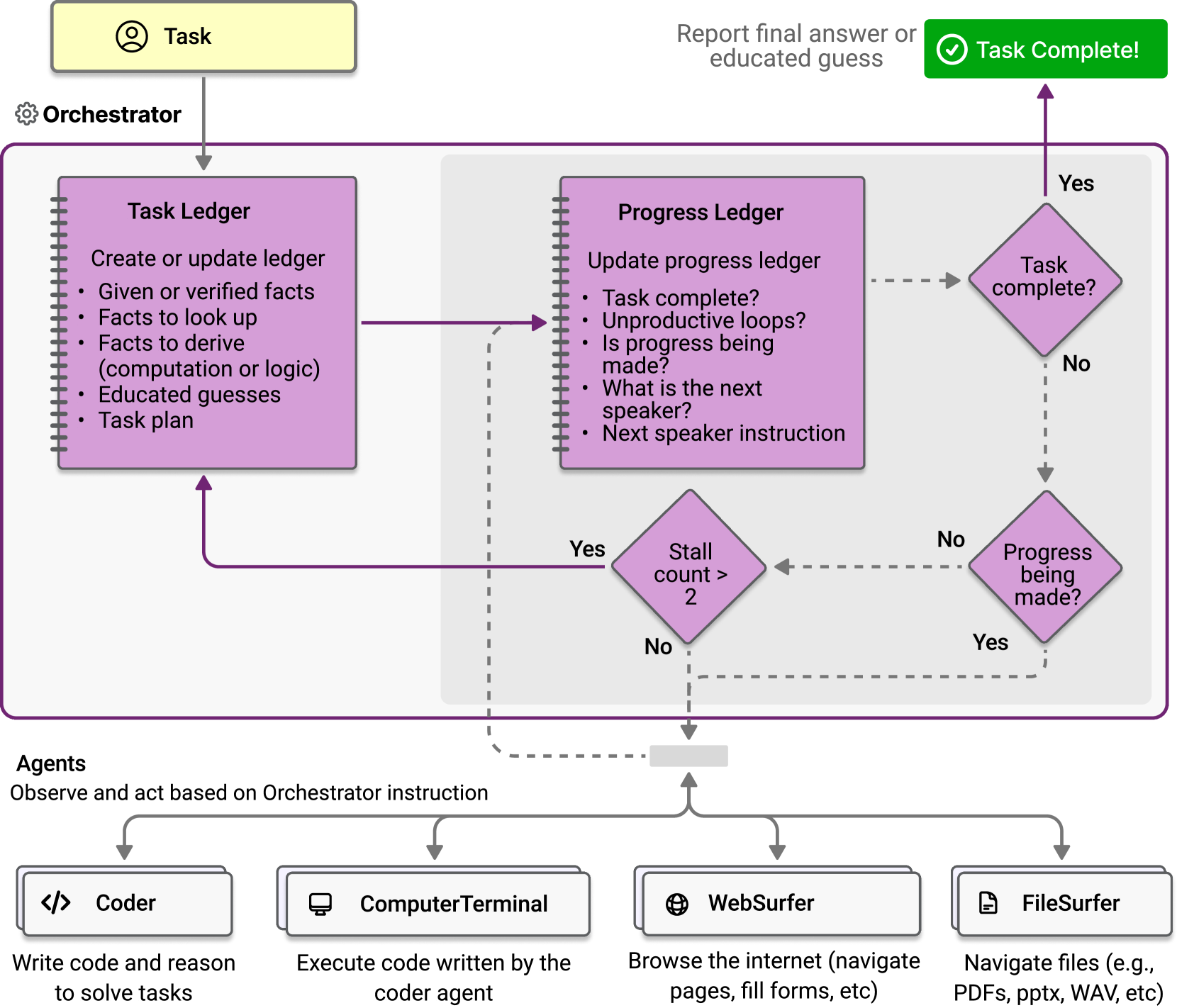
The Magentic-One architecture workflow, illustrating the Orchestrator's interaction with the Task/Progress Ledgers and the specialized agents.
Evaluation Highlights
- Achieves 38% completion rate on GAIA benchmark (validation set), statistically competitive with state-of-the-art
- Achieves 32.8% completion on WebArena, performing competitively against specialized web-only agents
- Attains 27.7% accuracy on AssistantBench, demonstrating capability in realistic user-assistant tasks
Breakthrough Assessment
8/10
Strong empirical results across diverse benchmarks (WebArena, GAIA) using a unified, generalist architecture. The ledger-based orchestration offers a clean, extensible paradigm for multi-agent coordination.