📝 Paper Summary
Multi-agent simulation
LLM inference systems
AI Metropolis accelerates LLM-based multi-agent simulations by replacing global time-step synchronization with an out-of-order execution scheduler that tracks spatial-temporal dependencies to maximize parallel inference.
Core Problem
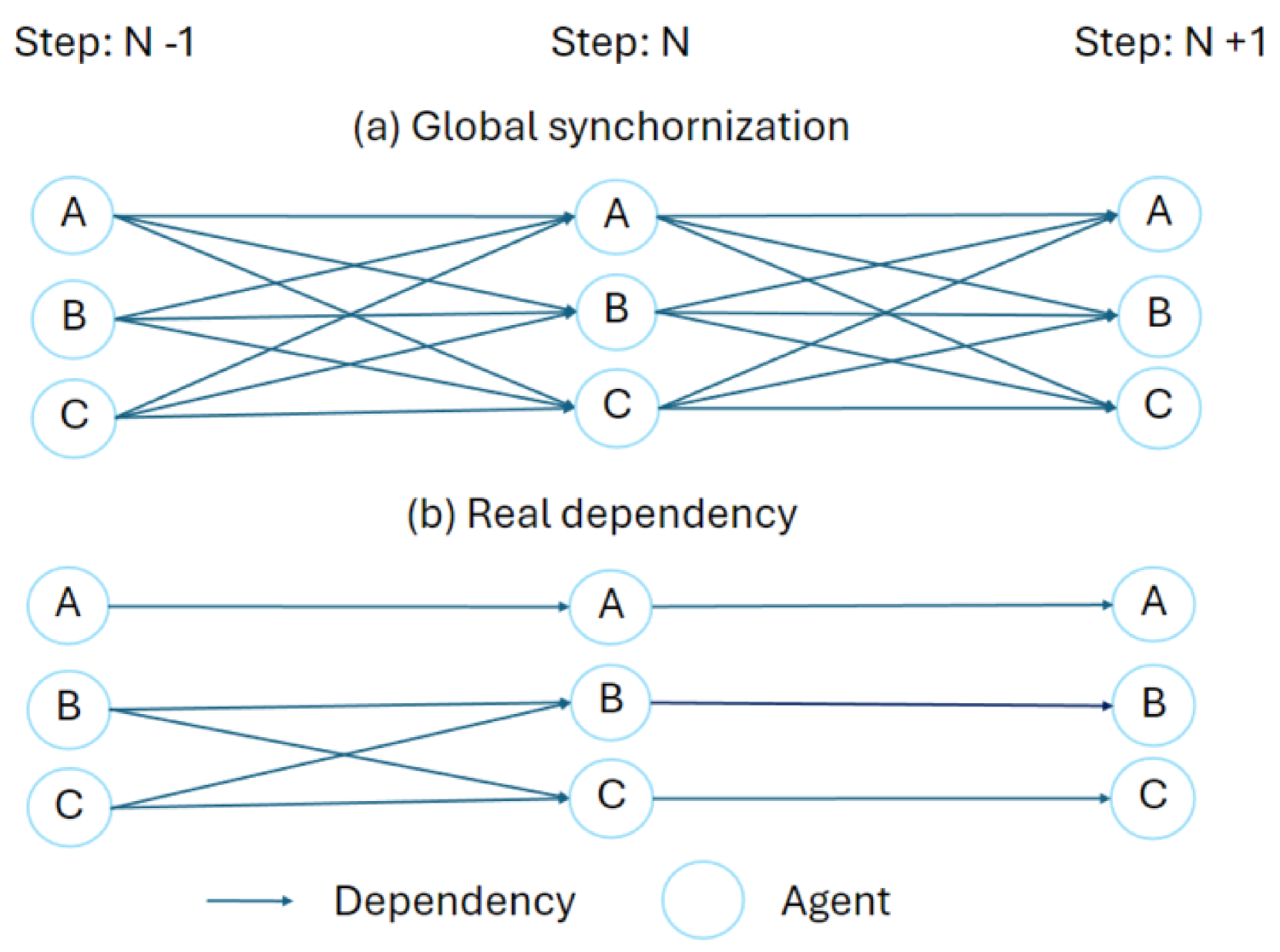
Traditional multi-agent simulations enforce global synchronization where all agents must finish a time step before any proceed, causing massive idle time due to variance in LLM response lengths and sparse agent activity.
Why it matters:
- Inference takes ~95% of simulation time; synchronization bottlenecks prevent batching, leading to low GPU utilization and high costs
- Current approaches borrowed from Reinforcement Learning (global `step()` functions) artificially limit parallelism by enforcing false dependencies between agents who are not interacting
- Scalability is poor; adding more compute resources fails to decrease simulation time because the critical path is dominated by the slowest agent in each step
Concrete Example:
In a 25-agent village, Agent A is isolated in a house while Agent B converses with Agent C. In standard simulations, Agent A must wait for B and C to finish their conversation (multiple LLM calls) before A can take their next step, even though A's actions cannot affect B or C.
Key Novelty
Out-of-order Agent Scheduling via Spatiotemporal Dependency Graph
- Treats simulation steps like instruction scheduling in a CPU: allows agents to process future time steps ahead of others if they are spatially distant (no read-after-write conflicts)
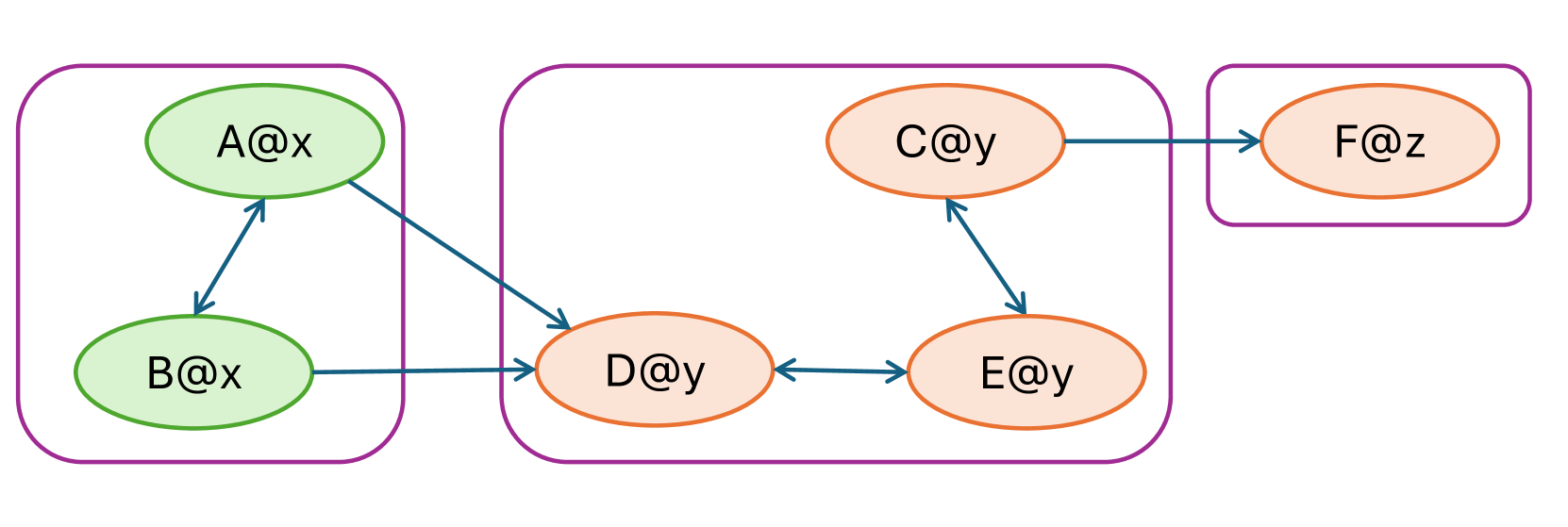
- Introduces 'Coupled' clusters: dynamically groups agents that interact into small synchronization units, while letting non-interacting agents proceed asynchronously
- Implements a 'Dependency Graph' that calculates safe execution windows based on agent distance and maximum velocity, removing false global dependencies
Architecture
The workflow of AI Metropolis contrasting with standard loops. Shows the interaction between Controller, Ready Queue, Ack Queue, and Workers.
Evaluation Highlights
- Achieves 1.3x to 4.15x speedup over standard parallel simulation with global synchronization
- Reduces the average number of dependencies per agent from 25 (global sync) to 1.85, effectively removing most false dependencies
- Performance approaches the theoretical optimal (unconstrained execution) as the number of agents increases, demonstrating high scalability
Breakthrough Assessment
7/10
Significant systems-level optimization for agent simulations. While it doesn't improve agent intelligence, it solves a critical bottleneck (speed/cost) that hinders large-scale agent research.