📝 Paper Summary
Multi-agent collaboration
Survey / Taxonomy
This survey proposes a comprehensive taxonomy for LLM-based Multi-Agent Systems (MAS), characterizing collaboration via actors, types, structures, and strategies to advance collective intelligence beyond isolated models.
Core Problem
Existing research lacks a unified framework to understand collaboration mechanisms in LLM-based Multi-Agent Systems, as current surveys focus primarily on single-agent capabilities or specific application domains without dissecting how agents interaction works.
Why it matters:
- Transitioning from isolated LLMs to collaborative MAS is essential for achieving artificial collective intelligence and horizontal scaling
- Current literature overlooks complex collaboration modes like competition and coopetition, limiting the design of robust multi-agent systems
- A lack of standardized taxonomy hinders the comparison and development of new coordination protocols for complex, multi-step tasks
Concrete Example:
While tools like Auto-GPT demonstrate agent capabilities, prior surveys (e.g., Xi et al., 2023) focus on the individual agent's 'brain' and 'perception' but fail to explain the mechanisms that enable multiple agents to negotiate or debate to solve a shared problem.
Key Novelty
Five-Dimensional Collaboration Framework for MAS
- Characterizes MAS not just by application, but by five core dimensions: Actors (agents involved), Types (cooperation, competition, coopetition), Structures (topology), Strategies (role/model-based), and Coordination protocols
- Integrates concepts from human collective intelligence (e.g., Society of Mind) into the design of LLM-based agent interactions
Architecture
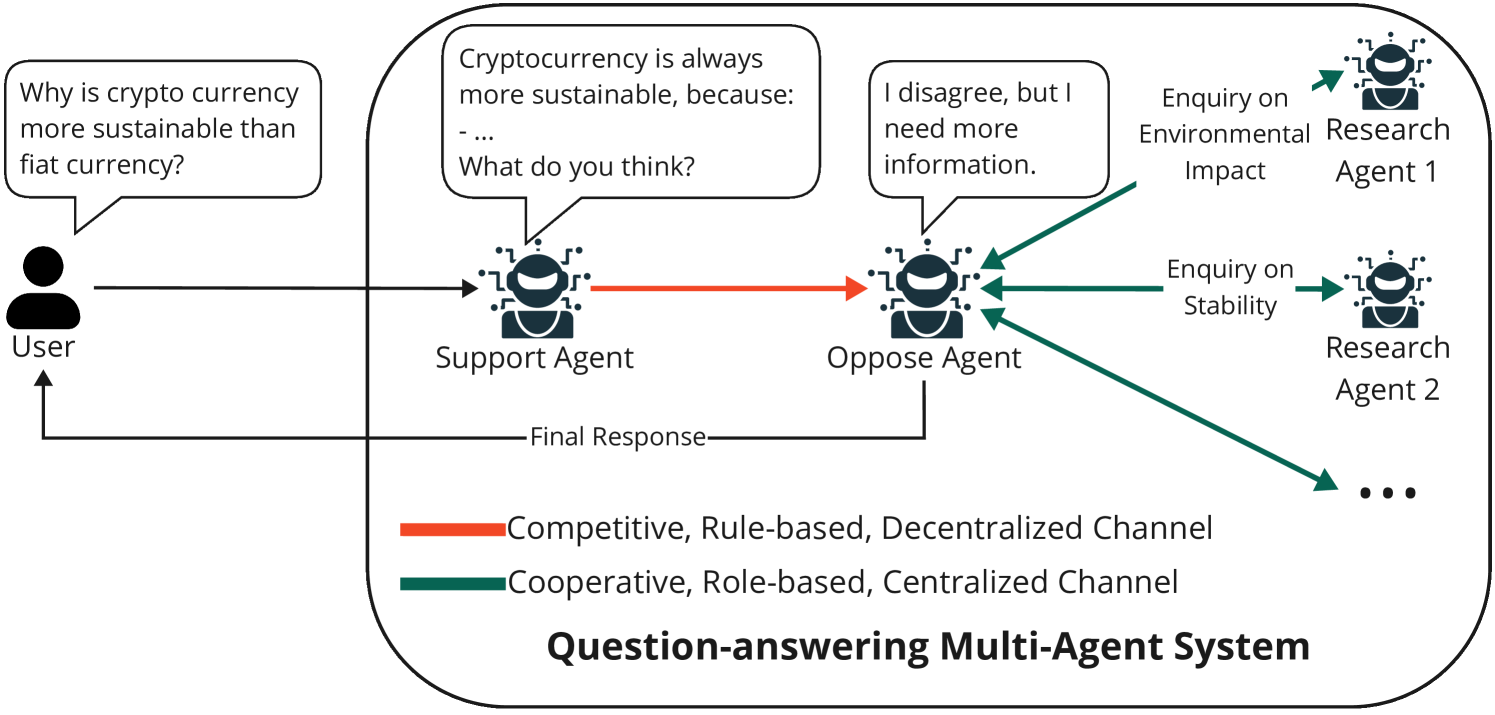
Conceptual illustration of LLM-based Multi-Agent Systems having multiple collaboration channels with different characteristics
Breakthrough Assessment
7/10
A comprehensive survey that fills a significant gap by structuring the fragmented field of multi-agent collaboration, though it is a review/framework paper rather than a new algorithmic contribution.