📝 Paper Summary
LLM Multi-Agent Systems
Scientific Discovery Automation
DrugAgent automates the construction of machine learning pipelines for drug discovery by coupling a high-level planner with an execution instructor that integrates specialized biochemical domain knowledge.
Core Problem
General-purpose coding agents fail at drug discovery tasks because they lack specialized domain knowledge (e.g., handling SMILES strings, biological data formats) and cannot effectively debug subtle scientific errors.
Why it matters:
- Drug discovery involves complex, costly experiments; automated ML could accelerate lead optimization and reduce wet-lab resource usage
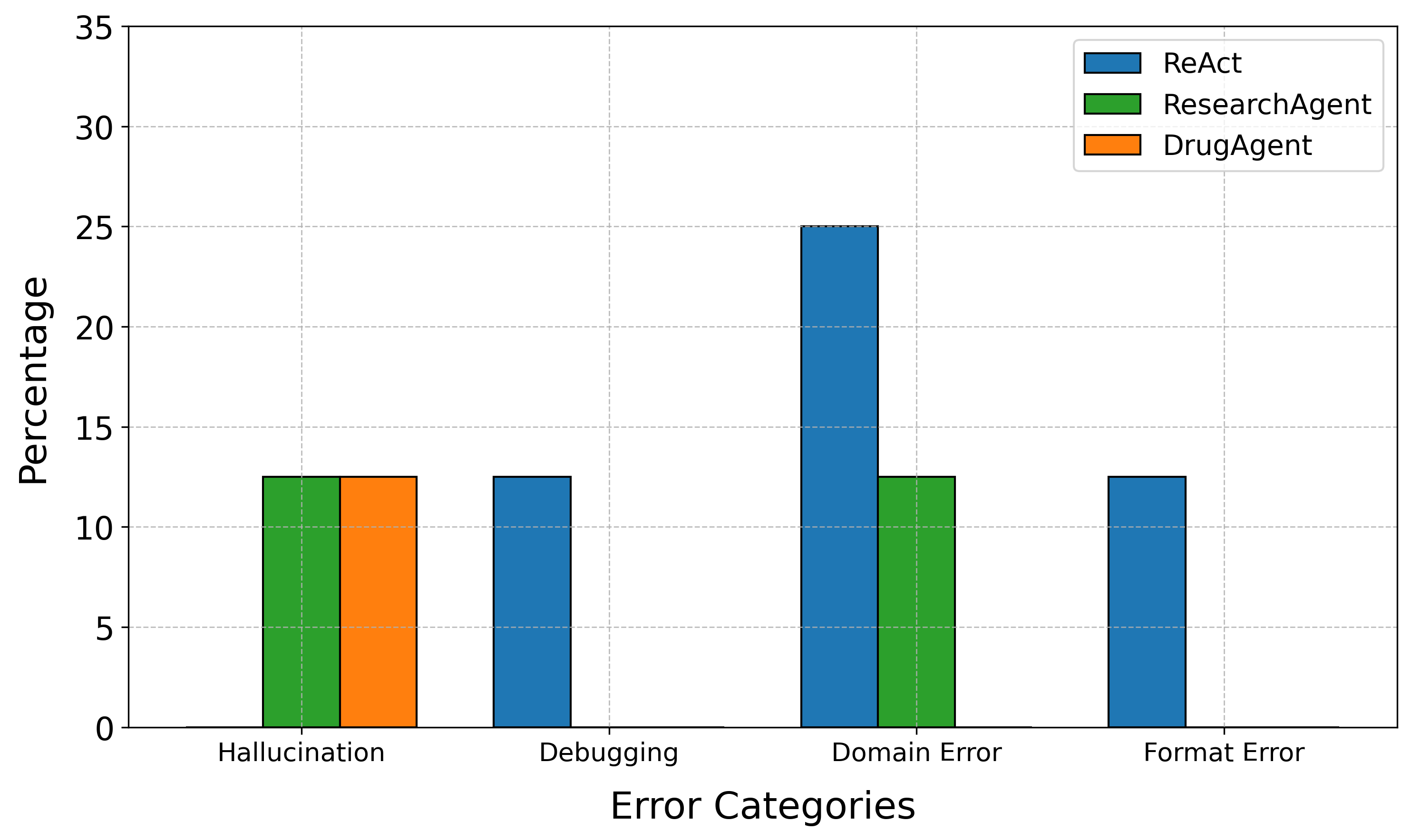
- Existing agents like ReAct or ResearchAgent make critical domain errors (e.g., wrong library usage) when applied to specialized pharmaceutical workflows
- Small mistakes in biological data preprocessing can silently invalidate entire ML pipelines, making standard debugging difficult
Concrete Example:
In a drug-target interaction task, a standard agent (ReAct) might incorrectly process protein sequences or select generic models, leading to poor performance. DrugAgent, however, correctly identifies the need for specific featurization (e.g., ESM embeddings) and successfully implements the pipeline.
Key Novelty
Domain-Knowledge-Integrated Multi-Agent Framework
- Separates high-level scientific planning (Planner) from low-level coding execution (Instructor) to mirror the workflow of a research team
- Equips the Instructor agent with a curated library of domain-specific documentation (Data Acquisition, Featurization, Models) to ground code generation in correct scientific practices
- Uses an iterative 'Generation-Exploration' strategy where the Planner generates multiple hypotheses and refines them based on the Instructor's experimental feedback
Architecture
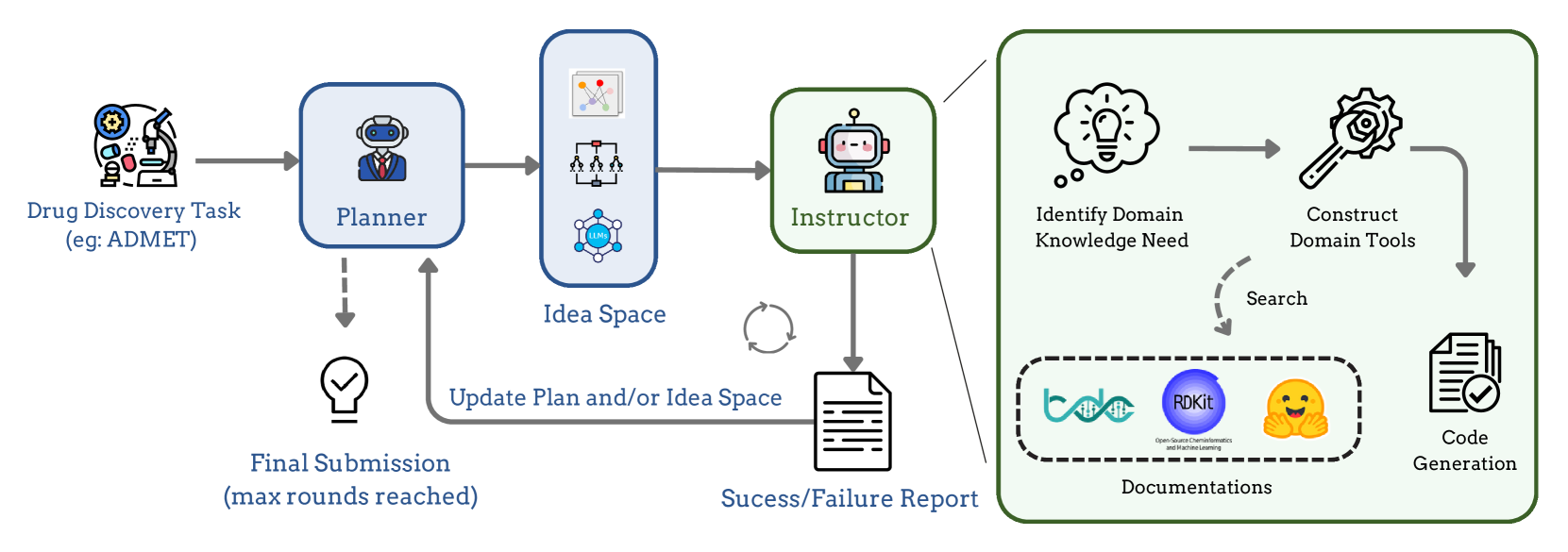
The multi-agent framework of DrugAgent, showing the interaction between the LLM Planner and LLM Instructor.
Evaluation Highlights
- +4.92% relative improvement in ROC-AUC on the Drug-Target Interaction (DTI) task compared to the ReAct baseline
- Achieves 100% Valid Rate (generating bug-free, compliant submissions) across all three tasks, whereas baselines frequently fail
- Matches or exceeds human expert baselines on ADMET and HTS tasks, demonstrating the capability to autonomously produce high-quality scientific code
Breakthrough Assessment
7/10
Strong practical application of agents to a high-value scientific domain. While the architecture is a standard planner-actor split, the deep integration of domain-specific tools and documentation sets a strong precedent for 'AI Scientist' applications.