📝 Paper Summary
Multi-call tool use with flexible plan
LLM-based recommendation
InteRecAgent connects LLMs with traditional recommender tools via a shared memory bus and a plan-first execution strategy, enabling conversational recommendation without expensive fine-tuning on item catalogs.
Core Problem
LLMs lack knowledge of specific item catalogs and new products, while traditional recommender systems lack conversational reasoning capabilities; combining them via standard prompting (like ReAct) is inefficient due to long context limits.
Why it matters:
- Fine-tuning LLMs for every domain is economically inefficient and struggles with private data or frequently updating item catalogs.
- Putting large lists of candidate items into the LLM context window (as observations) exceeds token limits and degrades reasoning performance.
- Existing conversational recommenders struggle to provide explanations or handle complex, open-ended user inquiries.
Concrete Example:
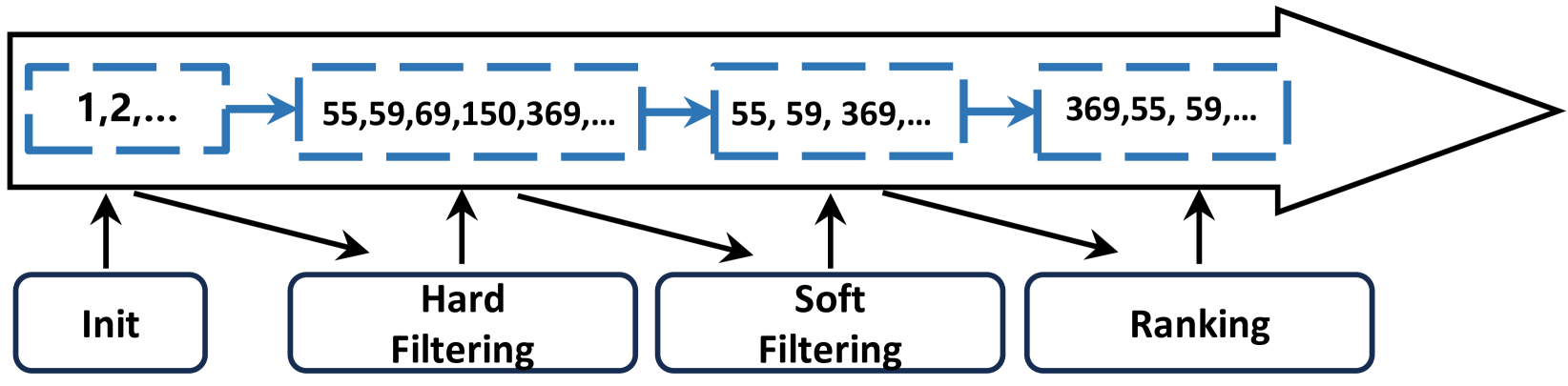
A user asks for 'puzzle games released after Fortnite.' A standard LLM might not know the release date or specific puzzle games. A standard ReAct agent might retrieve 1,000 games, crashing the context window. InteRecAgent queries Fortnite's date, filters the database via SQL, and passes the IDs via a memory bus without overwhelming the LLM.
Key Novelty
Candidate Bus & Plan-First Execution
- Introduces a 'Shared Candidate Bus' (memory) that stores item lists externally, allowing tools to filter/rank items without passing thousands of names through the LLM's prompt context.
- Replaces step-by-step reasoning (ReAct) with a 'Plan-First' strategy where the LLM generates the full tool execution path at once to reduce latency and API costs.
- Develops 'RecLlama', a smaller 7B model fine-tuned on GPT-4 interaction traces to democratize the agent capability.
Architecture
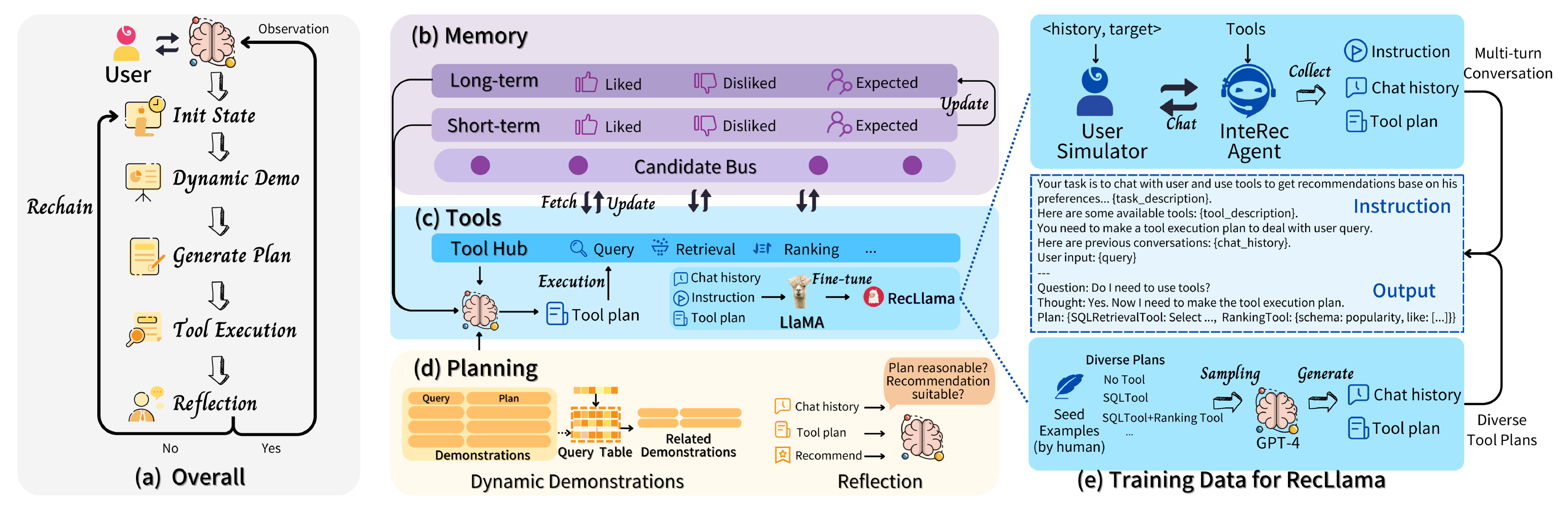
The overall framework of InteRecAgent.
Evaluation Highlights
- Constructed 'RecLlama' imitation dataset with 16,183 samples (13,525 from user simulator interactions, 2,658 from synthetic dialogue generation).
- Fine-tuned Llama-2-7B (RecLlama) demonstrated superior effectiveness as a recommender agent brain compared to vanilla Llama-2 (qualitative claim from abstract).
- Architecture reduces API calls significantly: Plan-First uses 2 calls (Plan + Response) vs N+1 calls for ReAct (where N is number of steps).
Breakthrough Assessment
8/10
Significant architectural contribution with the 'Candidate Bus' to solve the context window bottleneck in recommender agents. The distillation to a 7B model addresses practical deployment costs.