📝 Paper Summary
Human-AI Interaction
Embodied Conversational Agents (ECA)
Virtual Reality (VR)
This study demonstrates that embodied VR agents elicit greater presence than text agents and that gender differences drive visual attention patterns during health conversations, though they do not necessarily alter health behaviors.
Core Problem
Most research on AI influence focuses on disembodied text-based agents (chatbots), neglecting how physical embodiment, nonverbal cues, and social attributes like gender affect human perception and behavior.
Why it matters:
- Text-only interactions miss fundamental mechanisms of human communication, such as gaze and paralanguage, which are crucial for social connection
- As AI becomes more pervasive, understanding 'artificial social influence'—how AI bodies and identities affect human judgment—is critical for designing effective health interventions
- Current paradigms lack the integration of real-time generative AI with immersive biobehavioral tracking (e.g., eye-tracking) to study these dynamics
Concrete Example:
A user chatting with a text-based health bot receives advice but feels no social presence. In contrast, a user facing a life-sized 3D avatar that maintains eye contact might feel compelled to pay attention or comply due to social norms, a dynamic lost in text interfaces.
Key Novelty
Biobehavioral VR-ECA Framework
- Combines Large Language Models (GPT-4) with immersive VR avatars to create agents that can converse naturally while exhibiting human-like nonverbal behaviors (lip sync, gaze)
- Uses eye-tracking within the head-mounted display to objectively measure social attention (gaze duration) as a biobehavioral outcome of artificial influence
- Directly compares embodied AI (VR agents) against disembodied AI (text chat) to isolate the added value of virtual embodiment
Architecture
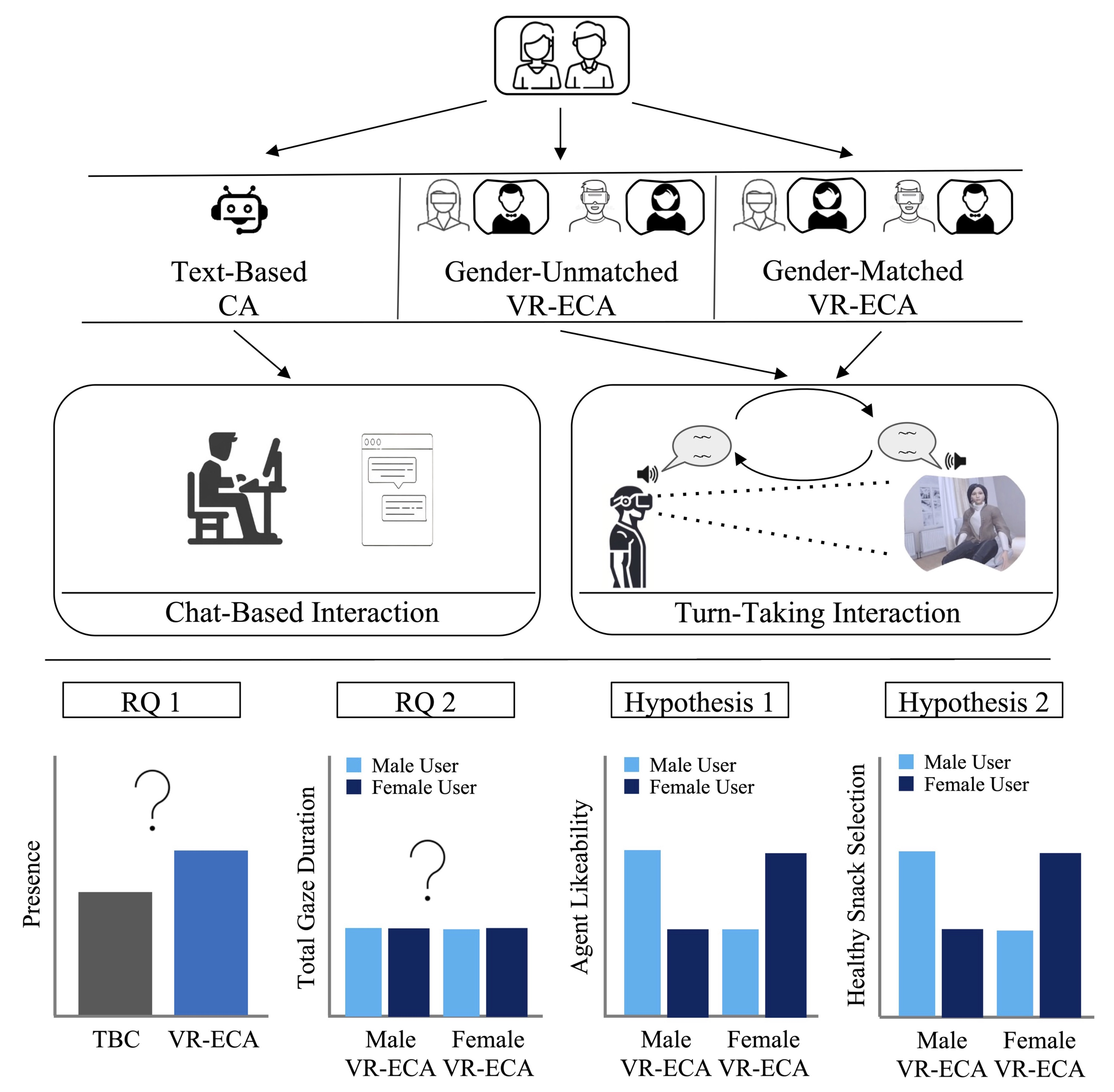
Conceptual depiction of the user interacting with the VR-ECA in a virtual environment.
Evaluation Highlights
- VR-embodied agents elicited significantly greater perceived presence (spatial, social, and co-presence) compared to text-based conversational agents
- Opposite-gender agents triggered longer gaze duration (visual attention) than same-gender agents, an effect driven primarily by male participants looking at female agents
- Contrary to the similarity-attraction hypothesis, gender matching did not significantly improve agent likeability or healthy snack selection behavior
Breakthrough Assessment
6/10
Establishes a novel paradigm connecting generative AI, VR, and biobehavioral tracking. While behavioral results (snack choice) were null, the framework for studying 'artificial social influence' is methodologically significant.