📝 Paper Summary
Multi-agent
Agentic RAG pipeline
This paper proposes a multi-agent system with configurable collaboration structures (vertical, horizontal, hybrid) for financial research, demonstrating that complex tasks like risk analysis benefit from agent ensembles while simple tasks favor single agents.
Core Problem
Existing financial AI tools typically rely on single-agent systems that fail to leverage collaborative intelligence, while standard multi-agent debate methods are impractical for complex, structured corporate workflows.
Why it matters:
- Financial decision-making requires integrating diverse perspectives (risk, sentiment, fundamentals), which single models struggle to balance
- Applying unstructured multi-agent debates (MAD) to large groups is inefficient and lacks the clear role definitions needed for rigorous investment research
- There is a lack of empirical validation regarding which agent topology (hierarchy vs. flat team) works best for specific financial sub-tasks
Concrete Example:
In a risk analysis task, a single agent might overlook a subtle liability in a 10-K form because it is overwhelmed by the context. A 'Vertical' multi-agent group assigns a leader to direct a subordinate specifically to 'analyze liquidity risks,' ensuring deeper coverage.
Key Novelty
Configurable Multi-Agent Collaboration Topologies for Finance
- Defines three distinct collaboration structures (Horizontal, Vertical, Hybrid) that dictate how agents share information and authority, moving beyond simple 'more agents is better' logic
- Implements a 'Vertical' structure via a nested chat mechanism where leaders issue hidden commands to subordinates, simulating corporate hierarchy within LLM interactions
- Treats RAG as a unified tool function callable by agents, allowing them to autonomously refine query parameters rather than relying on fixed retrieval settings
Architecture
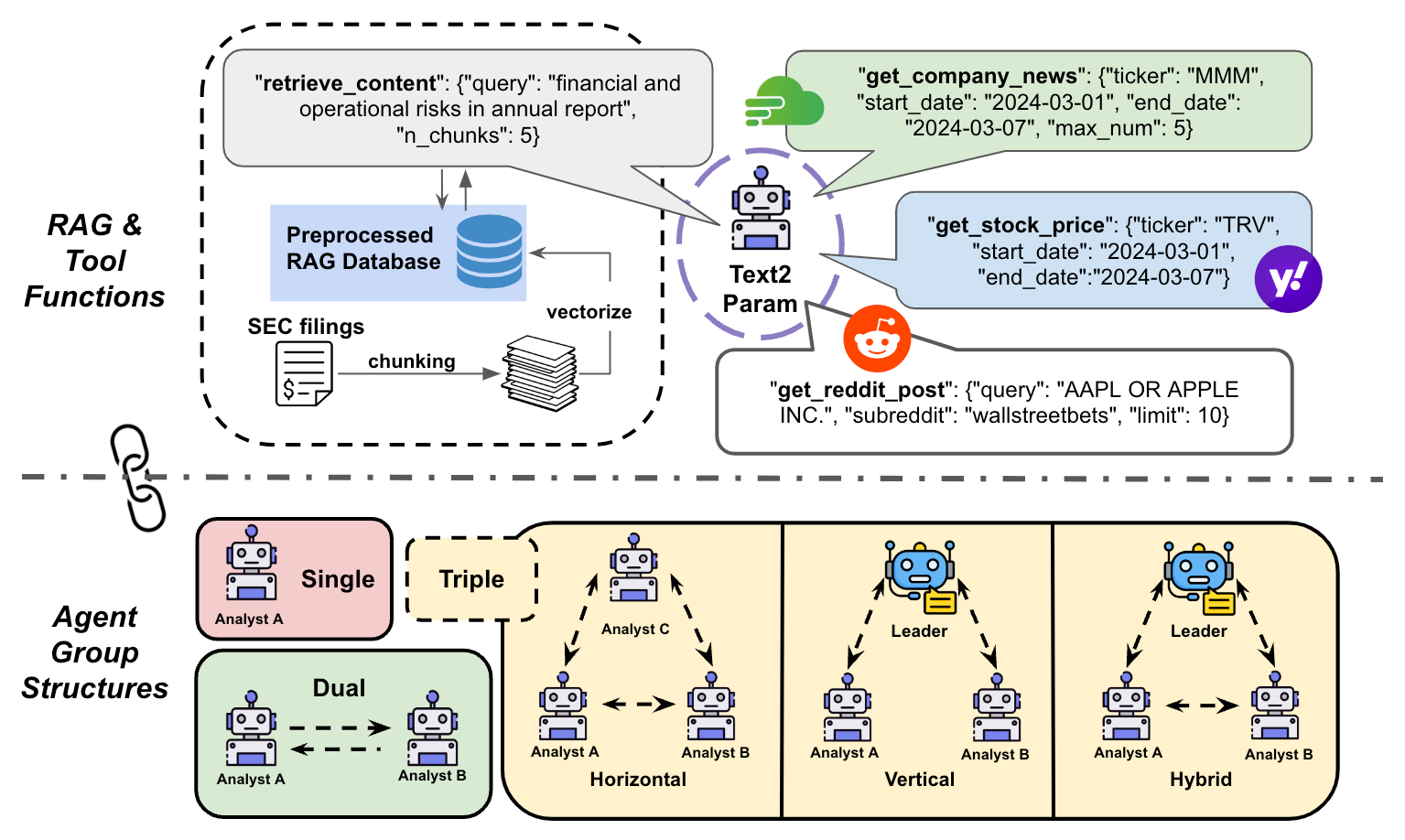
Overview of the agent structures (Single, Dual, Vertical, Horizontal, Hybrid) and the unified RAG/Tool calling mechanism.
Evaluation Highlights
- Ensemble multi-agent structure achieves 66.7% accuracy in 'buy or not' investment decisions on Dow Jones stocks
- Achieves a low 2.35% average difference in one-week target price predictions using the optimal agent configuration
- Demonstrates that single agents actually outperform multi-agent groups on simpler tasks like fundamental and sentiment analysis
Breakthrough Assessment
7/10
Provides a practical, empirically grounded framework for structuring multi-agent teams in finance. While the underlying models are standard (GPT-4), the structural analysis of agent collaboration typologies is valuable.