📝 Paper Summary
AI for Scientific Discovery
Biological Experiment Design
BioDiscoveryAgent utilizes Large Language Models and external tools to design iterative genetic perturbation experiments, outperforming Bayesian optimization by leveraging biological prior knowledge and reasoning over experimental results.
Core Problem
Identifying drug targets via genetic perturbation screens is costly because the search space of genes (approx. 19,000) and combinations is vast, while only a small subset yields the desired phenotype.
Why it matters:
- Experimentally perturbing every gene is prohibitively expensive and time-consuming
- Existing Bayesian optimization methods require training bespoke, opaque models on small datasets and cannot leverage the vast biological knowledge in scientific literature
- Misidentification of drug targets is a major cause of clinical trial failure
Concrete Example:
A perturbation screen typically targets ~19,000 genes, but only a handful may affect cell growth (the phenotype). Testing all of them is inefficient; existing ML methods struggle with the 'cold start' problem before data is collected, whereas human experts use literature knowledge to pick initial targets.
Key Novelty
LLM-driven Closed-Loop Experiment Design Agent
- Replaces specialized acquisition functions (like in Bayesian Optimization) with an LLM that directly suggests genes to perturb based on prompts containing task descriptions and prior results
- Integrates tool use (literature search, database queries, AI critic) to ground predictions in existing biological knowledge rather than just statistical patterns
Architecture
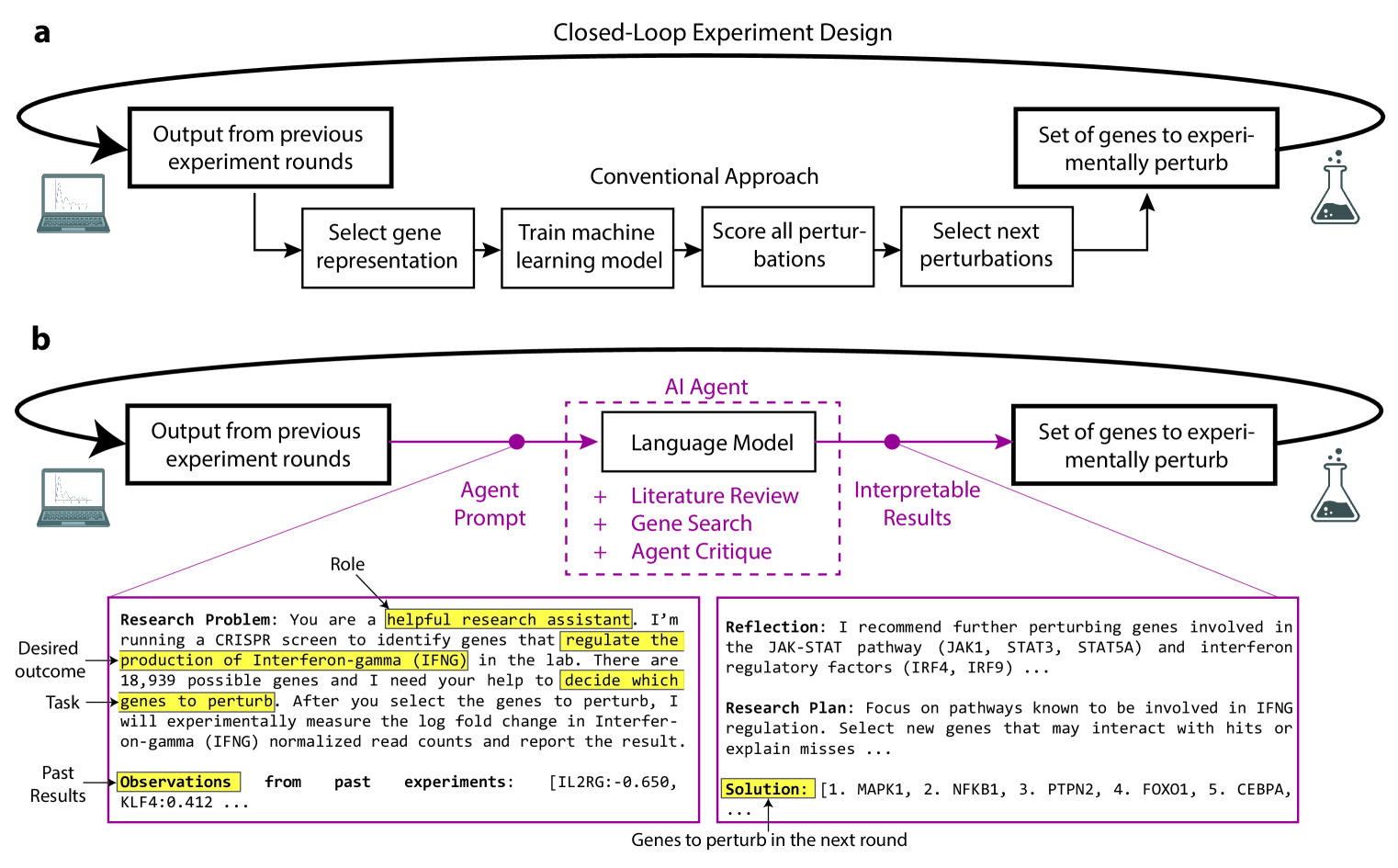
The workflow of BioDiscoveryAgent involving the User, the Agent (LLM), and Tools.
Evaluation Highlights
- +21% improvement in predicting relevant genetic perturbations (hits) across six datasets compared to Bayesian optimization baselines
- +46% improvement in the harder task of identifying non-essential gene hits, which are biologically more informative than essential genes
- +170% improvement over random baselines in the novel task of predicting 2-gene combinatorial perturbations
Breakthrough Assessment
8/10
Significant advance in applying agents to real-world scientific discovery. Demonstrates that general-purpose LLMs can outperform specialized ML models in experimental design by leveraging semantic knowledge, not just numerical optimization.