📝 Paper Summary
Self-evolving Agentic reasoning
Agentic healthcare data analysis
HealthFlow is an autonomous healthcare agent that improves its high-level research strategies over time by distilling successful task executions into a structured experience memory.
Core Problem
Current AI agents rely on static, hard-coded strategic frameworks for task decomposition, preventing them from learning how to orchestrate complex healthcare workflows or adapt plans based on previous failures.
Why it matters:
- Healthcare research involves open-ended problems and noisy data where rigid, predefined strategies often fail to adapt to intermediate findings
- Existing agents optimize tool usage (component-level) but cannot refine their overarching management policy, limiting autonomy in high-stakes domains
- The lack of meta-level learning means agents repeat strategic errors rather than accumulating procedural wisdom like human researchers
Concrete Example:
In a data visualization task involving blood pressure, a standard agent creates a plot immediately, ignoring outliers that distort the scale. HealthFlow, recalling a 'warning' experience from a prior task, proactively inserts a data filtering step to remove unrealistic values before plotting, ensuring interpretability.
Key Novelty
Meta-Level Evolution via Structured Experience Memory
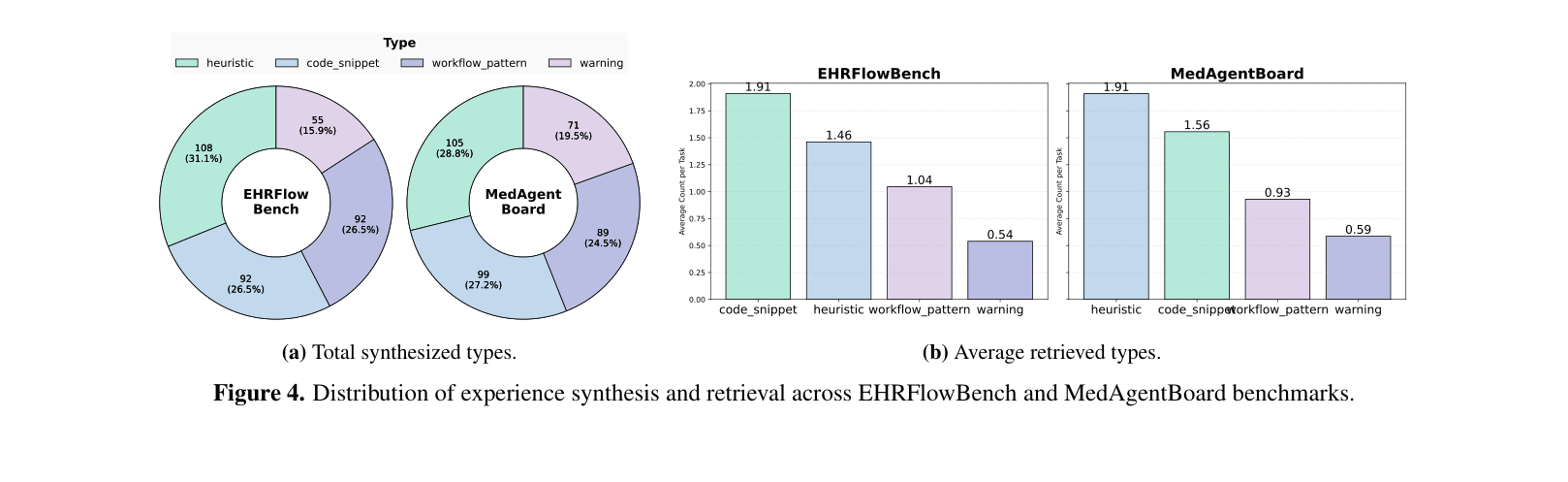
- Treats every completed task as a learning opportunity by reflecting on execution traces to synthesize durable 'experiences' (heuristics, code snippets, warnings)
- Updates the agent's high-level planning policy by retrieving these structured experiences for new tasks, allowing it to start with better strategies rather than just better tools
- Decouples strategic evolution (learning *how* to plan) from static execution, moving beyond simple tool-library expansion found in prior work
Architecture
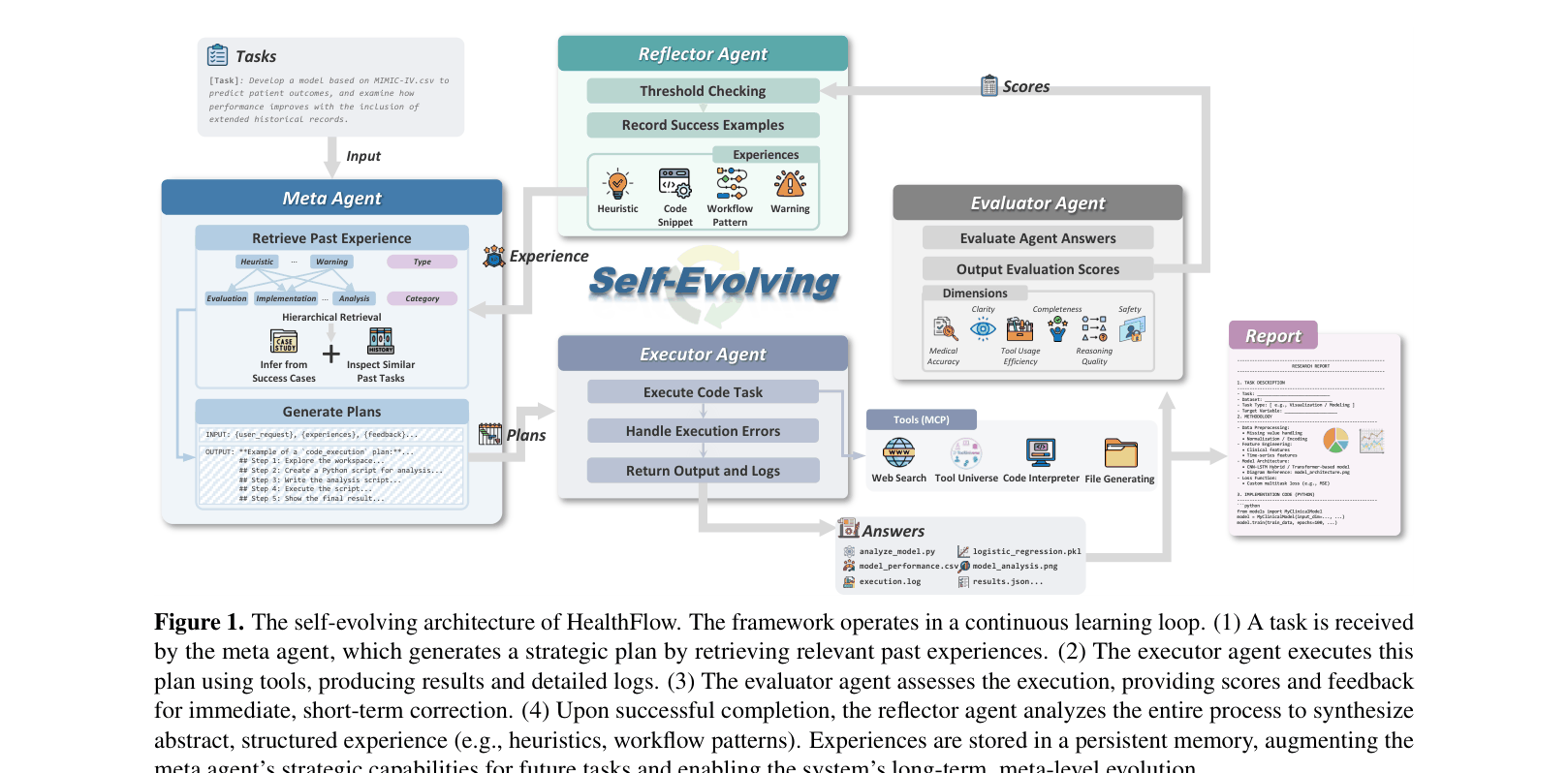
The self-evolving architecture of HealthFlow, detailing the interaction between the four agents (Meta, Executor, Evaluator, Reflector) and the Experience Memory.
Evaluation Highlights
- +15.99pp success rate on MedAgentBoard (81.89% vs 65.90% for next best) when using ToolUniverse
- Achieves 3.98/5.0 on the new EHRFlowBench, significantly outperforming general agent AFlow (3.31) and biomedical agent STELLA (2.39)
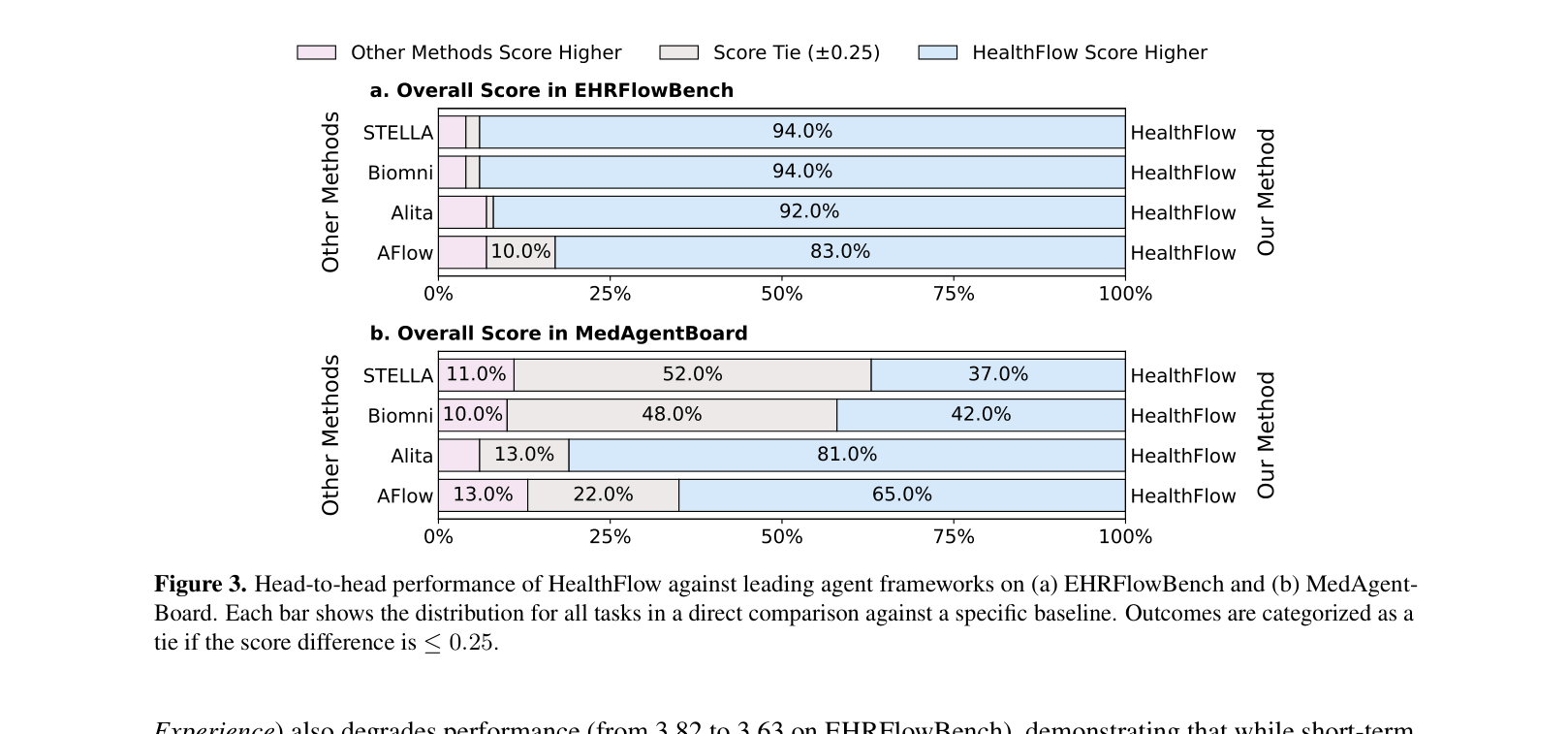
- Dominant win rate in head-to-head comparisons on EHRFlowBench (e.g., >90% win rate against Biomni and STELLA)
Breakthrough Assessment
8/10
Significant step in self-evolving agents by formalizing meta-level strategic learning rather than just tool tuning. Strong empirical gains on complex tasks, though reliant on closed-source LLM backbones.