📝 Paper Summary
Agent Communication Protocols
Agent Security
The paper provides the first comprehensive definition and classification of agent communication, identifying security risks and defenses across User-Agent, Agent-Agent, and Agent-Environment interactions.
Core Problem
As agents evolve from isolated models to communicating entities using protocols like MCP and A2A, they expose new attack surfaces (e.g., spoofing, privacy leakage) that existing security frameworks do not address.
Why it matters:
- Cross-organization agent communication significantly enlarges the attack surface, potentially leading to severe real-world damage via unauthorized tool access or data breaches
- Current research focuses on single-agent security or general Multi-Agent Systems (MAS) without addressing the specific protocols and lifecycle risks of LLM-driven agent communication
- Market adoption is rapid (e.g., hundreds of enterprises adopting Anthropic's MCP), but security research is still in a nascent stage compared to deployment speed
Concrete Example:
When making a travel plan, an agent must communicate with external entities (weather services, ticket booking agents). Without secure communication protocols, a malicious entity could spoof a booking agent to steal funds or inject false weather data to disrupt the plan.
Key Novelty
Three-Layer Agent Communication Architecture & Security Taxonomy
- Proposes the first clear definition of 'agent communication' and classifies it into three distinct classes: User-Agent (U-A), Agent-Agent (A-A), and Agent-Environment (A-E)
- Develops a three-layered communication architecture for each class to pinpoint exactly where security risks arise within the communication lifecycle
- Systematically categorizes 19 existing communication protocols and maps them to specific security risks and defense countermeasures
Architecture
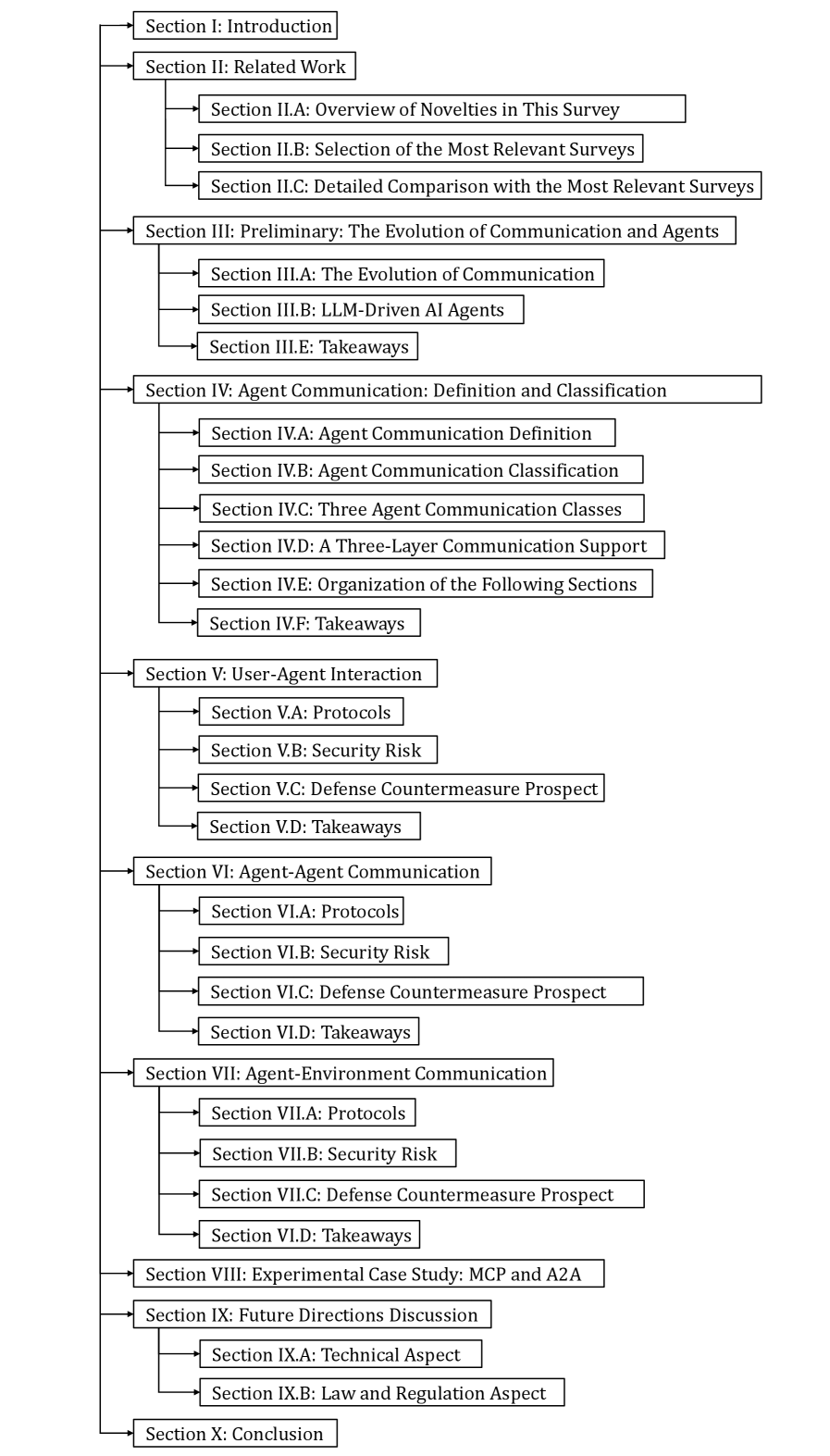
The organization of the survey and the proposed three-layered communication architecture, categorizing the field into User-Agent, Agent-Agent, and Agent-Environment interactions
Breakthrough Assessment
8/10
Establishment of a foundational taxonomy for a rapidly emerging field (Agent Communication). While it is a survey, the structural definition and security mapping fill a critical gap left by general agent surveys.