📝 Paper Summary
Self-evolving Agentic reasoning
Multi-call tool use with flexible plan
ATLASS is a multi-agent framework that allows LLMs to solve complex tasks by dynamically generating new Python tools on demand, storing them for reuse, and orchestrating their execution.
Core Problem
Pre-defined toolsets are inflexible and cannot handle unforeseen tasks, while current tool-making approaches often generate non-reusable, task-specific scripts without leveraging external APIs.
Why it matters:
- Human-designed toolsets are static and restricted to expert-defined scopes, limiting an agent's ability to solve novel problems
- Existing tool-making methods like LATM create disposable scripts that don't persist for future reuse, leading to redundancy
- Smaller models struggle with complex tasks, requiring specialized agents to handle tool creation and execution effectively
Concrete Example:
When asked to 'Generate a bar chart with the last five days stock price of Apple Inc.', a standard agent might fail if it lacks a specific stock tool. ATLASS decomposes this, identifies needed tools, and if a 'Data Visualizer' exists, reuses it; if not, it generates a Python script using external APIs (like SerpAPI) to fetch data and plot it.
Key Novelty
Closed-Loop Dynamic Tool Generation and Reuse
- Instead of just using tools, the system detects missing tools and generates Python code (with API support) to create them on the fly.
- Generated tools are validated and stored in a persistent JSON database, allowing future queries to retrieve and reuse them instead of regenerating them.
- A specialized 'Tool Selector' identifies when a new task can be solved by an existing generalized tool (e.g., using a 'Bar Chart Generator' for a 'Data Visualizer' request).
Architecture
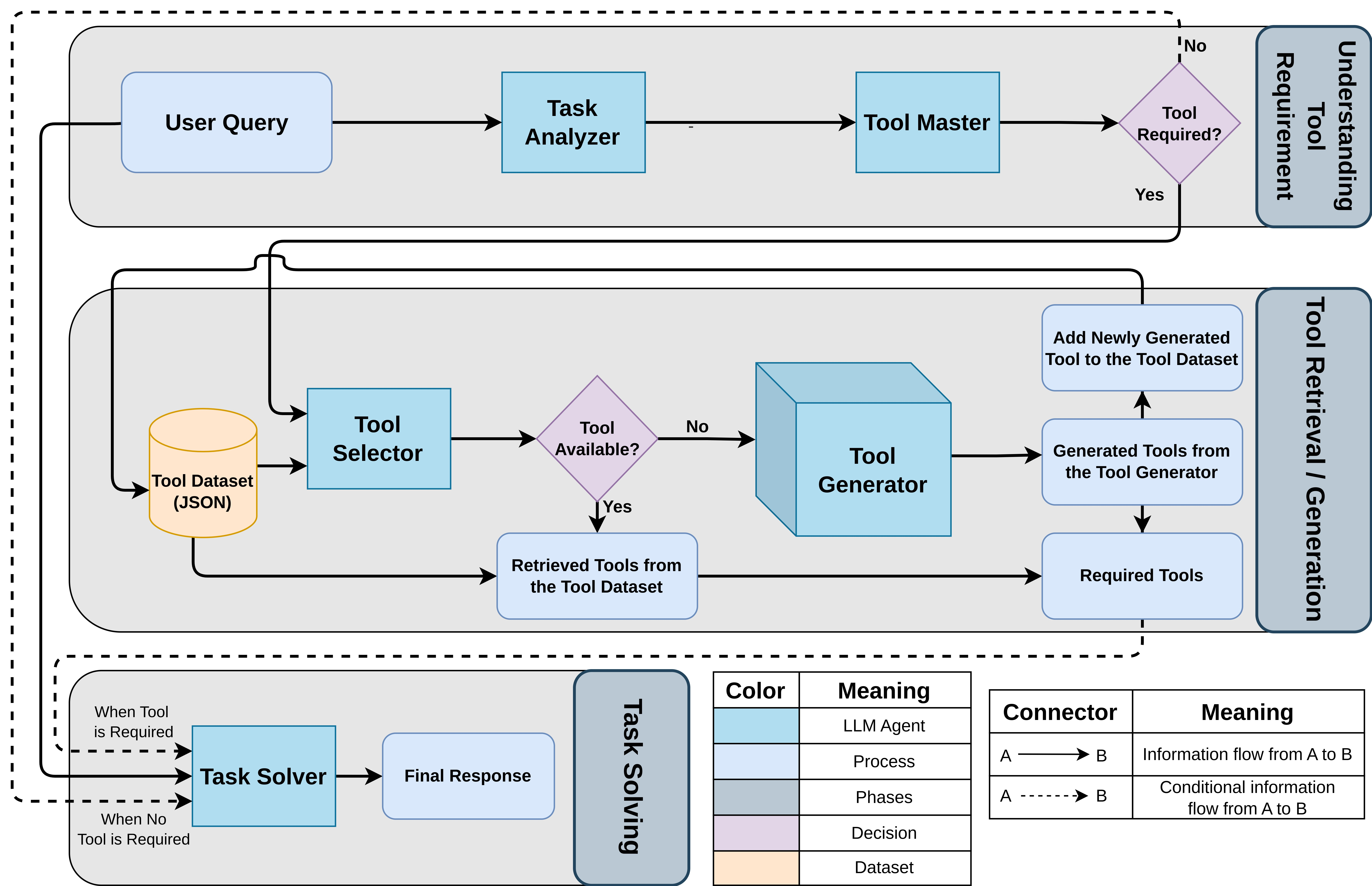
The overall architecture of ATLASS, illustrating the three main phases: Understanding Tool Requirements, Tool Retrieval/Generation, and Task Solving.
Evaluation Highlights
- Reduces inference cost by ~38% (0.1008 USD to 0.0624 USD) when reusing an available tool versus generating it from scratch.
- Achieves 100% Tool Selection Accuracy on mathematical, data analysis, and visualization tasks, and 85-90% on NLP and API-based retrieval tasks.
- Outperforms LATM (Large Language Models as Tool Makers) by supporting external API integration and persistent tool storage for reuse.
Breakthrough Assessment
7/10
Strong practical application of tool generation with a focus on reusability and API integration. While the underlying LLM usage is standard, the closed-loop architecture for persistent tool learning is a valuable contribution.