📝 Paper Summary
Memory organization
Tree/graph-based memory
CAM is a hierarchical memory system for LLM reading agents that organizes text into evolving schemata using incremental overlapping clustering to support flexible updates and associative retrieval.
Core Problem
Existing LLM memory modules are either unstructured (tabular chunks) or static (graphs/trees that require full reconstruction for updates), failing to handle evolving information or dispersed dependencies efficiently.
Why it matters:
- Current systems mimic human memory superficially, lacking the cognitive principles (schema accommodation/assimilation) needed for true autonomous reading.
- Static structures like RAPTOR or GraphRAG cannot handle streaming data efficiently, requiring expensive re-indexing for every new document chunk.
- Unstructured memories (retrieval-only) struggle to aggregate information dispersed across distant parts of long texts.
Concrete Example:
When a new book chapter arrives, static systems must rebuild their entire summary tree to integrate it. CAM updates only relevant local clusters (accommodation) while allowing the new text to associate with multiple existing themes (flexible assimilation).
Key Novelty
Constructivist Agentic Memory (CAM)
- Applies Piaget's Constructivist Theory to agent memory: uses 'assimilation' to fit new data into existing structures and 'accommodation' to adjust structures when they don't fit.
- Implements 'ego-centric disentanglement': splits a single memory node into multiple 'replicas' based on its local connections, allowing one piece of text to belong to multiple summary clusters simultaneously.
- Uses a 'Prune-and-Grow' retrieval strategy that mimics human associative memory, starting with a broad search and recursively exploring related structural connections.
Architecture
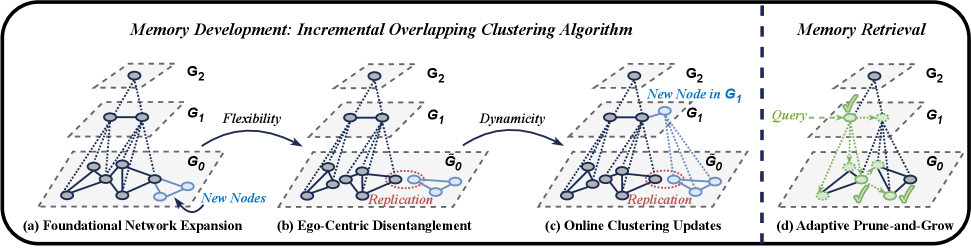
The complete framework of CAM, illustrating both the memory construction phase (assimilation/accommodation) and the inference phase.
Evaluation Highlights
- Achieves dual superiority in performance and efficiency, running over 4x faster in memory construction than offline clustering baselines like RAPTOR.
- Demonstrates high accuracy across diverse long-text tasks including question answering, query-based summarization, and claim verification.
- Successfully handles both single-document and multi-document scenarios by maintaining a cohesive hierarchical structure that supports online batch integration.
Breakthrough Assessment
8/10
Strong theoretical grounding in cognitive science translated into a practical, efficient algorithm (incremental overlapping clustering). Addresses the critical 'update' bottleneck in structured memory systems.