📝 Paper Summary
Scientific discovery agents
AI for Science (Photonics)
MetaChat couples a multi-agent LLM framework with a millisecond-scale surrogate solver to automate and accelerate complex photonic device design from semantic queries.
Core Problem
Photonic design currently relies on human experts using slow, specialized simulation tools, making design cycles time-consuming, computationally expensive, and inaccessible to non-experts.
Why it matters:
- Manual design cycles for nanophotonics take days to weeks, slowing innovation in imaging, sensing, and display technologies.
- Existing AI tools for science are often rigid planners or wrappers lacking true agency (self-correction and intermediate reasoning).
- Deep learning solvers are typically too specialized to handle the diversity of physical parameters (wavelength, angle, topology) needed for practical device design.
Concrete Example:
A user asks for a '180µm wide TiO2 metalens focusing 680nm and 480nm light'. A standard LLM assistant fails to execute the complex physics simulations. MetaChat's agents autonomously query a materials database, set up 300,000 parallel simulations, and optimize the device structure in minutes.
Key Novelty
Agentic Iterative Monologue (AIM) + FiLM WaveY-Net Surrogate Solver
- Proposes AIM, a prompting paradigm where agents default to internal 'monologue' thoughts, enabling iterative self-correction and multi-step reasoning before acting.
- Integrates FiLM WaveY-Net, a conditional neural surrogate solver that uses Feature-wise Linear Modulation to generalize across wavelengths, angles, and topologies orders of magnitude faster than conventional solvers.
Architecture
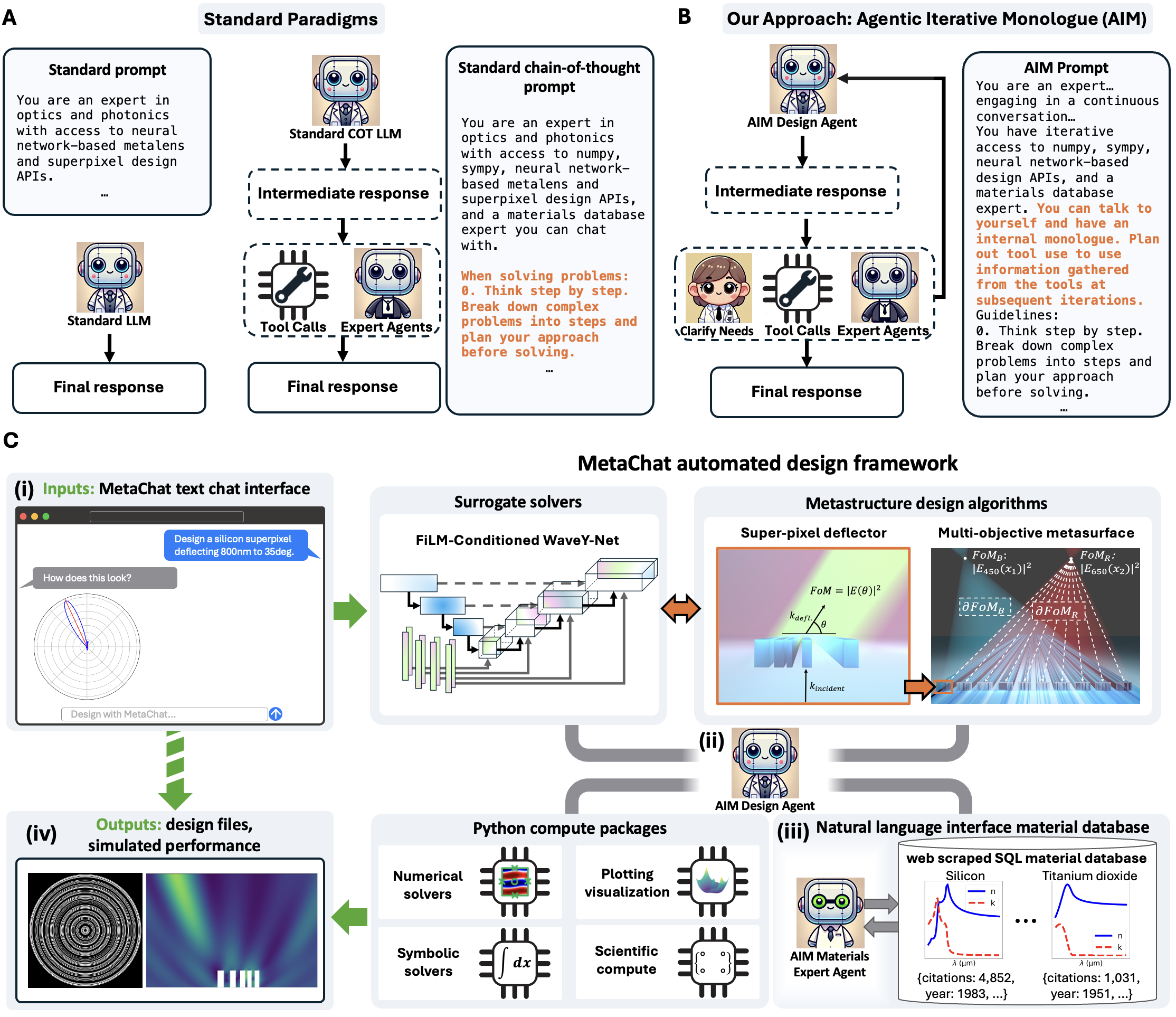
Overview of the MetaChat framework, contrasting it with standard LLM planners, and detailing the AIM agent interaction loop.
Evaluation Highlights
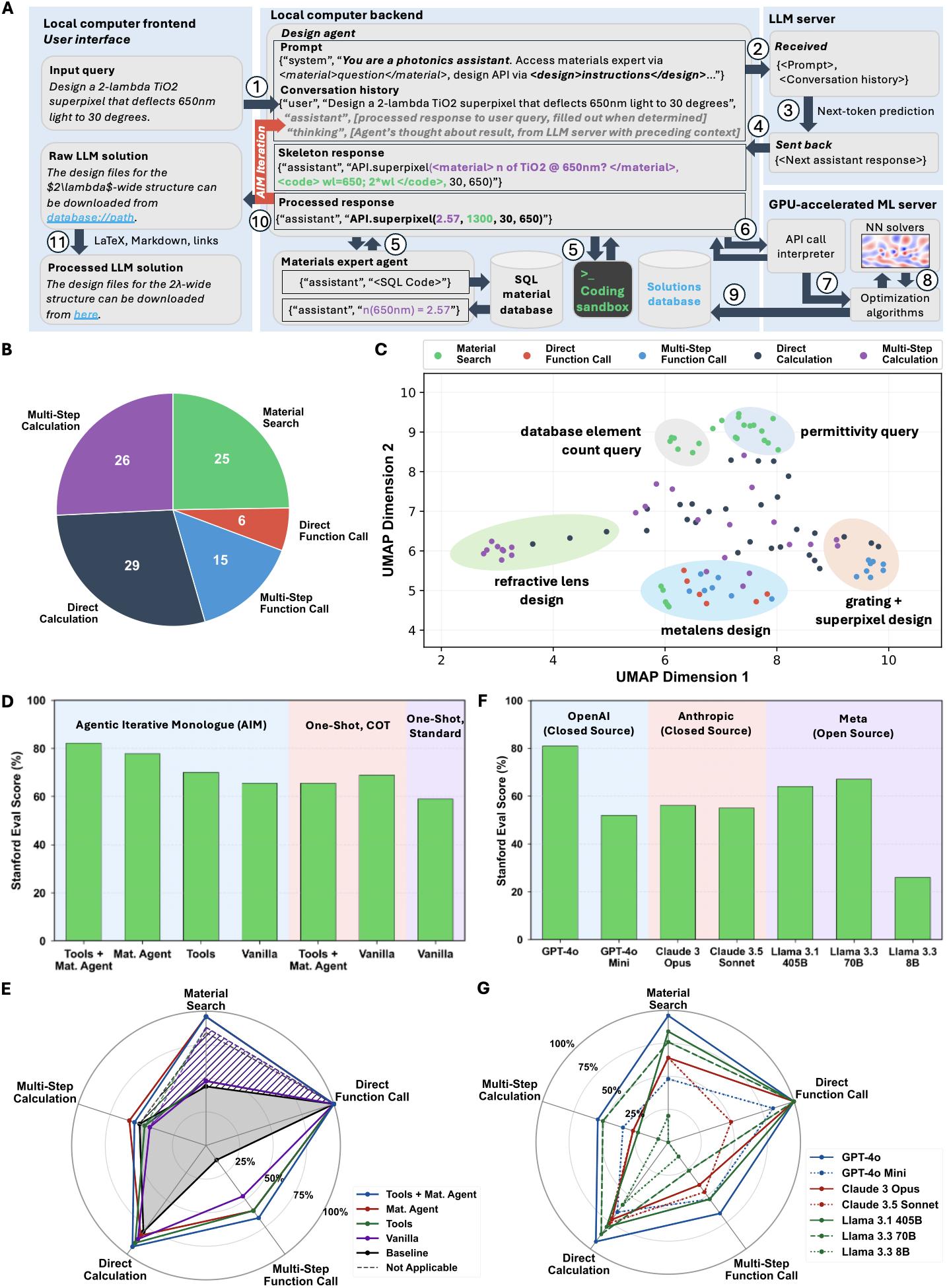
- Designed a dual-wavelength metalens in ~10 minutes using 8 GPUs, a task that would take ~5 days with conventional FDFD simulation methods.
- Achieved 81% accuracy on the Stanford Nanophotonics Benchmark, outperforming a standard Chain-of-Thought assistant (72%) and a vanilla assistant (65%).
- FiLM WaveY-Net surrogate solver achieves normalized mean absolute error (MAE) of ~0.055 across diverse incident angles, maintaining high fidelity for optimization.
Breakthrough Assessment
9/10
Combines a novel agentic reasoning pattern (AIM) with a high-utility domain-specific surrogate solver to achieve real-time automated design in a complex physical domain. Represents a significant leap in 'AI for Science' automation.