📝 Paper Summary
Agentic AI for Science
Biological Experiment Automation
CRISPR-GPT automates gene-editing experiment design by coupling an LLM planner with domain-specific tools and strict state-machine guardrails to prevent biological hallucinations common in general-purpose models.
Core Problem
General-purpose LLMs lack deep domain knowledge and specific reasoning for gene editing, leading to hallucinations where they invent non-existent DNA sequences or unsafe protocols.
Why it matters:
- Gene editing requires precise, error-free designs; hallucinated guide RNAs can fail to target genes or cause dangerous off-target mutations
- The complexity of experimental design (primer design, cloning, validation) acts as a high barrier for non-expert researchers entering the field
Concrete Example:
When asked to design a guide RNA (gRNA) for the human gene EMX1, ChatGPT-3/4 often generates a sequence with high confidence that does not actually exist in the human genome (verified via BLAST), rendering the experiment useless.
Key Novelty
State-Machine-Guided Domain Agent
- Decomposes the experimental design process into a rigorous sequence of 22 sub-tasks (State Machines) rather than allowing the LLM free-form generation
- Wraps external biological tools (CRISPRPick, Primer3, BLAST) into an agentic framework, allowing the LLM to query ground-truth databases instead of relying on internal weights
Architecture
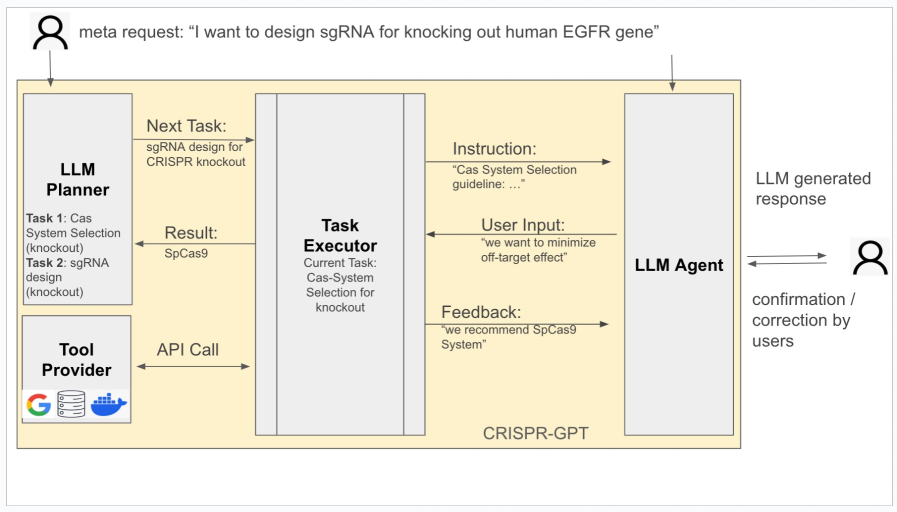
The 4 core modules of the CRISPR-GPT agent and their interaction flow.
Evaluation Highlights
- Successfully designed and validated knockout experiments for 4 genes (TGFBR1, SNAI1, BAX, BCL2L1) in A375 cells using the generated protocols
- Qualitative validation confirmed constructs were sequence-verified by Sanger sequencing and lentiviral transduction was successful
Breakthrough Assessment
8/10
Significant step in AI for Science. Moves beyond simple chat to executing complex, multi-step biological protocols with wet-lab validation, addressing the critical hallucination problem in scientific LLMs.