📝 Paper Summary
Multi-agent
Multi-task planning
Flow improves multi-agent efficiency by formulating workflows as dynamic Activity-on-Vertex graphs that prioritize modularity, enabling parallel execution and localized error recovery.
Core Problem
Existing multi-agent frameworks rely on static, sequential workflows that cannot adapt to real-time execution failures or efficiently parallelize independent subtasks.
Why it matters:
- Sequential execution creates bottlenecks where one slow or failed agent halts the entire process
- Rigid workflows lack robustness; a single unexpected error often forces a full restart rather than a local fix
- Complex dependencies between agents increase the probability of total system failure as the number of steps grows
Concrete Example:
If an agent responsible for data preprocessing encounters an unexpected error, a rigid framework like MetaGPT might fail the entire pipeline. In contrast, Flow detects the failure, dynamically inserts a new subtask to fix the specific data issue, and re-executes only the affected module without restarting the whole process.
Key Novelty
Dynamic Modularized AOV Graphs
- Models workflows as Activity-on-Vertex (AOV) graphs where nodes are subtasks and edges are dependencies, explicitly optimizing for high parallelism and low dependency complexity during generation
- Enables dynamic runtime modification of the graph (adding/deleting nodes) to recover from errors locally, rather than rigid sequential retries
Architecture
Conceptual flowchart of the Flow framework showing the initialization and dynamic update loops
Evaluation Highlights
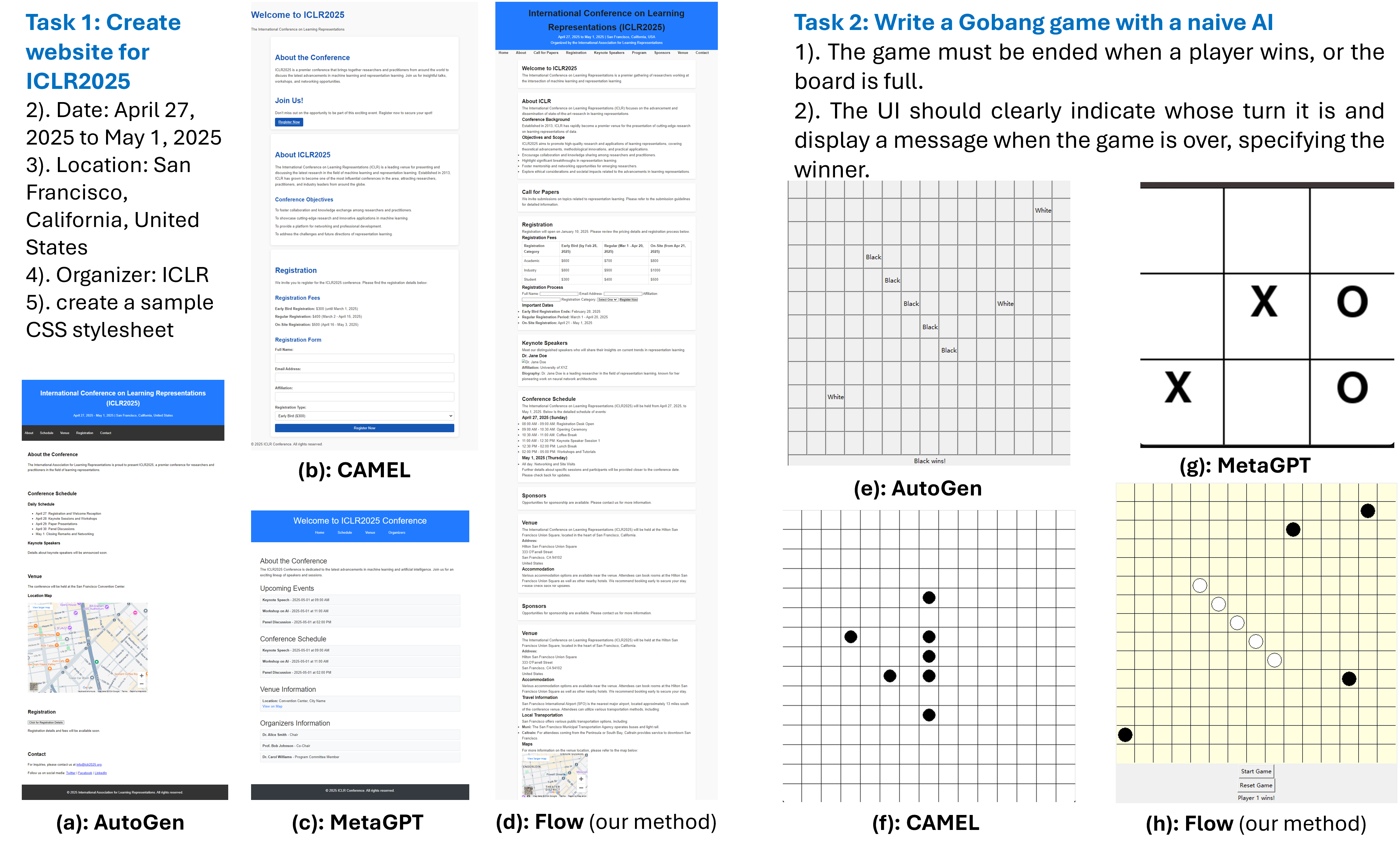
- Significant improvements in adaptability and efficiency compared to existing approaches like AutoGen and MetaGPT (qualitative summary of reported empirical success)
- Demonstrates capability to execute subtasks concurrently, reducing overall process time compared to sequential baselines
Breakthrough Assessment
7/10
Strong conceptual contribution in applying AOV graphs to multi-agent systems for modularity and parallelism. While it addresses key limitations of static workflows, the paper is an arXiv preprint and the specific quantitative lift over SOTA benchmarks is described qualitatively in the provided text.