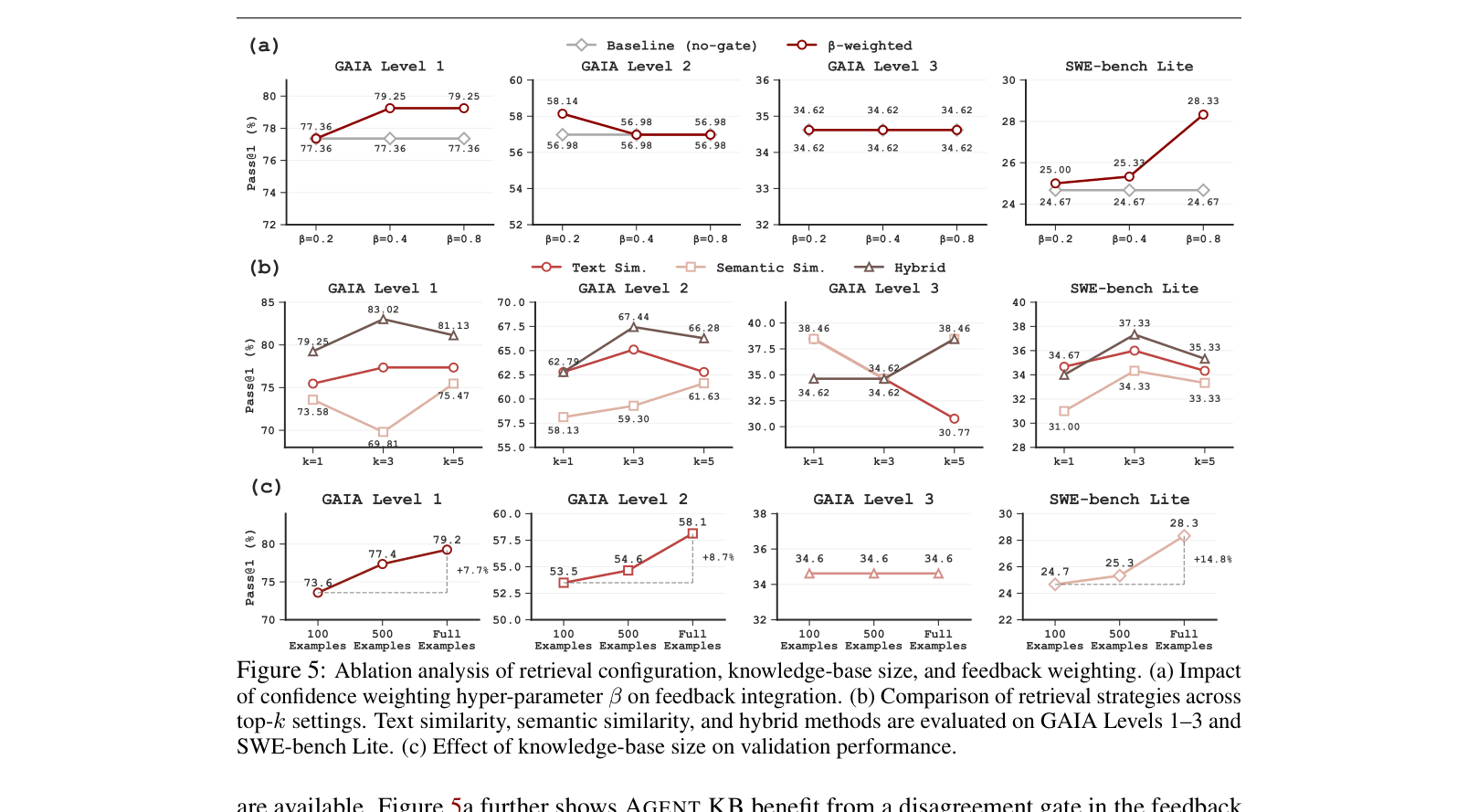
📝 Paper Summary
Agentic RAG pipeline
Self-evolving Agentic reasoning
Cross-framework knowledge transfer
AGENTKB is a universal memory infrastructure that allows heterogeneous agent frameworks to share and reuse problem-solving experiences without retraining, using a two-stage retrieval process for planning and feedback.
Core Problem
Current AI agent frameworks operate in silos with incompatible memory systems, forcing agents to rediscover solutions and repeat mistakes rather than learning from collective experience.
Why it matters:
- Representation heterogeneity prevents transferring effective solutions between different tools (e.g., smolagents vs. OpenHands)
- Context mismatch causes valid solutions in one environment to fail in another due to API or reasoning protocol differences
- Knowledge interference risks destabilizing an agent's reasoning flow when naively injecting external execution traces
Concrete Example:
In a PDB protein distance calculation, a standard agent naively reads the first two lines of a file, selecting solvent records and calculating a spurious distance (0.961 Å). It fails to learn from past correct workflows that filter for 'ATOM' entries and sanity-check bond lengths.
Key Novelty
Universal Cross-Framework Memory Layer
- Abstracts execution traces from diverse frameworks (smolagents, OpenHands, etc.) into a unified, framework-agnostic schema containing constraints, action-reasoning pairs, and metadata
- Implements a 'Reason-Retrieve-Refine' loop at two distinct stages: initially to seed planning with past workflows, and subsequently to inject targeted fixes based on execution feedback
- Uses a 'disagreement gate' during feedback integration to ensure retrieved knowledge corrects rather than disrupts the agent's reasoning process
Architecture
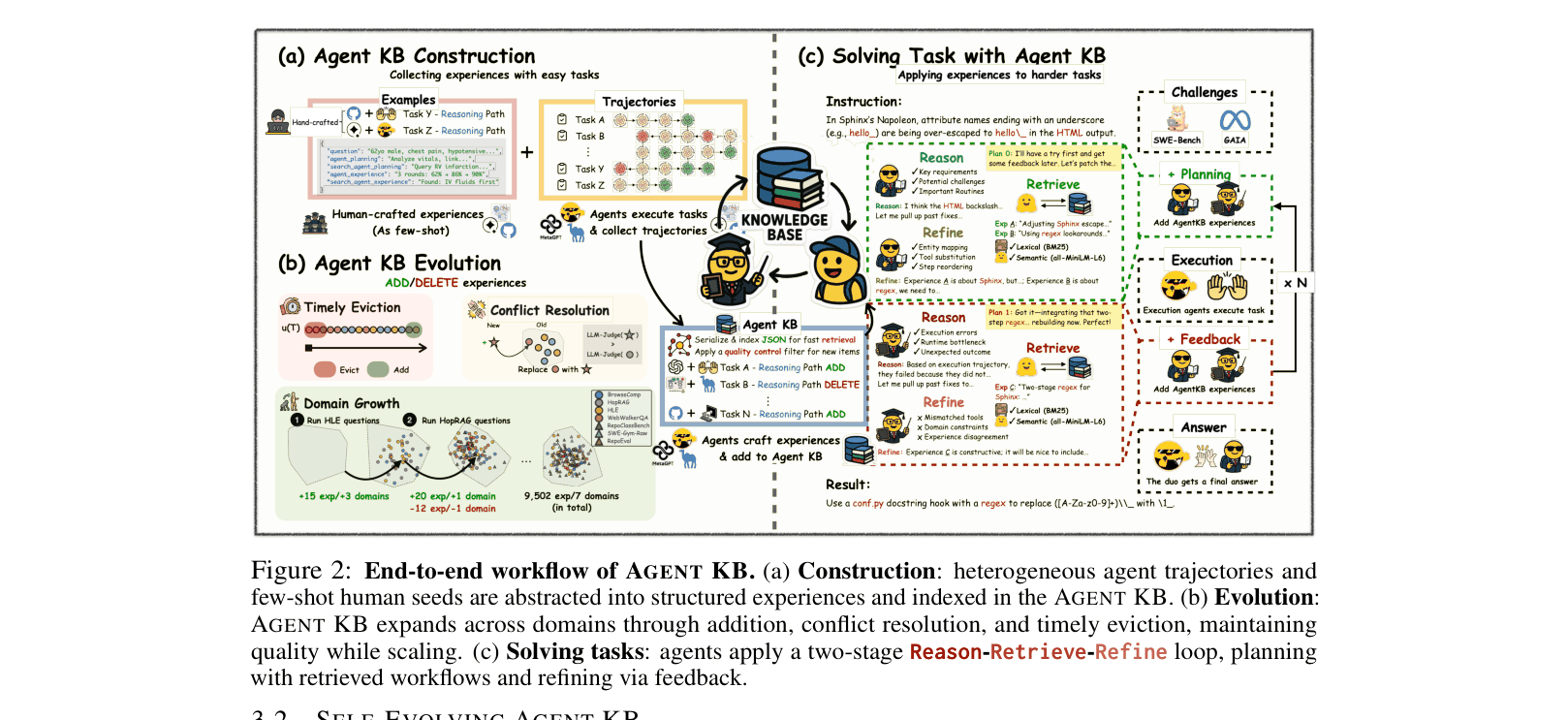
The end-to-end workflow of AGENTKB, covering construction, evolution, and the two-stage inference process.
Evaluation Highlights
- +18.7pp improvement on GAIA pass@3 (55.2% → 73.9%) for smolagents using AGENTKB
- +17.0pp improvement on SWE-bench Lite pass@100 (28.7% → 45.7%) for OpenHands using AGENTKB
- On Humanity's Last Exam (Bio/Chem), OpenHands improves from 9.5% to 14.1% pass@3, outperforming specialized systems like Biomni
Breakthrough Assessment
9/10
First system to demonstrate effective zero-shot knowledge transfer across completely different agent architectures (e.g., transferring knowledge from a coding agent to a reasoning agent) with substantial gains.