📝 Paper Summary
Automated Design of Agentic Systems (ADAS)
Evolutionary Algorithms for Agents
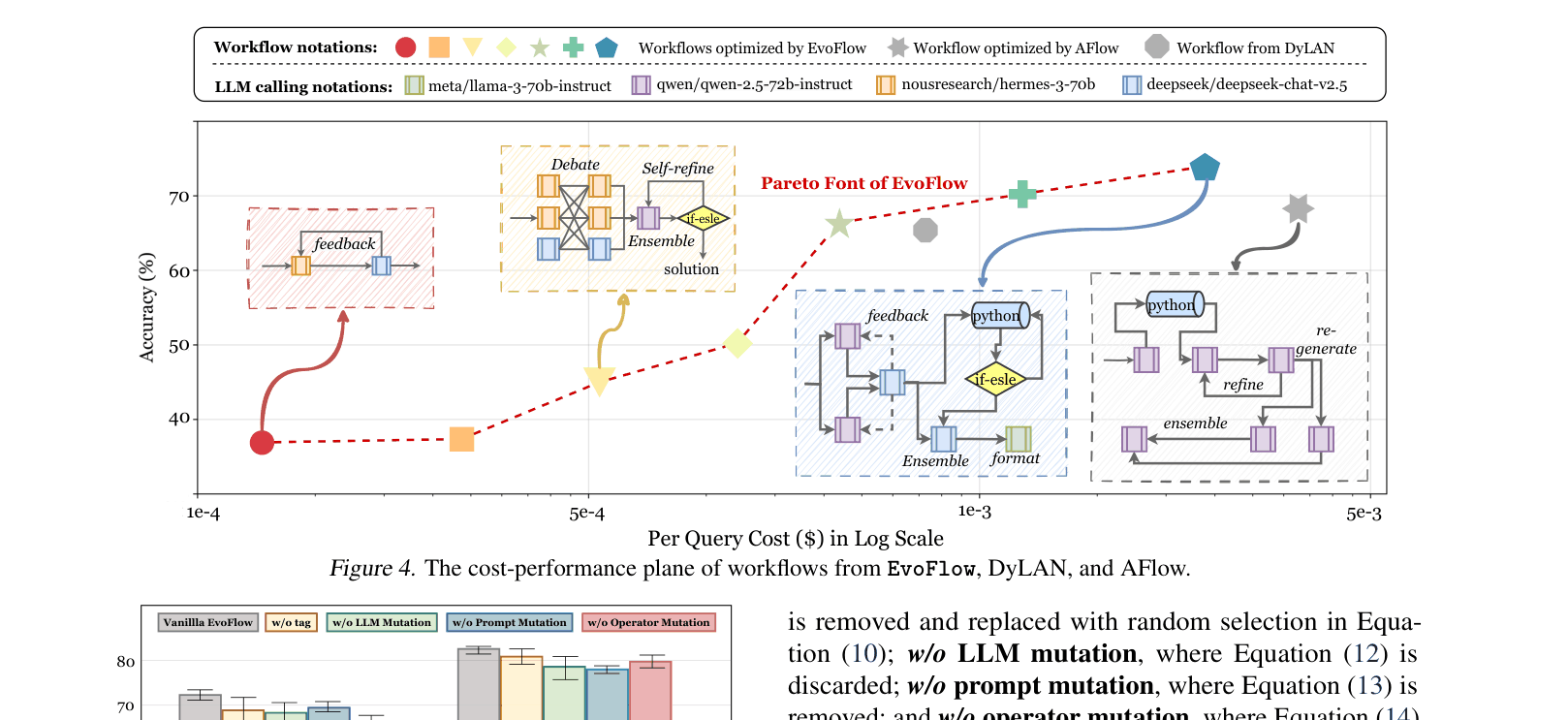
EvoFlow automates the design of agentic systems by evolving a diverse population of heterogeneous workflows that trade off cost and performance, rather than searching for a single complex optimal architecture.
Core Problem
Existing automated agentic design pipelines typically optimize for a single objective (performance), resulting in homogenous, expensive, and overly complex workflows that lack adaptability to simpler queries.
Why it matters:
- Current methods produce 'one-size-fits-all' expensive workflows (often using only GPT-4) even for simple tasks
- Ignoring LLM heterogeneity wastes the potential of smaller, cheaper models (e.g., Llama-3-70b) which can handle many subtasks effectively
- Real-world queries vary in difficulty; always using a complex multi-agent debate system is inefficient and costly
Concrete Example:
For a simple query like 'What is 2+2?', existing methods might invoke a complex Multi-agent Debate workflow costing many tokens. Ideally, the system should route this to a simple I/O agent, while reserving complex Debate/Reflexion workflows for graduate-level math problems.
Key Novelty
Niching Evolutionary Algorithm for Heterogeneous Agent Workflows
- Treats workflow search as a multi-objective optimization problem (cost vs. performance) to generate a Pareto set of solutions rather than one single best workflow
- Evolves 'operator nodes' (composite agent units like Debate or CoT) rather than just single prompts, allowing for topological structural search
- Uses 'niching' to maintain population diversity, ensuring the system keeps simple/cheap workflows for easy tasks and complex/expensive ones for hard tasks
Architecture
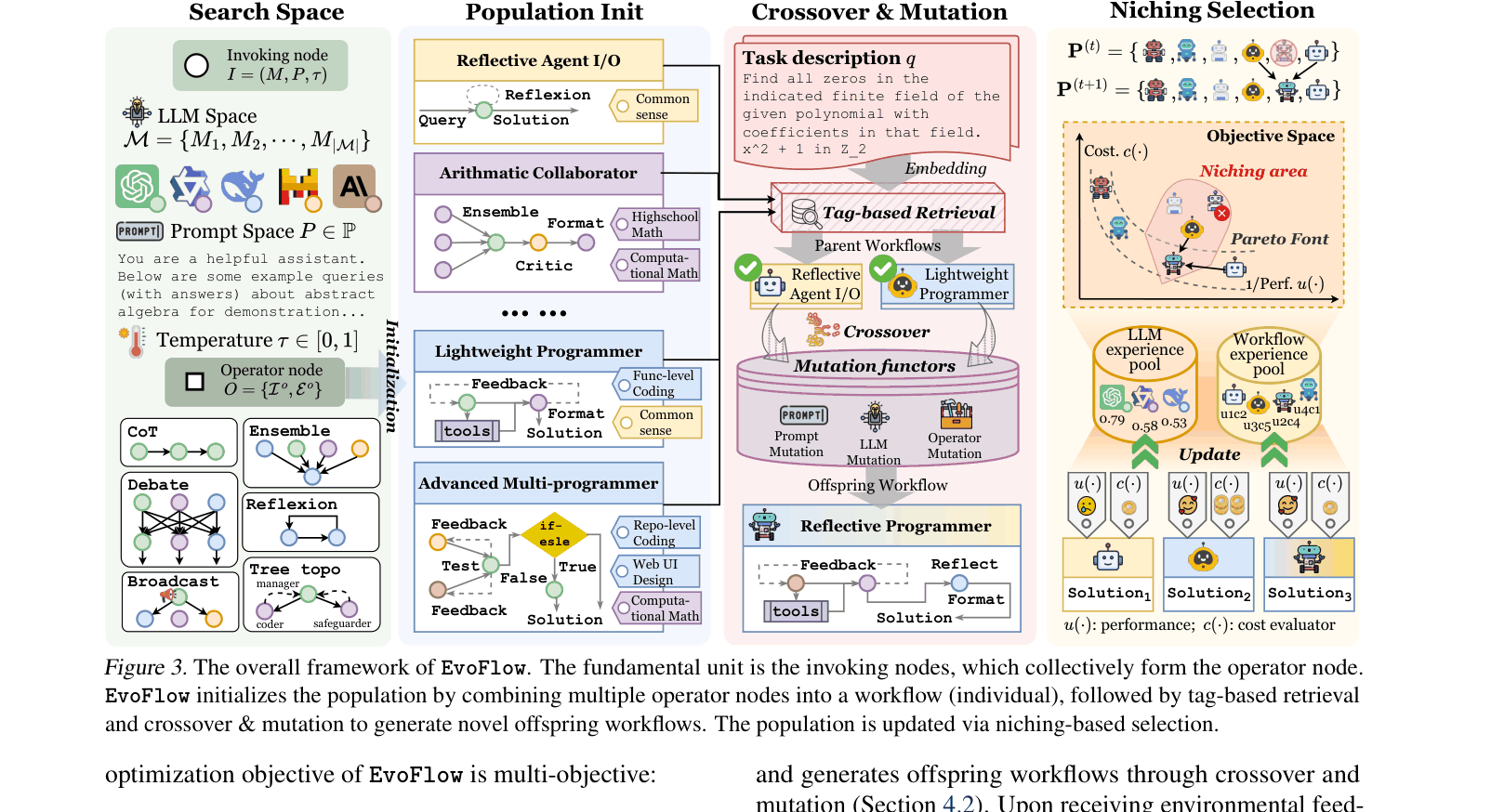
The complete EvoFlow framework, illustrating the evolutionary cycle from population initialization to niching selection.
Evaluation Highlights
- +11.41% accuracy improvement on MATH benchmark compared to vanilla GPT-4o-mini
- Outperforms state-of-the-art automated baseline AFlow by 6.42% on MATH while reducing inference cost by ~80%
- Surpasses o1-preview performance on MATH using only open-source models (Llama-3.1, Qwen-2.5, etc.) at 12.4% of the inference cost
Breakthrough Assessment
8/10
Significant shift from single-objective to multi-objective optimization in agent design. Demonstrates that open-source model ensembles can beat proprietary SOTA models (o1-preview) efficiently.