📝 Paper Summary
Tree/graph-based memory
Agentic memory architecture
MAGMA structures agent memory into four orthogonal graphs—semantic, temporal, causal, and entity—and uses an intent-aware policy to traverse these graphs for long-horizon reasoning.
Core Problem
Existing agent memory systems typically use monolithic vector stores that rely heavily on semantic similarity, entangling different types of relationships (time, cause, entity) and leading to poor reasoning on 'why' or 'when' questions.
Why it matters:
- Monolithic vector stores retrieve 'what' happened but struggle to reason about 'why' due to lack of explicit causal structure
- Standard retrieval methods often lose temporal context or object permanence across long interaction histories
- Entangled representations limit interpretability and alignment between the user's query intent and the retrieved evidence
Concrete Example:
When an agent is asked 'Why did the project fail?', a standard semantic retriever might fetch documents discussing 'project' and 'failure' generally. It misses the specific causal chain of events (e.g., 'Budget cut' -> 'Delay' -> 'Failure') because it lacks explicit causal edges linking these distinct events in memory.
Key Novelty
Multi-Graph Agentic Memory Architecture (MAGMA)
- Represents every memory item simultaneously across four distinct graphs: Semantic (similarity), Temporal (chronology), Causal (logic/entailment), and Entity (object permanence)
- Uses a dual-stream evolution process where a 'Fast Path' handles immediate ingestion and a 'Slow Path' uses an LLM to asynchronously infer and densify causal/entity connections
- Retrieval is treated as a policy-guided graph traversal where the query intent (e.g., 'Why' vs 'When') determines which graph edges are prioritized
Architecture
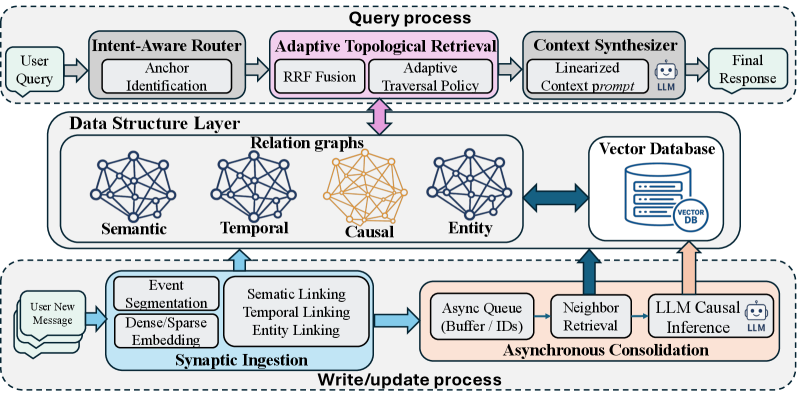
The overall MAGMA architecture showing the three logical layers: Query Process, Data Structure, and Write/Update Process.
Evaluation Highlights
- Outperforms state-of-the-art baselines (including MemoRAG and Hi-Mem) on LoCoMo and LongMemEval benchmarks
- Reduces retrieval latency and token consumption compared to prior systems by pruning irrelevant graph regions during traversal
- Achieves superior alignment between query intent and retrieved evidence through adaptive edge weighting
Breakthrough Assessment
8/10
Strong structural innovation by explicitly disentangling memory dimensions (causal vs. temporal) and coupling this with a dual-stream update mechanism. Addresses a critical bottleneck in agentic reasoning.