📝 Paper Summary
Synthetic data generation for agents
Multi-turn agentic interaction
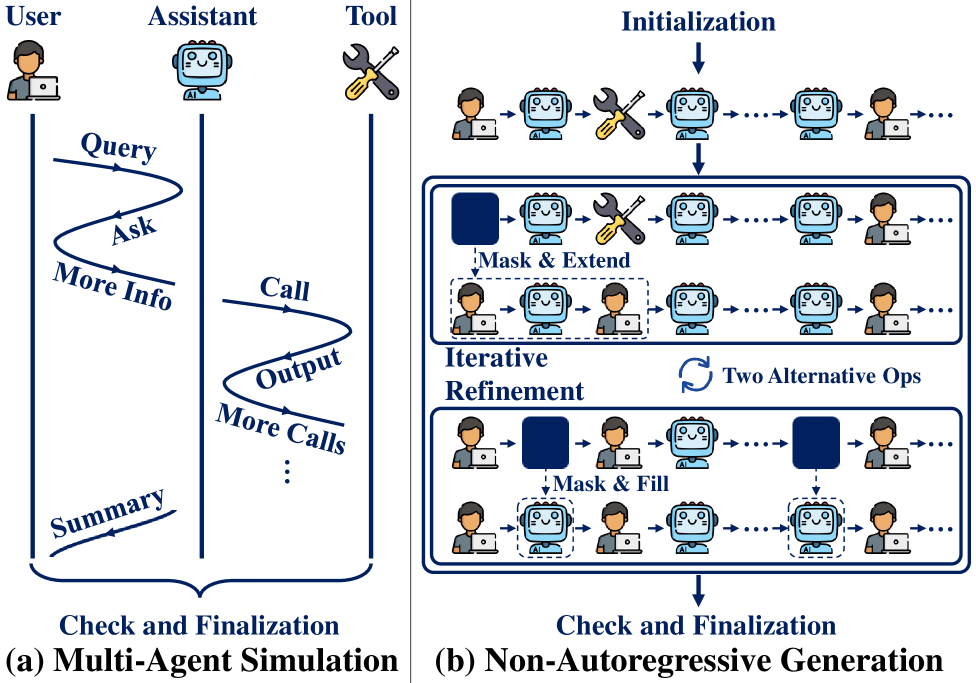
ToolACE-MT generates high-quality multi-turn agentic dialogue data efficiently by first creating a coarse trajectory skeleton and then iteratively refining it with complexity injections, avoiding costly autoregressive multi-agent simulations.
Core Problem
Existing methods for generating multi-turn agentic data rely on autoregressive multi-agent simulations (MAS), which are computationally expensive, hard to control for complexity, and prone to error accumulation due to lack of global context.
Why it matters:
- High-quality multi-turn data is essential for training agents to handle complex real-world tasks involving partial observability and dependent tool calls
- Autoregressive generation is slow and costly because every turn requires a new inference step based on growing context
- Assistants in standard simulations lack holistic awareness of the full task plan, leading to inconsistencies and factual errors in long horizons
Concrete Example:
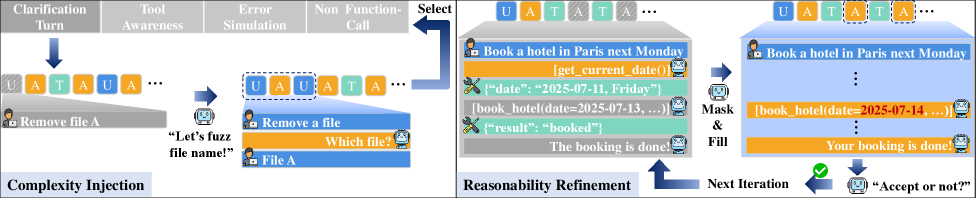
In a standard multi-agent simulation, an assistant might call a tool to book a flight without realizing the return date in a later subtask makes the itinerary impossible, because it generates one step at a time. ToolACE-MT plans the full skeleton first, ensuring the dates align before filling in the dialogue.
Key Novelty
Non-Autoregressive Iterative Generation for Agentic Data
- Decouples structure from content: Generates a complete dialogue skeleton (user tasks + tool actions) first, then fills in natural language details, unlike standard methods that generate them simultaneously turn-by-turn
- Iterative Refinement via Mask-and-Fill: Systematically injects complexity (e.g., user errors, clarifications) into the skeleton by masking specific turns and regenerating them, similar to non-autoregressive translation methods
- Global planning consistency: By generating the action trajectory upfront based on a plan, the assistant's behavior remains consistent across long horizons
Architecture
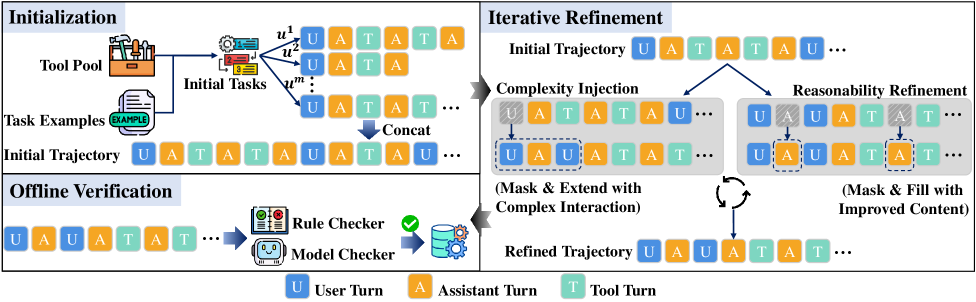
The overall workflow of ToolACE-MT, illustrating the three stages: Initialization, Iterative Refinement, and Offline Verification.
Evaluation Highlights
- Models trained on ToolACE-MT data outperform those trained on autoregressive MAS data on benchmarks like BFCL-v3, τ-bench, and ACEBench
- Efficient scaling: The iterative refinement process allows flexible complexity scaling without the linear cost increase of full autoregressive regeneration
- Data analysis confirms the generation pipeline produces diverse and valid agentic trajectories suitable for training tool-use LLMs
Breakthrough Assessment
8/10
Offers a significant paradigm shift from expensive autoregressive simulation to efficient non-autoregressive generation for agentic data, addressing key bottlenecks in cost and controllability.