📝 Paper Summary
Agentic Software Engineering (SE 3.0)
Human-Agent Collaboration
Software Engineering Process Frameworks
The paper proposes Structured Agentic Software Engineering (SASE), a framework replacing ad-hoc prompting with dual workbenches (Human vs. Agent) and formal artifacts to bridge the gap between agent speed and engineering trust.
Core Problem
Autonomous coding agents generate code rapidly but fail to meet 'merge-ready' quality standards (hygiene, subtle regressions), creating a 'speed vs. trust' gap that overwhelms human reviewers.
Why it matters:
- Current agents (e.g., Devin, Claude Code) are hyper-productive but unreliable, with high failure rates in broader CI checks despite passing unit tests
- Ad-hoc conversational prompting fails to establish the robust processes needed for reproducibility, auditing, and scaling N-to-N human-agent collaboration
- The industry lacks a standardized taxonomy for SE autonomy, confusing simple assistance (auto-complete) with true goal-oriented agency
Concrete Example:
A coding agent might pass all unit tests for a 'caching layer' task but introduce subtle behavioral regressions or style violations (as seen in SWE-Bench analyses where 29.6% of plausible fixes were incorrect), forcing humans to painstakingly review massive volumes of generated code.
Key Novelty
Structured Agentic Software Engineering (SASE)
- Proposes a 'Structured Duality' separating SE into two modalities: SE for Humans (strategic coaching via ACE) and SE for Agents (execution via AEE)
- Replaces informal chat with structured, version-controlled artifacts (e.g., Merge-Readiness Packs, BriefingScripts) to manage the human-agent contract
- Introduces a 6-level hierarchy for SE Autonomy, analogous to SAE driving levels, distinguishing between 'Task-Agentic' (Level 2) and 'Goal-Agentic' (Level 3) systems
Architecture
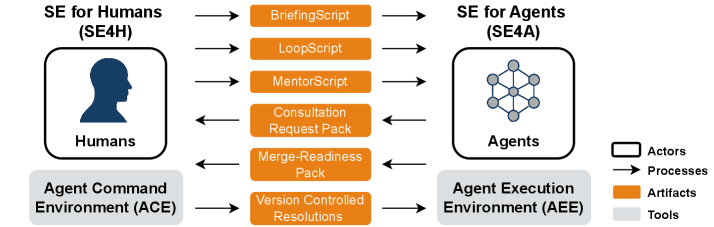
The Structured Agentic Software Engineering (SASE) framework visualization, contrasting the two modalities (SE4H and SE4A)
Breakthrough Assessment
8/10
Provides a necessary, rigorous conceptual scaffold (SASE) and taxonomy (Levels 0-5) to move the field from ad-hoc demos to disciplined engineering, though the framework itself is theoretical.