📝 Paper Summary
Self-evolving Agentic reasoning
Multi-agent
SwarmAgentic adapts Particle Swarm Optimization to the language domain to autonomously generate, refine, and coordinate multi-agent systems from scratch without predefined templates.
Core Problem
Existing agentic generation frameworks lack full autonomy, relying on fixed templates, seed agents, or manual engineering for collaboration strategies, which limits adaptability to open-ended tasks.
Why it matters:
- Rigid designs suppress the emergence of self-optimizing system behaviors necessary for complex, exploratory tasks
- Manually designing agents and collaboration strategies for open-ended tasks is prohibitively complex and labor-intensive
- Current frameworks (e.g., ADAS, AutoAgents) fail to satisfy all three autonomy criteria: from-scratch generation, self-optimizing functionality, and self-optimizing collaboration
Concrete Example:
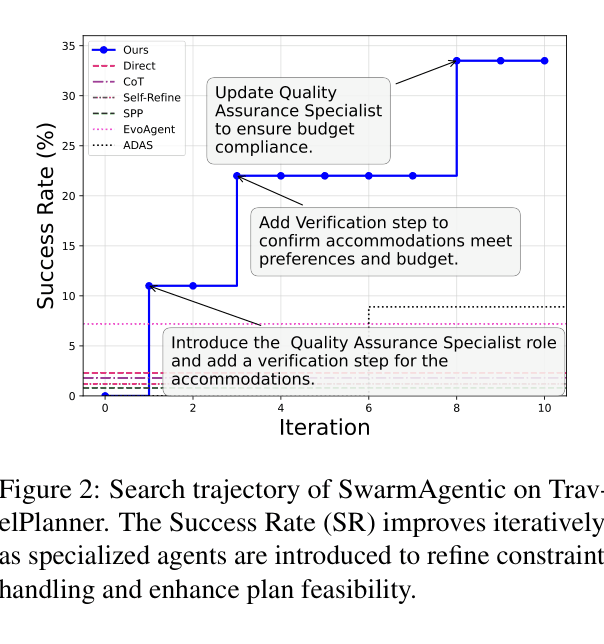
In a travel planning task, standard methods might fail to check budget constraints effectively. SwarmAgentic autonomously identifies this flaw and introduces a specific 'Quality Assurance Specialist' role with a verification step to ensure the plan meets the user's budget.
Key Novelty
Language-driven Particle Swarm Optimization (PSO) for Agentic Systems
- Reformulates PSO for discrete, symbolic search spaces where 'position' is an agentic system configuration and 'velocity' is a textual update plan
- Jointly optimizes agent functionalities (roles, prompts) and collaboration structures (workflows) as interdependent components rather than separately
- Introduces Failure-Aware Velocity Updates, using LLMs to analyze execution errors and guide the swarm toward better configurations based on personal and global bests
Architecture
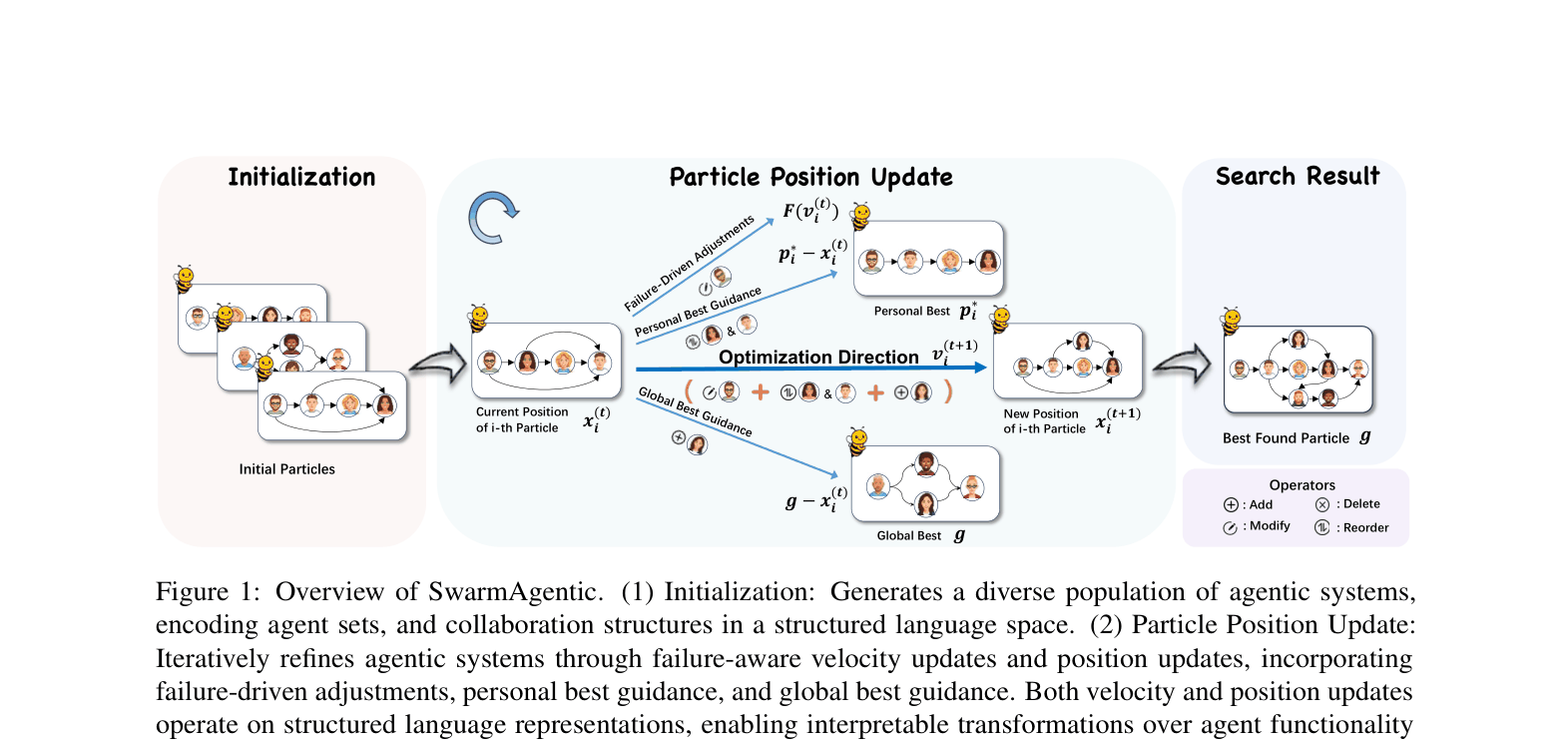
The complete SwarmAgentic pipeline, illustrating the transition from initialization to iterative PSO-based updates.
Evaluation Highlights
- +261.8% relative improvement over ADAS on the TravelPlanner benchmark, highlighting effectiveness in structurally unconstrained tasks
- Achieved state-of-the-art performance on 6 real-world tasks (including Natural Plan and Creative Writing) given only a task description and objective function
- Outperforms GPT-4o-based direct prompting by large margins (e.g., +41.9% score improvement on Creative Writing)
Breakthrough Assessment
9/10
Significantly advances automated agent design by removing the need for seed agents or templates. The adaptation of PSO to symbolic/language space is a novel and effective mechanism for structural search.