📝 Paper Summary
Multi-agent
Decentralized AI
Proposes a decentralized framework where heterogeneous AI agents dynamically form temporary coalitions over a network to execute complex tasks, ensuring both capability coverage and economic incentive compatibility.
Core Problem
Current agentic AI architectures are centralized and monolithic, limiting scalability, interoperability across organizational boundaries, and the ability to leverage specialized capabilities distributed across cloud and edge infrastructure.
Why it matters:
- Centralized systems scale primarily in model size rather than functional diversity or organizational reach.
- Existing modular systems like AutoGPT assume centralized orchestration, which creates bottlenecks and fails to utilize proprietary or access-controlled tools owned by different entities.
- Scaling agentic AI requires solving coordination, trust, and incentive problems across a network, not just adding more computation.
Concrete Example:
Consider a cybersecurity incident investigation requiring specialized logs from an edge device, a proprietary threat analysis tool in the cloud, and a legal compliance checker. A centralized model cannot easily access these distributed, ownership-restricted tools. The proposed framework allows these distinct nodes to form a temporary coalition to execute the workflow.
Key Novelty
Internet of Agentic AI (IoA-AI)
- Treats agentic intelligence as a network service where tasks find capable agents dynamically, similar to how packets find routes in the internet, rather than processing everything in one central model.
- Couples graph-based coalition formation with workflow execution: a coalition is only valid if it satisfies capability requirements AND economic constraints (incentives/costs) simultaneously.
Architecture
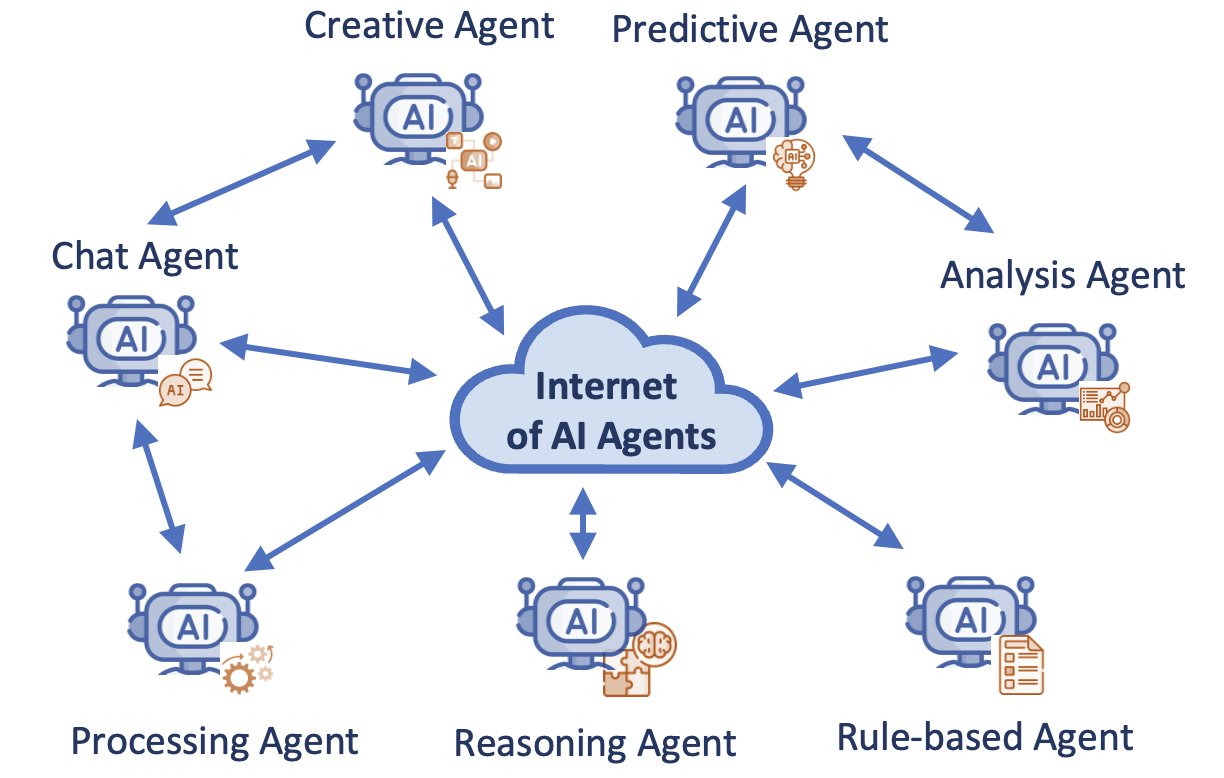
Conceptual diagram of the Internet of Agentic AI showing distributed nodes (Edge, Cloud, Institution) connected in a network.
Evaluation Highlights
- Healthcare case study demonstrates successful coalition formation spanning cloud and edge nodes.
- Proposed algorithm successfully finds minimum-effort coalitions that satisfy local incentive constraints.
- Framework integrates with the Model Context Protocol (MCP) to enable capability discovery across heterogeneous ownership structures.
Breakthrough Assessment
7/10
Strong conceptual framework for the next phase of decentralized AI. It formalizes the intersection of game theory, networking, and agentic workflows, though the paper is primarily theoretical/architectural with a case study rather than extensive empirical benchmarking.