📝 Paper Summary
Agentic AI for Wireless Networks
Integrated Sensing and Communication (ISAC)
The paper proposes an Agentic AI framework for Integrated Sensing and Communication (ISAC) systems that leverages LLMs for high-level planning and DRL agents for low-level execution to optimize UAV trajectory and power allocation.
Core Problem
Conventional AI (like DRL) lacks generalization for complex, dynamic ISAC environments, while standalone LLMs suffer from hallucinations and cannot execute precise control tasks.
Why it matters:
- Future 6G ISAC systems operate in highly dynamic environments where static optimization rules fail.
- Existing DRL methods struggle with cross-domain generalization and changing application demands.
- LLMs alone cannot handle the real-time, high-precision numerical control required for wireless signal processing.
Concrete Example:
In a UAV-enabled ISAC scenario, a standard DRL agent might learn to optimize power for a specific trajectory but fails when the environment changes. An Agentic AI system can reason about the new environment using an LLM to decompose the task and guide the DRL agent to adapt its power allocation strategy dynamically.
Key Novelty
Hierarchical Agentic ISAC Framework
- Integrates a Large Language Model (LLM) as a 'Brain' for high-level reasoning and task decomposition with a Deep Reinforcement Learning (DRL) 'Actuator' for low-level control.
- Utilizes a perception-reasoning-action loop where the LLM analyzes environmental feedback to generate context-aware subtasks and reward signals for the execution agents.
- Employs a Chain-of-Thought (CoT) mechanism to improve the reliability of the LLM's planning and reduce hallucinations during decision-making.
Architecture
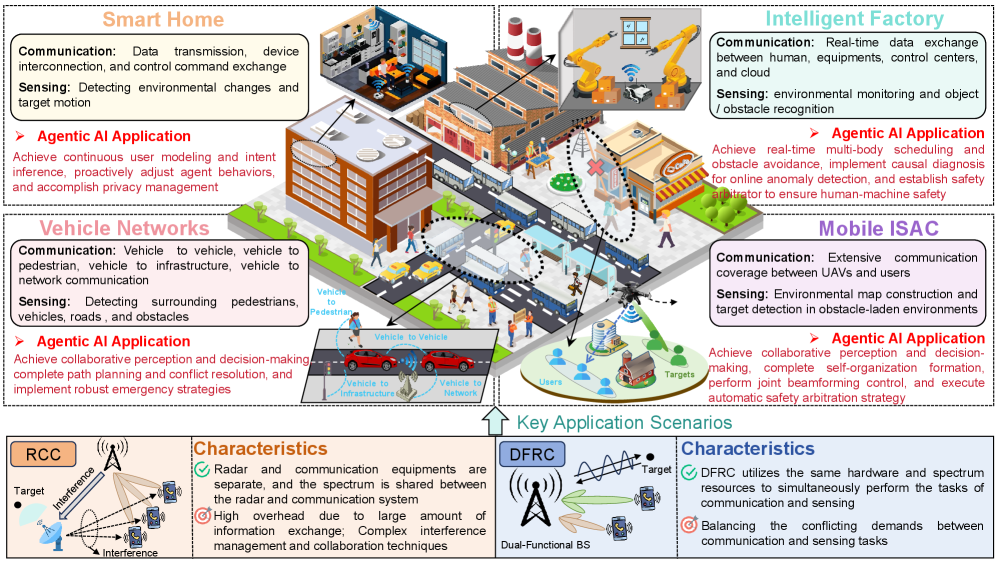
Overview of Agentic AI applications in ISAC, specifically illustrating the UAV-ISAC scenario workflow.
Evaluation Highlights
- Outperforms PPO (Proximal Policy Optimization) by approximately +8.3% in communication rate in satellite network scenarios (cited from related work, verified in case study context).
- Achieves superior convergence speed and higher total reward compared to standard PPO and SAC (Soft Actor-Critic) baselines in the UAV-ISAC case study.
- Demonstrates robust adaptability in dynamic environments where conventional DRL agents typically suffer from performance degradation.
Breakthrough Assessment
7/10
Proposes a solid hierarchical framework combining GenAI and DRL for ISAC. While the architectural concept is strong, the experimental validation is limited to a specific UAV case study without extensive real-world implementation details.