📝 Paper Summary
Agent security and governance
Multi-agent systems
SAGA is a security architecture that enables users to govern their AI agents through a centralized registry for discovery and policy management, combined with decentralized, cryptographically secured inter-agent communication.
Core Problem
Current agentic systems lack concrete implementations for user-controlled agent management, leaving users without oversight mechanisms to prevent malicious agents from impersonating or exploiting their agents.
Why it matters:
- Malicious actors can impersonate agents or manipulate behavior to extract sensitive information if identity and communication aren't secured.
- Existing proposals are largely theoretical or lack fine-grained policy enforcement (like Google's A2A), failing to meet emerging safety requirements for critical applications.
- Users currently cannot effectively limit who their autonomous agents interact with or for how long, expanding the attack surface.
Concrete Example:
Alice's calendar agent might need to contact Bob's agent to schedule a meeting. Without SAGA, a malicious agent could impersonate Bob's agent to harvest schedule data, or flood Alice's agent with requests. SAGA ensures Alice's agent only communicates with authenticated agents under specific user-defined policies (e.g., 'allow 5 requests from Bob').
Key Novelty
User-Governed Agent Lifecycle with Cryptographic Access Tokens
- Introduces a 'Provider' entity that manages agent identities and policies but does not mediate actual communication, preserving scalability.
- Uses a cryptographic mechanism where receiving agents issue 'Access Control Tokens' to authorized initiators; these tokens are encrypted under dynamically derived shared keys.
- Tokens enforce fine-grained constraints (expiration time, request limits) defined by the user's policy, balancing security windows with performance.
Architecture
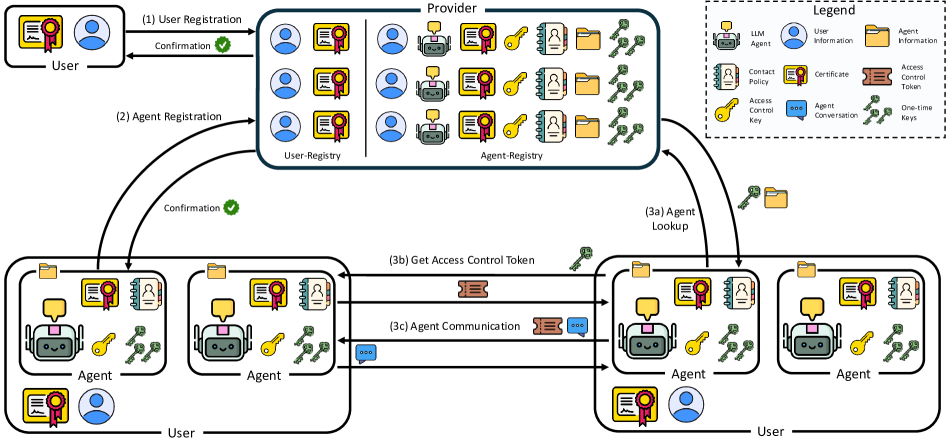
Overview of the SAGA architecture showing the Provider, User Registry, Agent Registry, and the flow of registration and communication between User, Provider, and Agents.
Evaluation Highlights
- Formal verification using PROVERIF proves secrecy of tokens and authentication of communication against network attackers.
- Making the Provider fault-tolerant using RAFT consensus introduces negligible throughput degradation across key operations.
- Provider throughput scales linearly with sharding, demonstrating the architecture can handle large-scale agent deployments.
Breakthrough Assessment
8/10
Provides a complete, implemented, and formally verified security architecture for agentic systems, addressing a critical gap in governance that previous theoretical works missed.