📝 Paper Summary
Graph-based RAG pipeline
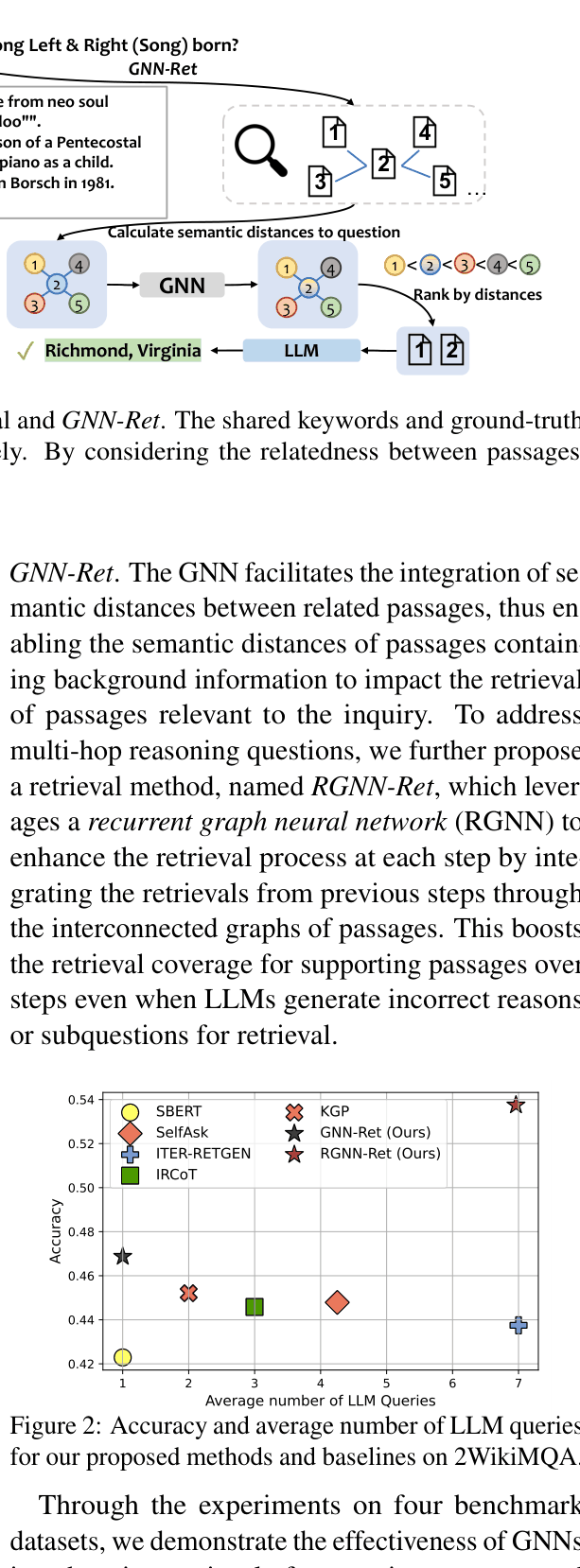
GNN-Ret constructs a graph of passages based on structural and keyword connections and uses a Graph Neural Network to propagate relevance scores, improving retrieval for complex questions.
Core Problem
Existing retrieval methods treat passages in isolation based on semantic distance, failing to retrieve supporting passages that share context (like keywords or document structure) but lack direct semantic similarity to the query.
Why it matters:
- Complex questions often have information asymmetry: a short inquiry focuses on one aspect while background details in the question connect to other passages
- LLMs struggle to answer multi-hop questions when retrieval misses intermediate reasoning steps due to poor semantic overlap with the initial question
Concrete Example:
For the question 'Where was the performer of song Left & Right born?', standard retrieval finds the performer (D'Angelo) but misses his birthplace passage because the birthplace passage doesn't mention 'Left & Right'. GNN-Ret connects them via the shared entity 'D'Angelo'.
Key Novelty
Graph Neural Network Enhanced Retrieval (GNN-Ret) and Recurrent GNN (RGNN-Ret)
- Constructs a 'Graph of Passages' (GoPs) where nodes are text chunks and edges represent structural adjacency or shared keywords extracted by an LLM
- Uses a GNN to update the semantic distance of a passage by aggregating minimum distances from its neighbors, allowing relevant but semantically distant passages to be retrieved via their connections
- For multi-hop questions, RGNN-Ret uses a Recurrent GNN to integrate retrieval states across reasoning steps, helping subsequent steps find passages related to previous retrievals
Architecture
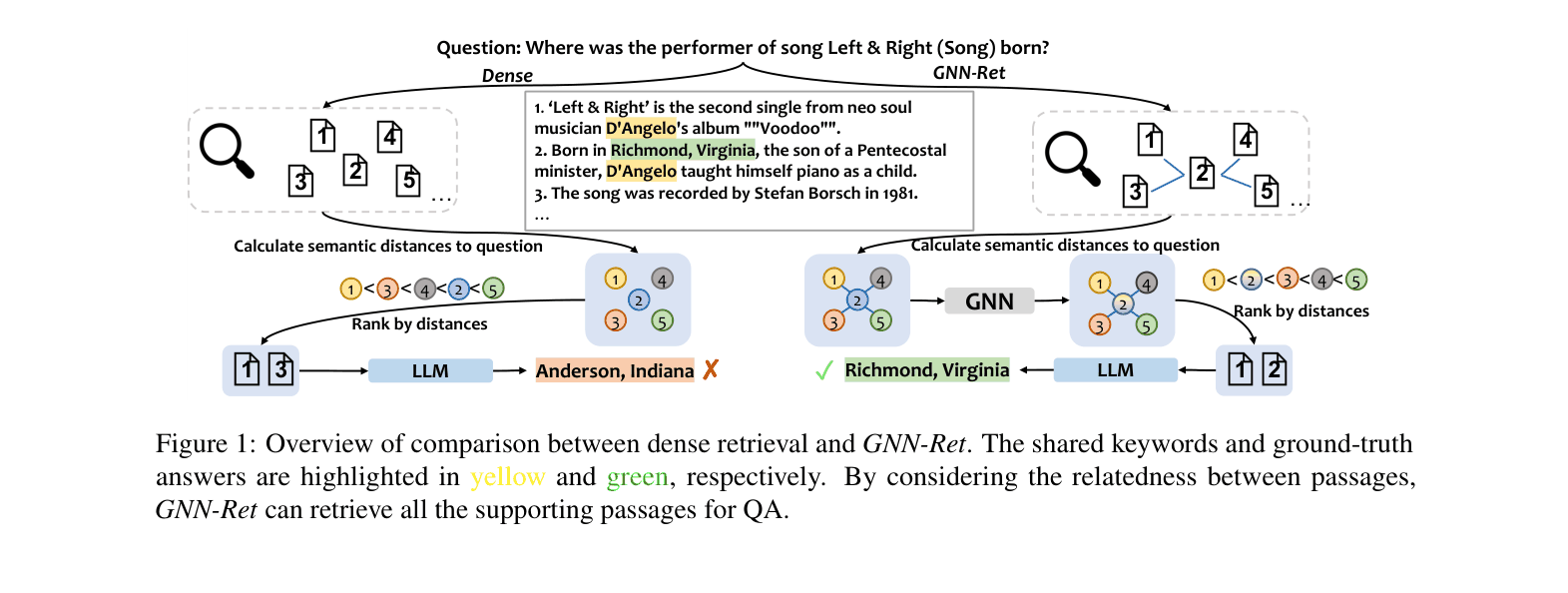
Overview of GNN-Ret vs Dense Retrieval (Fig 1) and the workflow of RGNN-Ret (Fig 3).
Evaluation Highlights
- RGNN-Ret achieves state-of-the-art accuracy on 2WikiMQA (55.8%), outperforming the strong baseline KGP by 10.6%
- GNN-Ret improves accuracy by 4.0% over SBERT on the IIRC dataset using a single retrieval step
- RGNN-Ret outperforms SelfAsk (a multi-step prompting baseline) by 11.0% accuracy on 2WikiMQA
Breakthrough Assessment
8/10
Significant improvement on multi-hop QA by explicitly modeling passage relationships. effectively addresses the 'isolated passage' assumption of standard dense retrieval.