📝 Paper Summary
Multi-agent orchestration
Dynamic workflow generation
DAAO uses a variational autoencoder to predict query difficulty, dynamically generating custom multi-agent workflows and routing sub-tasks to cost-effective models based on that difficulty.
Core Problem
Existing multi-agent frameworks use static or task-level workflows that over-process simple queries (wasting resources) and underperform on complex ones (lacking sufficient reasoning depth).
Why it matters:
- Current systems treat all queries within a task category uniformly, ignoring the vast difference in complexity between individual inputs
- Homogeneous workflows fail to leverage the cost-performance trade-offs of heterogeneous LLMs, leading to excessive token costs for simple tasks
- Static architectures lack the flexibility to adapt reasoning depth and operator selection to specific user needs
Concrete Example:
When a user requests a travel guide, a simple retrieval-summarization workflow might suffice for a general overview but fails for a specific, complex itinerary request. Conversely, a complex multi-step reasoning chain is wasteful for a simple factual query.
Key Novelty
Difficulty-Aware Agentic Orchestration (DAAO)
- Learns a continuous latent difficulty representation for each query using a VAE (Variational Autoencoder) that updates based on workflow success/failure
- Dynamically determines workflow depth and selects operators (agents) layer-by-layer conditioned on this predicted difficulty
- Routes each selected operator to a specific LLM backbone based on a balance of performance needs and cost constraints
Architecture
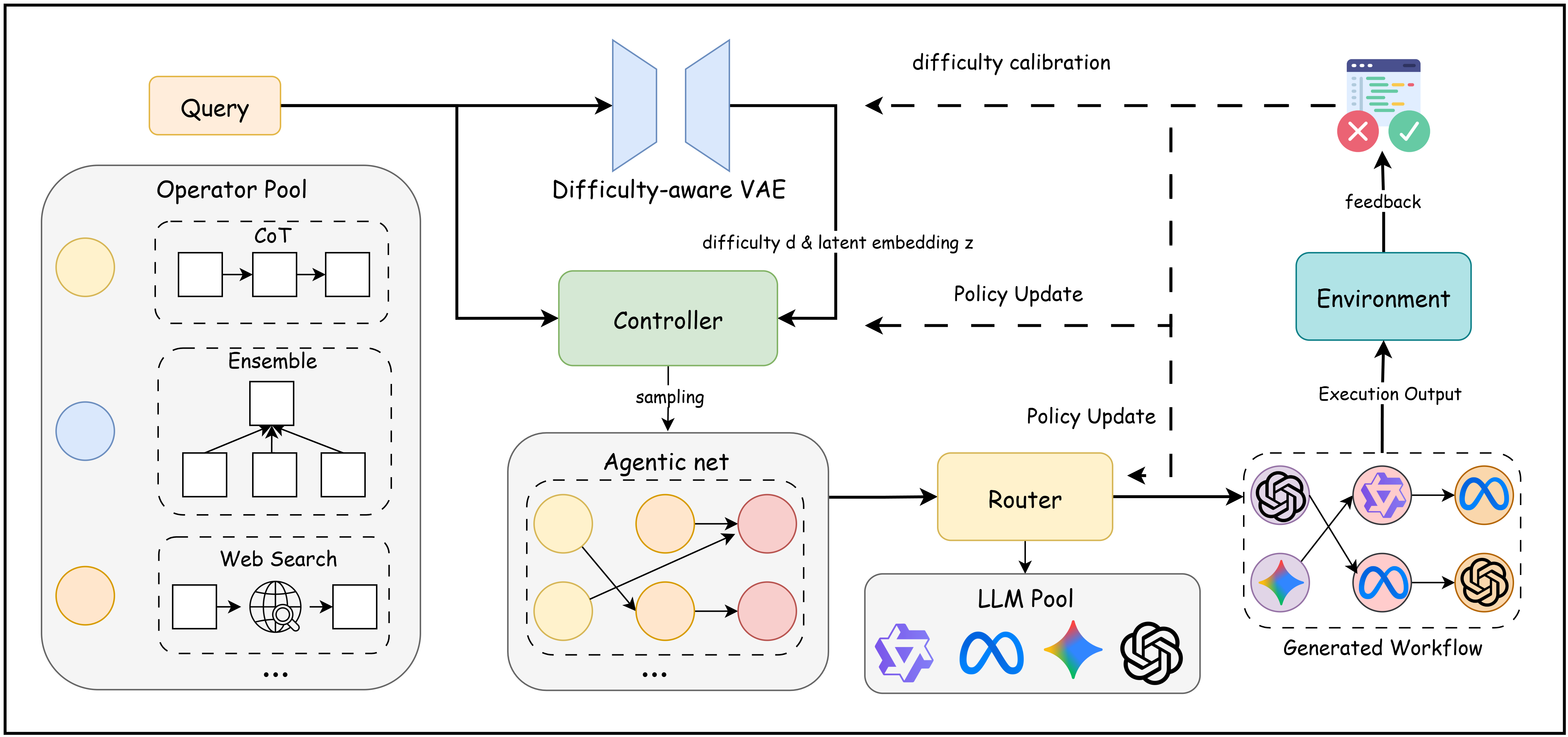
The overall DAAO framework, showing the flow from Input Query -> Difficulty Estimator -> Workflow Generation -> Execution -> Feedback Update.
Evaluation Highlights
- Surpasses existing automated orchestration methods (AFlow, ADAS) by 3.5%~15.2% across six benchmarks
- Outperforms state-of-the-art LLM routing (MasRouter) on MATH benchmark with 41% of the inference cost and 65% of the training cost
- Achieves higher accuracy than static multi-agent frameworks like GPTSwarm and AutoGen across code, math, and reasoning tasks
Breakthrough Assessment
8/10
Strong contribution in making agentic workflows dynamic and cost-efficient. The explicit modeling of 'query difficulty' as a learnable latent variable for controlling workflow topology is a significant advance over static or heuristic methods.