📝 Paper Summary
Multi-agent
Agentic AI
Agentic Lybic is a multi-agent desktop automation system that uses a Finite State Machine controller to dynamically route subtasks among specialized workers while enforcing continuous quality gates.
Core Problem
Current desktop automation agents struggle with complex, long-horizon tasks because they rely on simplistic 'delegate-and-forget' approaches that lack continuous oversight and adaptive re-planning.
Why it matters:
- Existing hybrid agents fail to implement sophisticated routing mechanisms essential for coordinating multiple functional modules over extended workflows
- Quality assessment in current systems is typically binary and reactive (only checking final success), missing opportunities for proactive intervention and incremental course correction during execution
Concrete Example:
In a multi-stage workflow like an examination task, a standard GUI agent might try to answer questions directly on screen. However, if the questions must be collected first, analyzed, and then answered, a standard agent fails without separating perception, reasoning, and action phases.
Key Novelty
FSM-based Tiered Reasoning Architecture
- Implements the entire multi-agent architecture as a Finite State Machine (FSM), where a central Controller manages transitions between planning, execution, and quality check states based on specific triggers.
- Introduces a 'continuous quality gate' system that monitors progress after every few steps (not just at the end), allowing the system to detect stagnation or errors early and trigger immediate re-planning.
Architecture
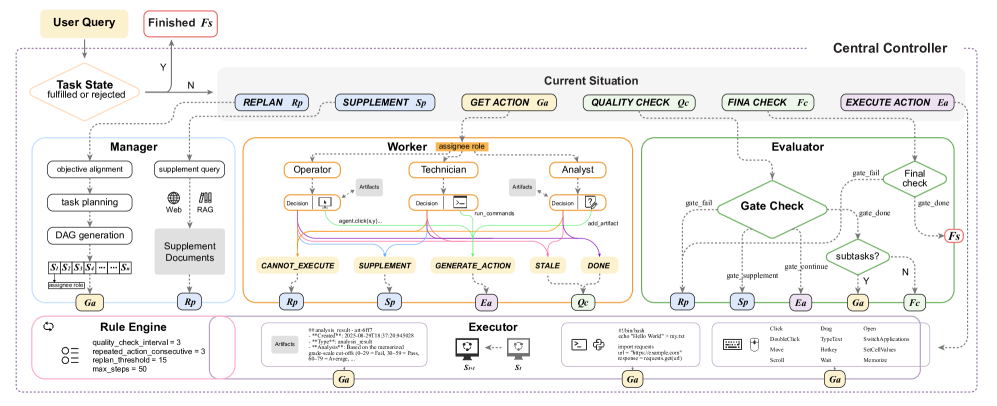
The hierarchical four-component architecture of Agentic Lybic and its FSM-based workflow.
Evaluation Highlights
- Achieves a state-of-the-art success rate of 57.07% on the OSWorld benchmark (in 50 steps), surpassing CoAct-1 (56.4%) and Agent S2.5 (54.2%)
- Demonstrates superior reliability in long-horizon scenarios through proactive quality control mechanisms that prevent error propagation
Breakthrough Assessment
7/10
Offers a strong architectural contribution by formalizing multi-agent orchestration via FSMs and continuous quality gating. While the performance gain on OSWorld is incremental (+0.67% over CoAct-1), the structural approach to reliability is significant.