📝 Paper Summary
Multi-agent collaboration
Agentic payments
HMASP is a hierarchical multi-agent framework that modularizes payment tasks into distinct agent roles (Conversation, Supervisor, Routing, Summary) to enable secure, end-to-end agentic payments with minimal infrastructure changes.
Core Problem
Current LLM agents cannot perform end-to-end payments because traditional payment infrastructure (anti-bot, fraud controls, PCI DSS) blocks them, and existing solutions require major structural changes to payment rails.
Why it matters:
- Regulatory frameworks like PCI DSS strictly govern AI use in payments, making direct integration of standard agents difficult due to data exposure risks
- Traditional payment networks employ anti-bot mechanisms that inherently reject automated agentic interactions
- LLM hallucination risks pose severe threats to financial transaction reliability and security
Concrete Example:
When an external agent tries to "Register a new card," it fails at the network boundary due to authentication controls. In HMASP, a dedicated Routing Agent triggers a specific, isolated registration subgraph that validates the 16-digit card checksum (Luhn Check) before execution, preventing invalid data from reaching the payment rail.
Key Novelty
Hierarchical Multi-Agent System for Payments (HMASP)
- Deconstructs payment processing into four hierarchical levels: a conversational entry point, domain supervisors, task-specific routers, and process summarizers
- Isolates sensitive payment data in decoupled state variables that agents can access but not hallucinate, ensuring deterministic execution of critical financial tasks
- Uses a structured handoff protocol where agents pass control downstream to execute tasks and propagate summary outcomes back upstream without exposing raw internal states
Architecture
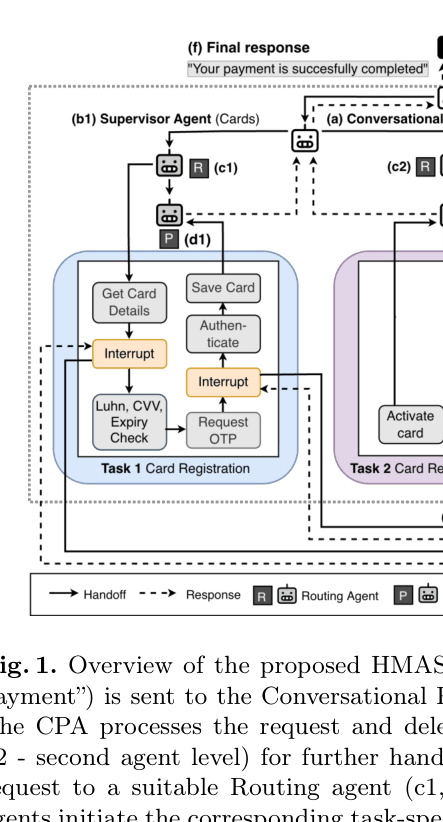
The hierarchical structure of HMASP, detailing the flow from user input to payment execution and back
Evaluation Highlights
- 99.6% task success rate on payment checkout tasks using GPT-4.1, with open-weight model Qwen2.5:32b achieving a comparable 95.6%
- 99.9% F1-score for agent handoffs (routing requests correctly) with GPT-4.1, demonstrating reliable orchestration
- 100% rejection rate of irrelevant inputs (e.g., "tell me a joke") across top performing models (GPT-4.1, Qwen2.5:32b), preventing unauthorized workflow triggers
Breakthrough Assessment
7/10
Significant as the first proposed framework for end-to-end agentic payments that respects existing rails. High practicality, though evaluation is simulation-based.