ML-Agent trains a language model to autonomously perform machine learning engineering by using step-wise reinforcement learning on expert trajectories to overcome the high latency of experimental feedback.
Core Problem
Current autonomous ML agents rely on static, manually engineered prompts and fail to improve from experience, while applying standard RL is impractical because ML experiments take too long to run.
Why it matters:
Manual prompt engineering prevents agents from generalizing across diverse tasks or learning from their own successes and failures.
Standard online RL requires generating full task trajectories, but running a single ML training loop to get feedback can take hours, making data collection prohibitively slow.
Existing agents often repeat similar, narrow strategies (limited exploration) rather than discovering novel optimization paths.
Concrete Example:In a standard setup, an agent might repeatedly try small, ineffective code edits (like changing a learning rate slightly) across many episodes because it cannot explore broadly. Furthermore, to learn that a complex architecture change is good, RL would need to wait hours for the model to train, slowing down policy updates to a crawl.
Key Novelty
Step-wise RL with Exploration-Enriched Fine-tuning
Decouples RL from full trajectory rollouts by optimizing the agent on single steps starting from pre-collected expert states, drastically speeding up training.
Uses a 'fast' set of small ML tasks to generate diverse expert strategies (e.g., regularization ideas) via GPT-4o-mini, then fine-tunes the agent on these to ensure broad exploration capabilities before RL begins.
Unifies diverse ML feedback (compilation errors, runtime crashes, accuracy gains) into a single scalar reward function to guide optimization.
Architecture
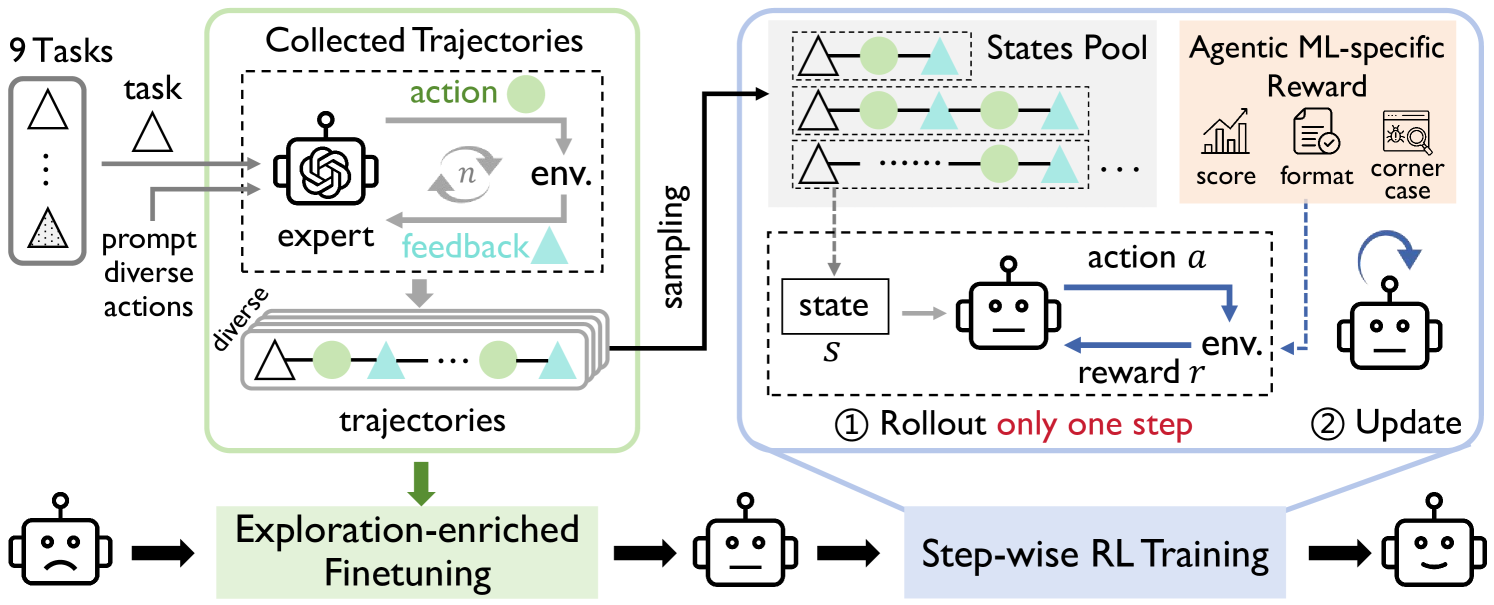
The overall ML-Agent training framework comprising three stages: Exploration-enriched fine-tuning, Step-wise RL, and the Agentic ML-specific reward module.
Evaluation Highlights
The 7B-parameter ML-Agent outperforms the 671B-parameter DeepSeek-R1 agent on autonomous ML tasks despite being 100x smaller.
Achieves superior performance on 10 held-out ML tasks not seen during training, demonstrating strong cross-task generalization.
Continuously improves performance during the RL training phase, verifying the effectiveness of the step-wise learning paradigm.
Breakthrough Assessment
8/10
Proposes a practical solution to the 'long feedback loop' problem in agentic RL for coding/ML tasks. Successfully enabling online RL in this domain is a significant methodological step.
⚙️ Technical Details
Problem Definition
Setting: Agentic ML formulated as a Markov Decision Process (MDP) where the agent interacts with an editable code workspace and interpreter.
Inputs: Current state s_t consisting of history of feedback (execution results, errors) from previous steps.
Outputs: Action a_t (e.g., code edits to machine learning scripts).
Pipeline Flow
Exploration-Enriched Fine-Tuning (Pre-training)
Step-wise RL Training (Policy Optimization)
Inference/Deployment
System Modules
Idea Generator (GPT-4o-mini)
Generate diverse ML optimization ideas (e.g., 'add L1 regularization') to create varied expert trajectories.
Model or implementation: GPT-4o-mini
ML-Agent Policy
Generate code edits or actions based on current environment state.
Model or implementation: Qwen-2.5-7B
Reward Module
Compute scalar reward from environment feedback.
Model or implementation: Rule-based function
Novel Architectural Elements
Step-wise RL objective that samples states from a fixed expert distribution rather than the current policy's distribution to decouple state exploration from policy training.
Modeling
Base Model: Qwen-2.5-7B
Training Method: Proximal Policy Optimization (PPO) adapted for Step-wise RL
Objective Functions:
Purpose: Optimize policy to maximize expected reward on single steps sampled from expert states.
Purpose: Supervised Fine-Tuning loss for initialization.
Formally: L_SFT(θ) = -sum log π_θ(a_t | s_t)
Training Data:
9 fast-executable ML tasks used for generating expert trajectories.
Diverse ideas (100+ candidates) filtered by embedding distance to ensure variety in SFT data.
Key Hyperparameters:
base_model_size: 7B
Compute: Not reported in the paper
Comparison to Prior Work
vs. AIDE/SELA: ML-Agent learns parameters via online RL rather than relying on fixed prompt heuristics and inference-time search.
vs. AgentQ [not cited in paper]: ML-Agent uses step-wise RL on single steps rather than DPO on full trajectories to handle the high cost of ML experiments.
vs. DeepSeek-R1: ML-Agent (7B) is significantly smaller but specialized for ML engineering via RL, whereas DeepSeek-R1 (671B) is a general-purpose reasoning model.
Limitations
Relies on a set of fast-executable tasks for training; performance depends on the quality and diversity of these proxy tasks.
Step-wise RL assumes that optimizing single steps from expert states translates to better full-trajectory performance (distribution shift issue).
Requires computable metrics for rewards, which may be harder to define for qualitative ML tasks (e.g., interpretability).
Reproducibility
Code availability is not explicitly mentioned in the text provided. The method relies on a set of 9 fast-executable ML tasks for training and a specific reward shaping formula involving sigmoid scaling of task metrics. GPT-4o-mini is required for the data generation phase.
📊 Experiments & Results
Evaluation Setup
Autonomous ML engineering tasks where the agent must improve code to maximize a performance metric (e.g., accuracy).
Benchmarks:
Held-in ML Tasks (Machine Learning Engineering (9 tasks))
Held-out ML Tasks (Machine Learning Engineering (10 tasks))
Statistical methodology: Not explicitly reported in the paper
Main Takeaways
The 7B ML-Agent surpasses the massive 671B DeepSeek-R1 agent, highlighting the efficiency of domain-specific RL over general-purpose scale.
Step-wise RL allows for efficient training even when environment interaction (running ML experiments) is slow, a key bottleneck for previous methods.
The agent generalizes well, outperforming SOTA on 10 held-out tasks, suggesting it learns general ML engineering principles rather than memorizing solutions.
Exploration-enriched fine-tuning is critical; without it, agents tend to repeat conservative actions and fail to discover diverse optimization strategies.
Step-wise RL: A training paradigm that updates the policy based on single-step actions taken from sampled expert states, avoiding the need to execute full multi-step trajectories during training.
Exploration-enriched fine-tuning: A supervised pre-training stage using diverse, expert-generated trajectories to prevent the agent from collapsing into narrow, repetitive behaviors during RL.
PPO: Proximal Policy Optimization—an RL algorithm that updates policies monotonically and stably.
SFT: Supervised Fine-Tuning—training the model on labeled examples (expert trajectories) before RL.
MDP: Markov Decision Process—a mathematical framework for modeling decision making where outcomes are partly random and partly under the control of a decision maker.
Held-in/Held-out tasks: Held-in tasks are those seen during training; held-out tasks are unseen tests used to measure generalization.
DeepSeek-R1: A large-scale (671B parameter) state-of-the-art language model agent used as a baseline.