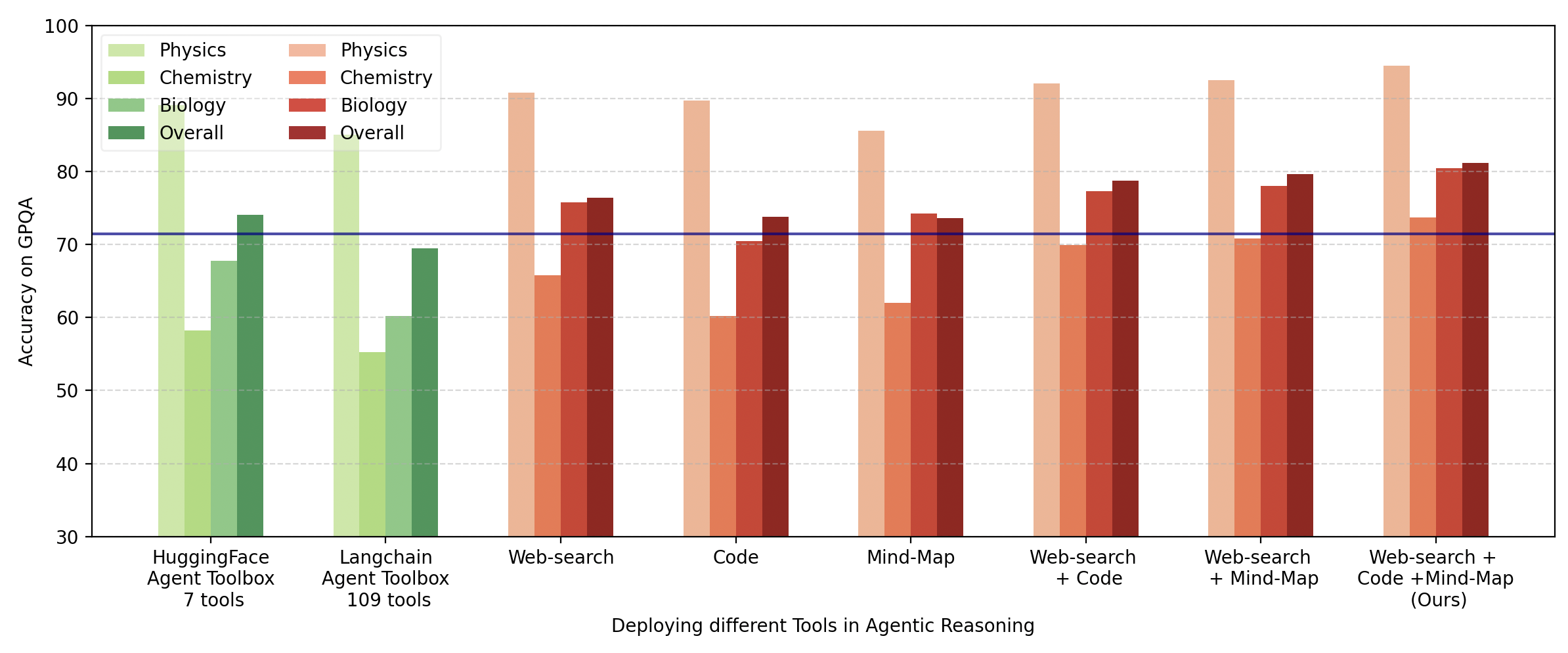
📝 Paper Summary
Agentic RAG pipeline
Memory organization
Tool-use post-training
Agentic Reasoning enhances LLM problem-solving by dynamically integrating web search, code execution, and a structured Mind-Map memory into the reasoning chain to handle complex, knowledge-intensive tasks.
Core Problem
Current reasoning models excel in structured domains like math/code but struggle with open-ended, knowledge-intensive tasks requiring extensive research and maintaining coherence over long reasoning chains.
Why it matters:
- Applying math/code-style reasoning to social sciences or experiential fields often produces flawed or overly rigid results
- Open-source models lag behind proprietary systems (like OpenAI Deep Research) in deep research capabilities due to lack of effective external tool integration
- LLMs frequently lose track of context or hallucinate when attempting long reasoning sequences without structured memory
Concrete Example:
When asked a riddle about family relationships involving a surgeon ('The surgeon... says I can't operate on this child, he's my son!'), DeepSeek-R1 fails after 17 seconds due to bias. Agentic Reasoning uses a Mind-Map to explicitly graph the entities [surgeon], [boy], and [father], correctly identifying the relationship.
Key Novelty
Agentic Reasoning Framework with Mind-Map Memory
- Integrates three specific agents (Web-Search, Code, Mind-Map) directly into the reasoning loop via special tokens, allowing the model to pause, query tools, and reintegrate results
- Introduces a 'Mind-Map' agent that constructs a dynamic knowledge graph from the reasoning context, allowing the model to query its own past thoughts and maintain coherence over long chains
- Optimizes the Web-Search agent by combining query breakdown, reranking, and Mind-Map context, finding this superior to standard RAG or knowledge refinement alone
Architecture
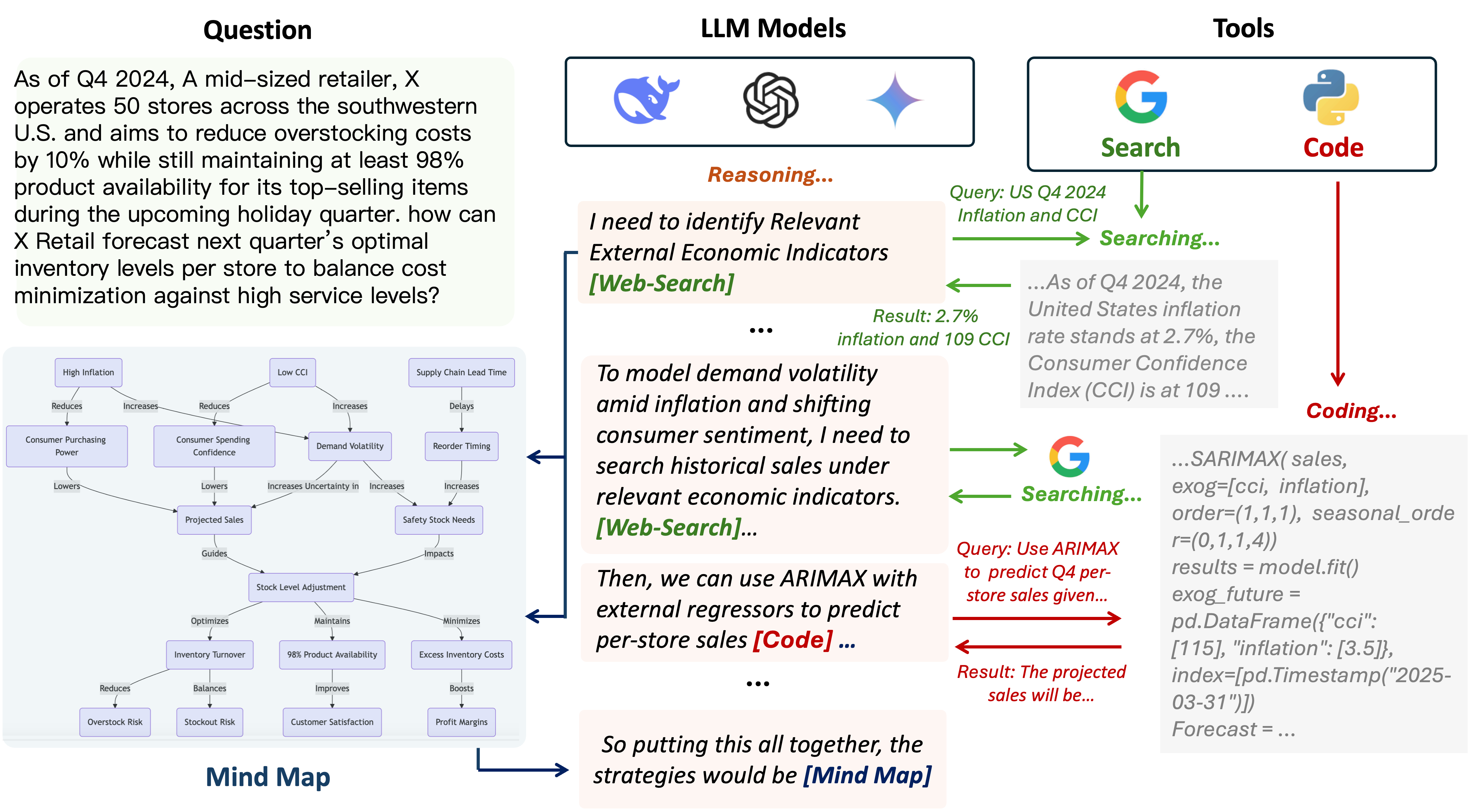
The Agentic Reasoning workflow where the LLM halts generation to invoke external tools (Search, Code, Mind-Map) and reintegrates results.
Evaluation Highlights
- Achieves 23.8% accuracy on Humanity's Last Exam, a 14.4% improvement over the raw model and narrowing the gap with OpenAI Deep Research to 2.8%
- Surpasses o3-mini-high on GPQA Diamond benchmark with 66.8% accuracy (vs 64.1%)
- Establishes a new state-of-the-art on GAIA benchmark among public methods, outperforming OpenAI Deep Research on Level 1 and Level 2 tasks
Breakthrough Assessment
9/10
Significantly narrows the gap between open-source and proprietary 'Deep Research' models. The Mind-Map concept for maintaining reasoning coherence is a strong architectural contribution.