Weinan Zhang, Junwei Liao, Ning Li, Kounianhua Du, Jianghao Lin
Shanghai Jiao Tong Univeristy
arXiv
(2024)
AgentRAGRecommendationP13N
📝 Paper Summary
Agentic Information RetrievalInformation Retrieval Paradigm
Agentic IR redefines information retrieval as a goal-oriented process where AI agents navigate a dynamic 'information state' transition graph to fulfill user instructions, rather than merely retrieving static items.
Core Problem
Traditional IR systems are constrained by their reliance on static, pre-defined corpora and passive filtering, rendering them unable to manipulate content, adapt to dynamic contexts, or execute tasks.
Why it matters:
Current systems (like web search) only filter existing items but cannot synthesize new content or act on information (e.g., cannot book a flight, only show schedules)
Users face information overload and must manually bridge the gap between retrieved data and their actual goals (e.g., planning a complex trip)
The static definition of 'information items' fails to capture real-time constraints, user preferences, and evolving task status
Concrete Example:In an online travel scenario, a traditional IR system merely lists available flights and hotels. It cannot generate a customized itinerary that accounts for real-time weather and budget, nor can it execute the booking task to finalize the arrangement.
Key Novelty
Shift from 'Information Items' to 'Information States'
Redefines the object of retrieval from static documents to a dynamic 'information state' that includes user context, cognitive knowledge, and task status
Formulates IR as a state transition graph where an agent takes actions (searching, reasoning, tool use) to move the user from an initial state to a desired target state
Treats Traditional IR as a special, restricted case of Agentic IR where the state space is limited to retrieved items and actions are limited to filtering
Architecture
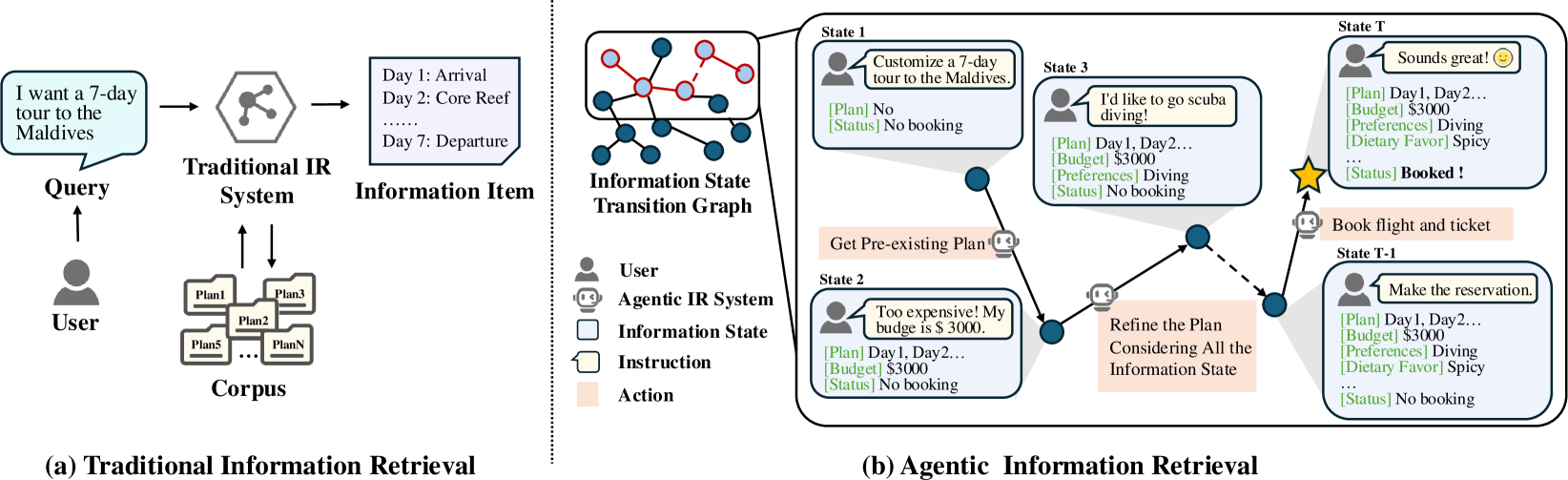
Comparison between Traditional Information Retrieval and Agentic Information Retrieval paradigms using an online travel agency example
Breakthrough Assessment
7/10
Foundational perspective paper proposing a significant paradigm shift for the IR community. High conceptual novelty, though this specific paper presents the formulation rather than empirical breakthroughs.
⚙️ Technical Details
Problem Definition
Setting: Information State Transition Graph navigation in a dynamic environment
Inputs: User instruction and initial information state s_0
Outputs: Target information state s_* (and the trajectory of actions to reach it)
Pipeline Flow
User Instruction -> Agent Policy -> Action -> Environment -> State Transition -> Updated Information State
System Modules
Agent Policy
Receives current information state and generates actions to interact with the environment
Model or implementation: LLM-centered compounded system
Verifier/Reward Function
Estimates the performance of the system by comparing the terminated state to the user's desired state
Model or implementation: Mathematical function r(s_*, tau)
Novel Architectural Elements
Formulation of IR as a decision-making process over a state transition graph rather than a ranking problem over a static corpus
Modeling
Base Model: Conceptual framework (LLM-agnostic)
Comparison to Prior Work
vs. Traditional IR: Agentic IR expands 'information' to dynamic states and actions to include content synthesis and task execution
vs. Conversational Recommendation: Agentic IR involves proactive planning and external tool usage (task execution) rather than just dialogue-based filtering
Limitations
Conceptual framework only; no empirical evaluation or benchmark results provided in the text
Relies heavily on the capabilities of back-end LLMs, inheriting their hallucinations and planning failures
The global state space S and action space A are theoretically infinite 'in the wild', making practical implementation challenging
Reproducibility
This is a theoretical position paper. No code, datasets, or trained models are provided. The definitions and mathematical formulations are fully described in the text.
📊 Experiments & Results
Evaluation Setup
Theoretical Task Formulation (No experiments reported)
Metrics:
Statistical methodology: Not explicitly reported in the paper
Main Takeaways
Traditional IR is a special case of Agentic IR where the state space is restricted to retrieved items and the action space is restricted to filtering.
The core goal of IR shifts from 'ranking items' to 'navigating the state transition graph' to reach a target state.
Agentic IR integrates proactive user intent reasoning, external tool usage, and task solving into the retrieval process.
The paper lays the theoretical foundation for next-generation IR but does not yet provide empirical validation of the proposed architecture.
📚 Prerequisite Knowledge
Prerequisites
Information Retrieval (IR) fundamentals
Reinforcement Learning (MDP formulation)
Large Language Models (LLMs) as Agents
Key Terms
Agentic IR: A next-generation IR paradigm driven by LLMs and AI agents that focuses on achieving target information states rather than just retrieving items
Information State: A dynamic context encompassing acquired information, user preferences, task status (e.g., booking confirmed), and decision-making processes
Information State Transition Graph: A graph where nodes are information states and edges are agent actions, representing all possible interaction trajectories in the wild
Information Item: The static unit of retrieval in traditional IR (e.g., a document or web page), viewed here as a subset of the broader information state
Policy: The function (typically an LLM) that decides which action to take based on the current information state