📝 Paper Summary
Automated Multi-Agent System Design
Agentic Architecture Search
Resource-Efficient Agents
MaAS replaces static multi-agent workflows with an agentic supernet that dynamically samples query-specific architectures, balancing performance with token costs via differentiable and textual gradient optimization.
Core Problem
Existing automated agent design methods search for a single, complex, 'one-size-fits-all' workflow, which is inefficient for simple queries and fails to adapt to diverse domains within a single benchmark.
Why it matters:
- Deploying complex multi-agent systems for simple tasks (e.g., elementary arithmetic) wastes significant computational resources and money (token costs)
- Static architectures struggle with heterogeneous benchmarks (e.g., GAIA) where some tasks need web search while others need file reading, forcing practitioners to split datasets manually
- Current SOTA methods like AFlow optimize for performance but ignore the prohibitive inference costs of massive agent teams
Concrete Example:
For a simple arithmetic question like '2+2', current systems might trigger a complex multi-agent debate consuming thousands of tokens. Conversely, for a Ph.D.-level algebra problem, a simple chain-of-thought fails. A static system cannot optimally handle both.
Key Novelty
Agentic Supernet (MaAS)
- Paradigm shift from searching for one optimal graph to optimizing a probability distribution over many possible agent architectures (the supernet)
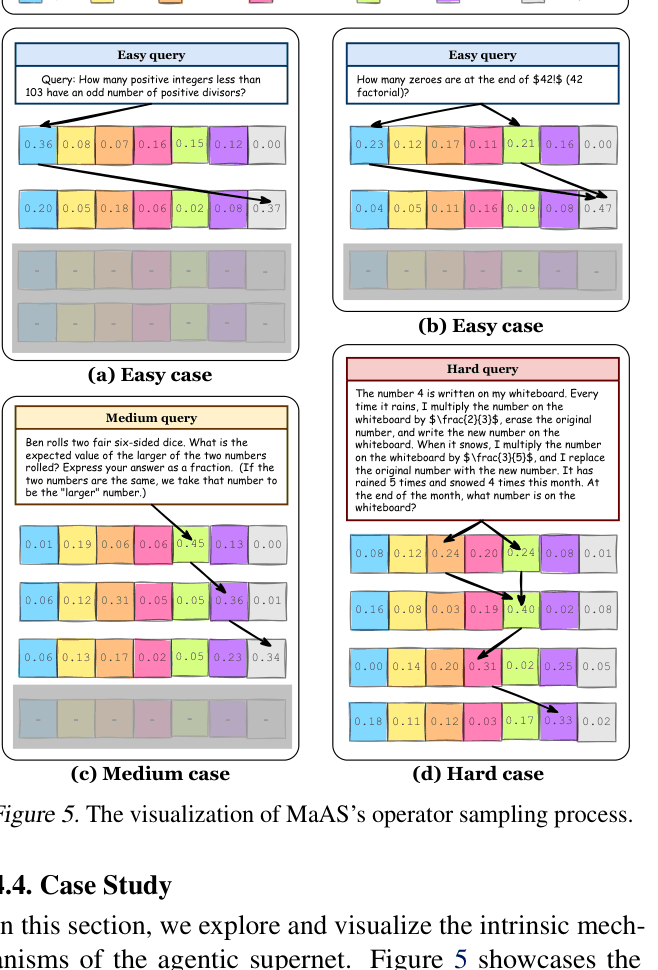
- Introduces a controller that inspects the query difficulty and samples a custom multi-agent topology (e.g., simple I/O for easy tasks, multi-turn debate for hard ones) per instance
- Optimizes discrete agent components (prompts, tools) using textual gradients while optimizing architecture probabilities using differentiable sampling
Architecture
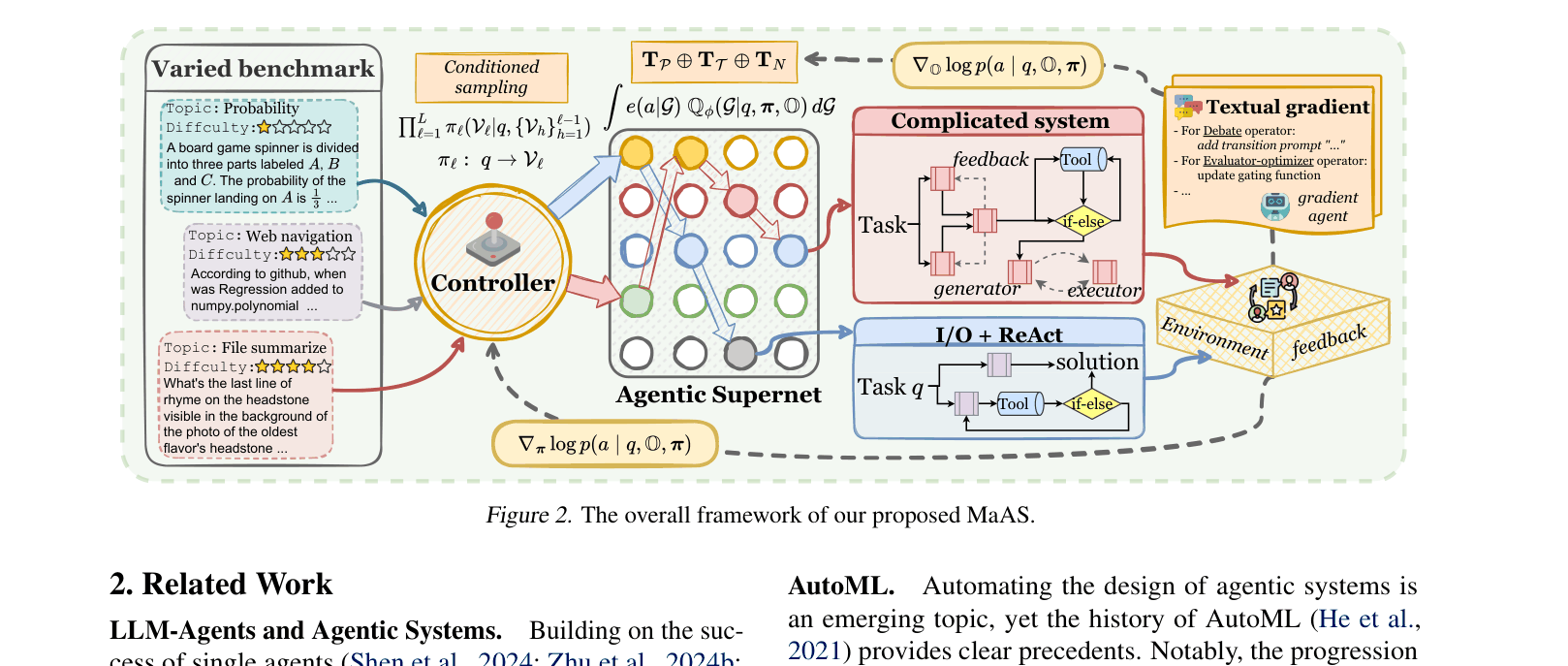
The overall framework of MaAS, showing how a query is processed by a controller to sample a subnetwork from the agentic supernet.
Evaluation Highlights
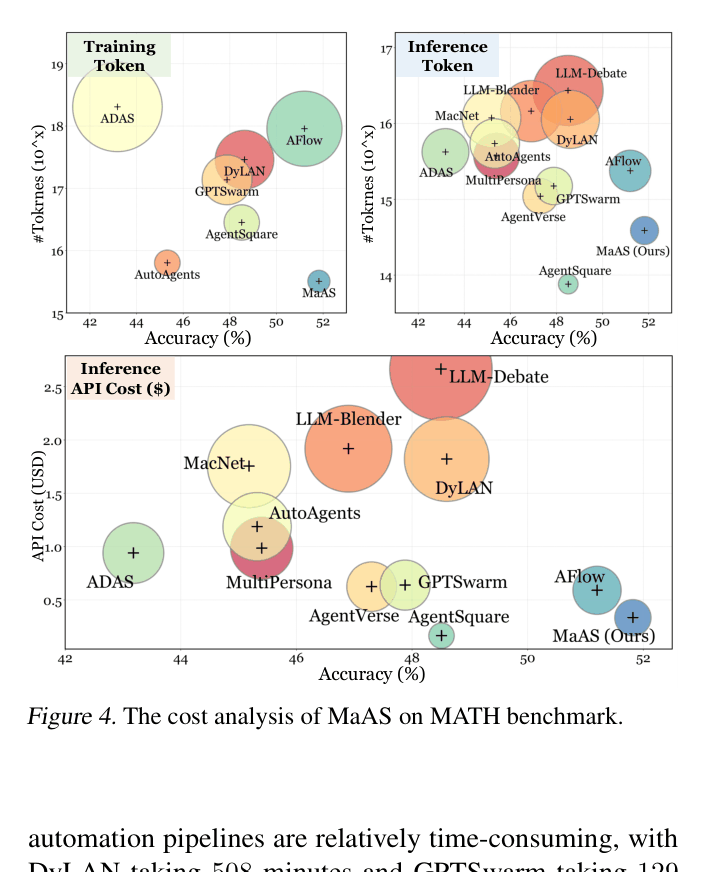
- Achieves 51.82% accuracy on MATH benchmark with only $0.42 inference cost, compared to AFlow's 51.28% accuracy at $1.66 cost (approx. 4x cheaper)
- Outperforms state-of-the-art automated methods by 0.54% to 16.89% across six benchmarks including HumanEval and GSM8K
- Reduces training costs significantly: optimizes in 53 minutes for $3.38 on MATH, whereas comparable baseline AFlow requires 184 minutes and $22.50
Breakthrough Assessment
8/10
Significantly advances automated agent design by solving the efficiency vs. performance trade-off. The concept of an 'agentic supernet' with dynamic routing is a strong conceptual leap over static graph search.