📝 Paper Summary
Agentic Recommender Systems
Multi-Agent Systems
Collaborative Filtering
MACF instantiates similar users and relevant items as interacting LLM agents to perform collaborative filtering through natural language discussion and dynamic orchestration.
Core Problem
Existing agentic recommenders use generic roles or single-agent loops that fail to effectively leverage the strong collaborative signals found in user-item interaction histories.
Why it matters:
- Current agentic systems treat history merely as context prompts, missing the structural benefits of neighborhood-based collaborative filtering
- Generic multi-agent roles (e.g., 'planner', 'critic') are loosely tied to actual preference data sources like similar users
- Single-agent systems struggle to draw on diverse preference signals from correlated items and similar users simultaneously
Concrete Example:
A user asks for 'lightweight running shoes'. A standard agent might just search item descriptions. A MACF system instantiates an agent representing a similar user who liked 'Shoe X' for marathons and an agent representing 'Shoe Y' (a past purchase) to debate if 'Shoe X' fits the current 'lightweight' constraint based on their profiles.
Key Novelty
Multi-Agent Collaborative Filtering (MACF)
- Analogizes Traditional CF to Multi-Agent Systems: Instead of mathematical vector aggregation, MACF uses 'User Agents' (representing similar users) and 'Item Agents' (representing history items) to debate recommendations
- Dynamic Orchestration: A central Orchestrator agent dynamically recruits specific agents and issues personalized instructions round-by-round to resolve uncertainty or conflicts
Architecture
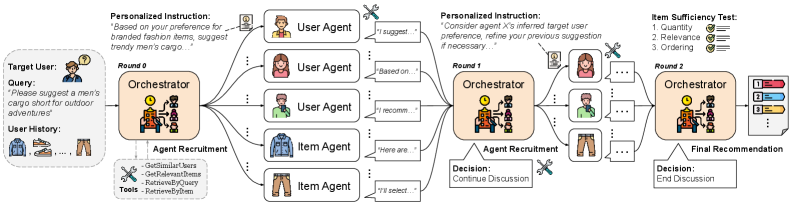
Conceptual framework of MACF contrasting it with traditional CF. Shows the instantiation of User Agents from similar users and Item Agents from history items, all managed by an Orchestrator.
Evaluation Highlights
- Achieves best Hit Rate@10 on Amazon Clothing, Beauty, and Music datasets compared to strong agentic baselines like ReAct and MACRec
- Outperforms traditional Collaborative Filtering (ItemCF, UserCF) and retrieval baselines (BM25, BGE-M3) across all three domains
- Ablation studies confirm that both 'User Agents' and 'Item Agents' contribute to performance, with the combined MACF approach yielding the highest consistency
Breakthrough Assessment
7/10
Clever conceptual mapping of CF neighbors to LLM agents. While computationally expensive, it successfully bridges the gap between classic collaborative filtering principles and modern agentic reasoning.