📝 Paper Summary
LLM-based Network Control
Agentic AI for Telecom
Self-organizing Networks (SON)
AgentRAN replaces static 6G network controllers with a hierarchy of LLM-powered agents that coordinate via natural language to autonomously execute high-level operator intents across different timescales and layers.
Core Problem
Cellular networks rely on static configurations and manual parameter tuning, making them slow to adapt to changing conditions or complex operator intents like 'prioritize emergency traffic'.
Why it matters:
- Manual reconfiguration is error-prone and cannot scale to the complexity of 6G disaggregated networks
- Existing AI-RAN approaches use fixed objectives and static architectures, requiring retraining if goals change
- Current programmable RAN interfaces (O-RAN) specify *how* to communicate but lack a standard for *what* intelligent agents should communicate to coordinate effectively
Concrete Example:
An operator wants to 'prioritize emergency sensor traffic over broadband users.' Today, engineers must manually calculate and adjust scheduling weights, power targets, and resource blocks across dozens of nodes. In AgentRAN, the operator types this intent, and agents autonomously negotiate sub-intents (e.g., 'increase MTC power', 'throttle broadband') to achieve it.
Key Novelty
Hierarchical Natural Language Agent Fabric
- Decomposes network control into a hierarchy of LLM agents (L1/L2/L3) that communicate strictly via standardized Natural Language (NL) intents and status reports
- Introduces the 'AI-RAN Factory,' a closed-loop system that continuously monitors agent performance and automatically generates, distills, or fine-tunes new agents when data distribution shifts occur
- Uses In-Context Learning (ICL) to bootstrap control logic immediately without network-specific pre-training, enabling 'day-zero' deployment
Architecture

High-level architecture of AgentRAN showing the hierarchy of agents and their mapping to O-RAN components
Evaluation Highlights
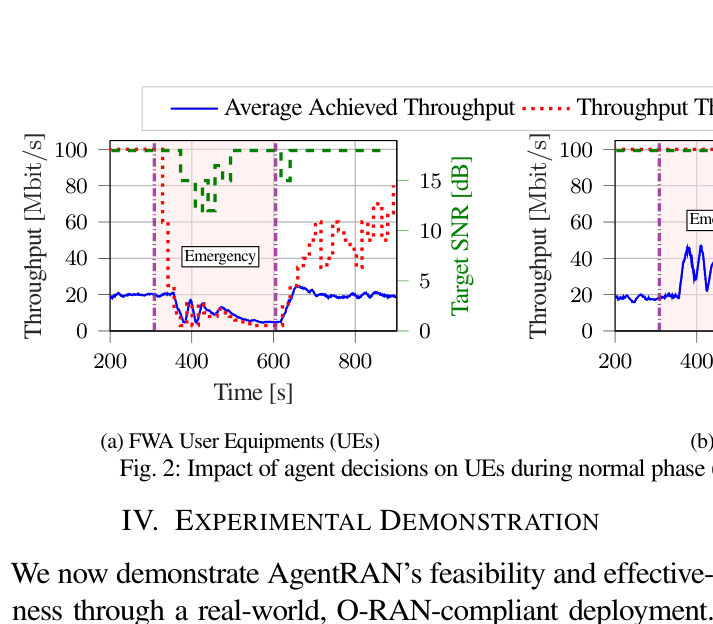
- Demonstrated real-time adaptation: Agents dynamically throttled broadband users to secure ~30-40 Mbit/s for emergency sensors solely from NL intent
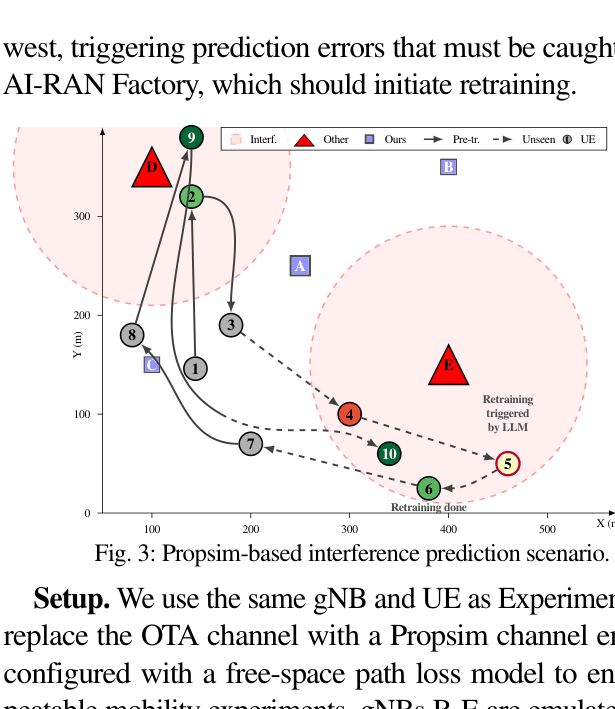
- Validated self-improvement: AI-RAN Factory autonomously detected a drop in interference prediction accuracy (from 97% to 43%) due to mobility shift and triggered retraining to restore ~95% accuracy
- Achieved ~200mW power savings for MTC devices by autonomously interpreting a 'save battery' post-emergency intent
Breakthrough Assessment
8/10
Strong proof-of-concept for LLM-driven control in real physical systems (5G RAN). The hierarchical decomposition and self-improving factory are significant architectural advances over single-agent optimization.