📝 Paper Summary
Multi-agent
Agent interoperability
Agentic infrastructure
The paper argues for 'Web of Agents', a minimalist architectural framework using existing web standards (HTTP, JSON) to enable interoperability between fragmented agentic AI ecosystems.
Core Problem
The agentic AI landscape is fragmenting into incompatible silos (e.g., Google's A2A, Anthropic's MCP) with distinct protocols, preventing agents from different ecosystems from collaborating.
Why it matters:
- Fragmentation imposes engineering overheads, forcing developers to reimplement agents for each ecosystem or build brittle translation layers
- Lack of interoperability leads to vendor lock-in, limiting user choice and stifling the innovation that comes from open, composable systems
- Security risks increase when relying on complex, non-standard translation layers rather than audited, common web protocols
Concrete Example:
A travel-booking agent developed by an airline using one protocol (e.g., A2A) cannot be invoked by a calendar agent running on a different ecosystem (e.g., MCP), preventing a seamless 'book flight based on my schedule' workflow.
Key Novelty
Web of Agents (Architectural Blueprint)
- Proposes reusing existing, battle-tested web standards (HTTP methods, Cookies, URLs) for agent coordination instead of inventing new, heavy protocols
- Introduces 'Interaction Documents'—flexible, self-describing manifests accessible via HTTP—allowing agents to dynamically discover and understand each other's capabilities without rigid schemas
Architecture
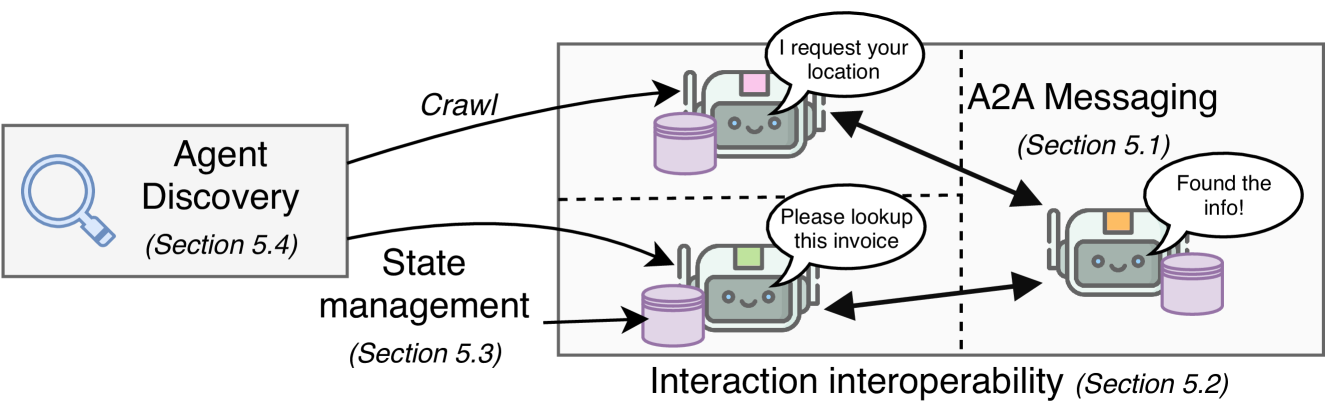
The 'Web of Agents' architectural blueprint, illustrating how agents interact using standard web technologies.
Breakthrough Assessment
7/10
A strong position paper advocating for a pragmatic shift in agent design. While it lacks empirical experiments, its proposal to align agents with HTTP/Web architecture could fundamentally solve the looming fragmentation crisis.