📝 Paper Summary
Materials Discovery
Generative Models for Science
Agentic AI Systems
MOFGen is a multi-agent AI system that autonomously designs, filters, and experimentally synthesizes novel Metal-Organic Frameworks by chaining LLMs, diffusion models, and quantum mechanical verification.
Core Problem
Generative models can propose millions of theoretically stable materials, but most are impossible or prohibitively expensive to synthesize in the real world.
Why it matters:
- Vast chemical spaces remain unexplored because trial-and-error synthesis is labor-intensive and costly
- A huge gap exists between computational stability (DFT) and experimental realizability; few AI-predicted crystals are ever made
- Accelerating MOF discovery is critical for urgent global challenges like carbon capture and water harvesting
Concrete Example:
A standard generative model might output a chemically valid crystal structure that requires unstable precursors or impossible reaction conditions. MOFGen avoids this by using a dedicated agent (SynthABLE) to decompose the structure and verify that its organic linkers are synthesizable before attempting experimentation.
Key Novelty
MOFGen (Agentic System for MOF Discovery)
- Decomposes materials discovery into specialized agents: an LLM for chemical logic, a diffusion model for 3D structure generation, and physics/ML agents for stability and synthesis verification
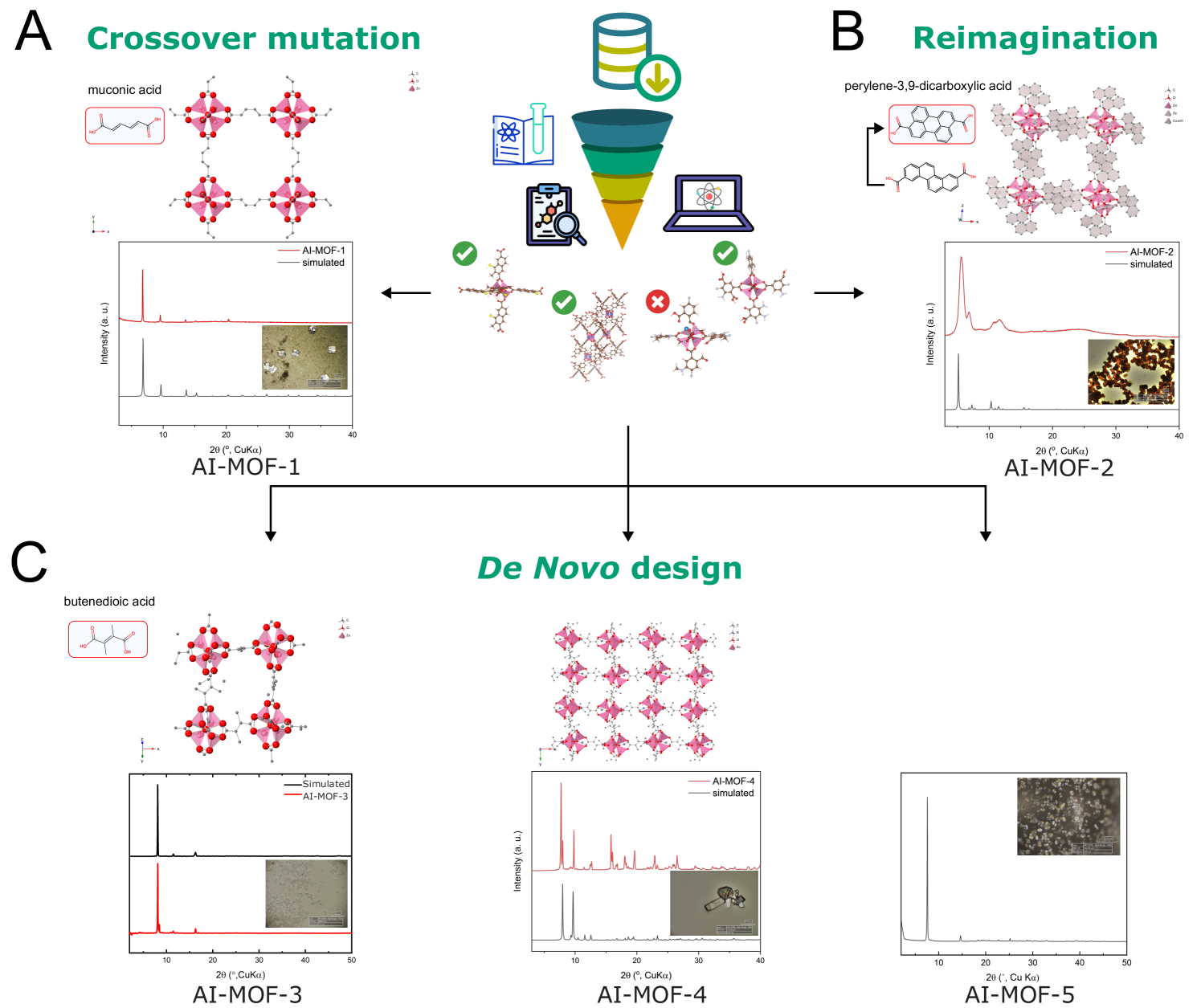
- Integrates 'reimagination synthesis' where AI drafts are refined by human experts, and 'de novo synthesis' where the system designs entirely new linkers verified by robotic experimentation
Architecture
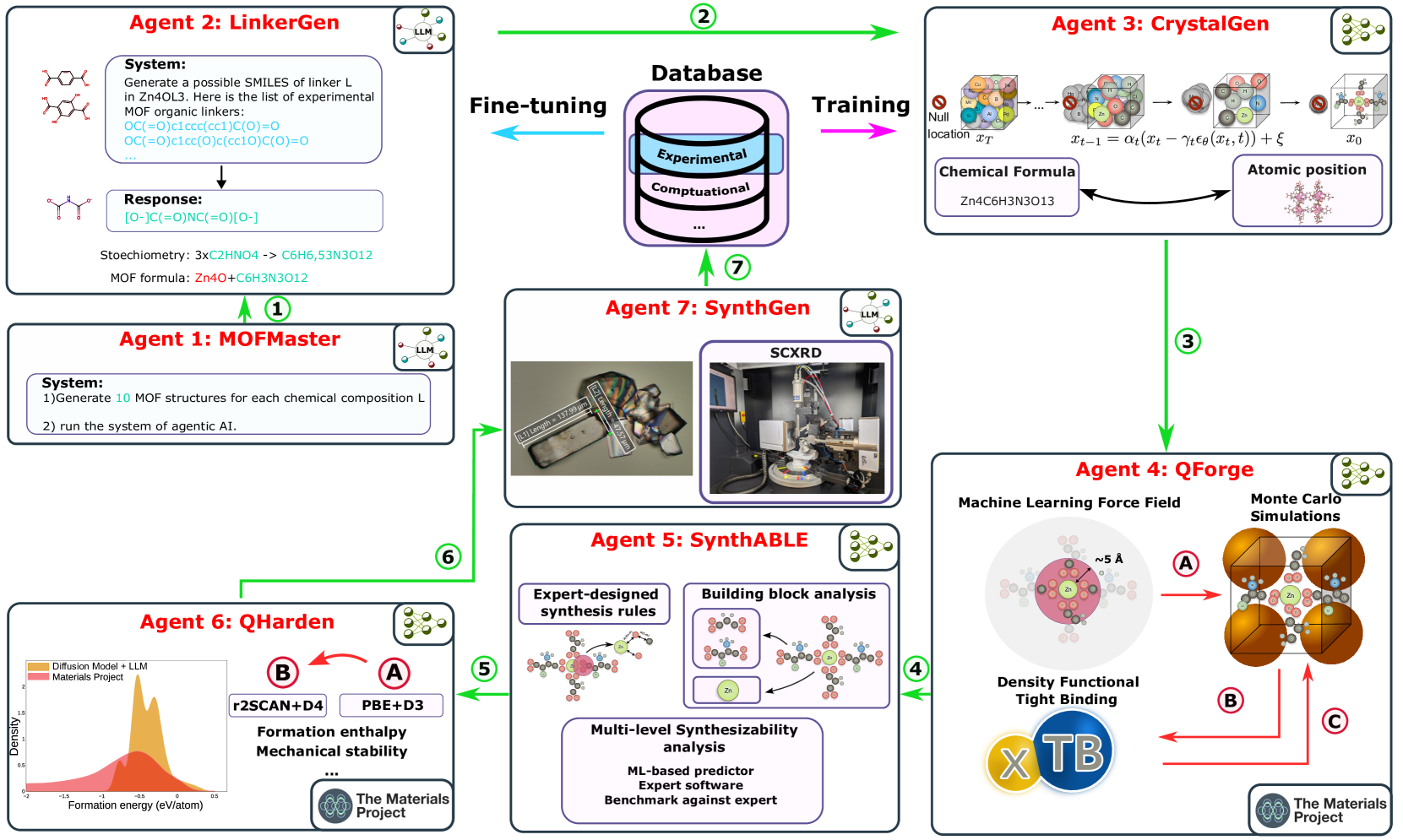
The modular architecture of MOFGen, showing the flow from LLM instruction to physical synthesis.
Evaluation Highlights
- Successfully synthesized 5 novel 'AI-dreamt' MOFs, including structures with unique coordination modes never before reported for Zinc SBUs
- Generated a database of 259,559 predicted MOF structures, with 3,000 highly accurate DFT-optimized candidates
- Identified ~50,000 viable organic linkers, surpassing the number of all historically reported linkers
Breakthrough Assessment
9/10
Achieves the 'holy grail' of materials informatics: closing the loop from generative AI prediction to successful experimental synthesis of multiple novel materials.