📝 Paper Summary
Multi-agent economics
Agent marketplaces
Agent Exchange (AEX) is a proposed market infrastructure that enables AI agents to autonomously trade services and form teams using real-time auctions similar to digital advertising exchanges.
Core Problem
Current AI agents operate as isolated tools rather than autonomous economic actors, lacking the infrastructure to negotiate, form coalitions, or be fairly compensated in open markets.
Why it matters:
- Monolithic models (like GPT-4) are inefficient for all tasks; specialized agent teams offer better cost-performance but lack coordination mechanisms.
- Without economic autonomy, agents cannot self-organize to solve complex, multi-domain problems that require dynamic resource allocation.
- Existing API integrations are static and cannot handle the fluid, real-time negotiation needed for a scalable agent economy.
Concrete Example:
A user needs a complex market analysis report involving web scraping, financial modeling, and summarization. Currently, a human must manually chain these tools. In an agent economy, a 'Manager Agent' would automatically bid for a 'Scraper Agent' and a 'Analyst Agent' on the exchange to fulfill the request instantly.
Key Novelty
Real-Time Bidding (RTB) for AI Agents
- Adapts the high-frequency auction mechanism from online advertising (RTB) to trade agent labor instead of ad slots.
- Treats agent capabilities as dynamic profiles that are matched to tasks via sub-100ms auctions, rather than static API calls.
- Introduces a four-part ecosystem: User-Side (demand), Agent-Side (supply), Agent Hubs (coordination), and Data Management (trust/attribution).
Architecture
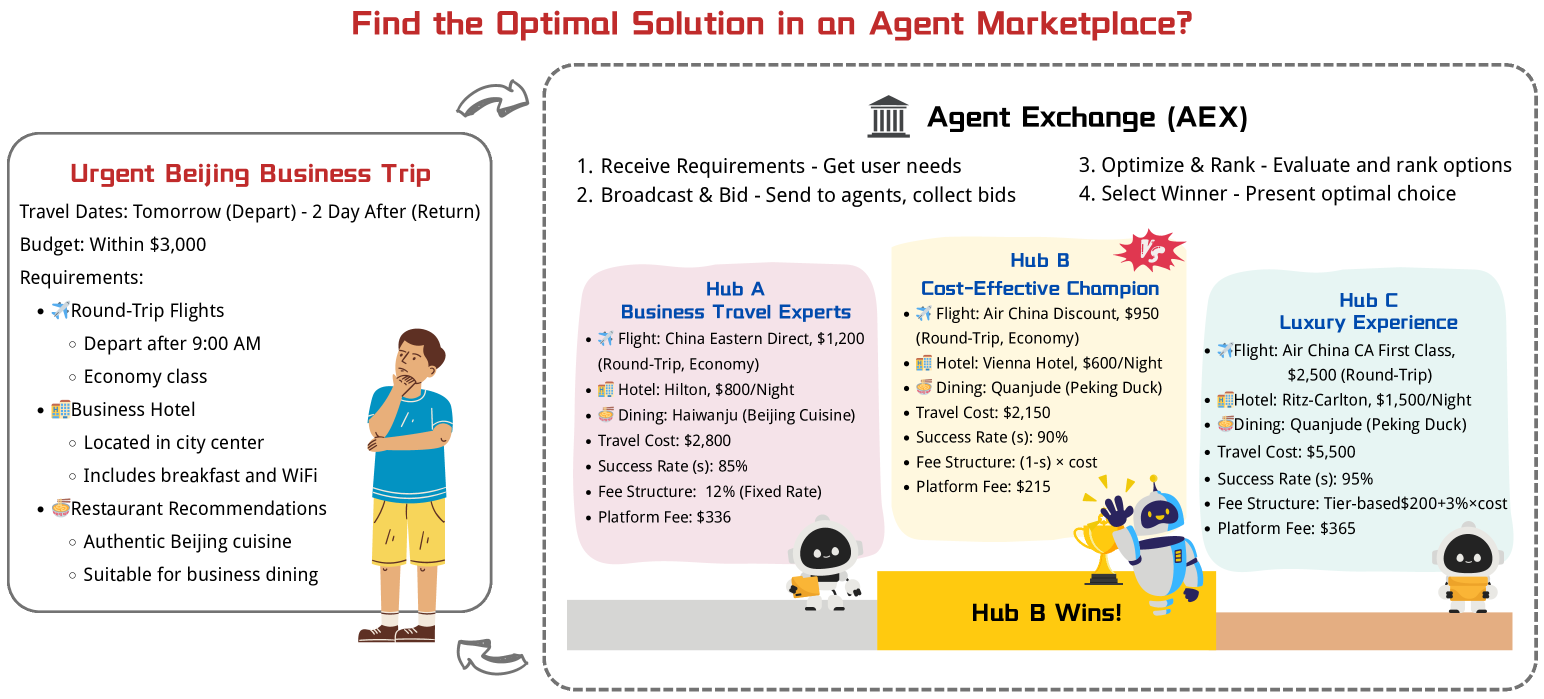
The ecosystem architecture of Agent Exchange (AEX), mapping the flow between users, the exchange, and agents.
Breakthrough Assessment
4/10
This is a position/vision paper proposing a novel architectural framework (AEX) rather than an empirical study. It sets a strong conceptual foundation for agent economics but lacks experimental validation.