📝 Paper Summary
Multi-agent
Scientific Discovery
ChatBattery is a multi-agent system that integrates expert domain knowledge into LLM reasoning to discover, synthesize, and experimentally validate high-performance battery cathode materials.
Core Problem
Applying Large Language Models (LLMs) to specialized domains like battery discovery is difficult because general models produce unreliable reasoning traces and lack access to expensive, verifiable domain datasets.
Why it matters:
- Developing better battery materials is critical for electric vehicles and climate change mitigation, but traditional trial-and-error methods are slow and costly
- Current AI for materials focuses on geometric deep learning or automation agents, often neglecting the reasoning capabilities required for hypothesis generation
- Existing Large Reasoning Models (LRMs) like OpenAI o1 often fail in specialized scientific domains due to a lack of grounded expert guidance
Concrete Example:
When asking a standard LLM to optimize a cathode material like NMC811, it might suggest chemically unstable formulas or invalid charge balances. ChatBattery uses a Decision Agent to reject low-capacity candidates and a Retrieval Agent to fetch valid, similar compounds to guide the next attempt.
Key Novelty
ChatBattery: Expert-Guided Multi-Agent Framework
- Decomposes materials discovery into Exploration (generating hypotheses) and Exploitation (filtering and ranking), managed by seven specialized agents (Search, Decision, Rank, etc.)
- Integrates domain-specific rules (charge balance, structural complexity) directly into the reasoning loop to steer LLMs away from scientifically invalid hallucinations
- Achieves a full closed-loop discovery process: from initial AI hypothesis generation to actual wet-lab synthesis and characterization of new materials
Architecture
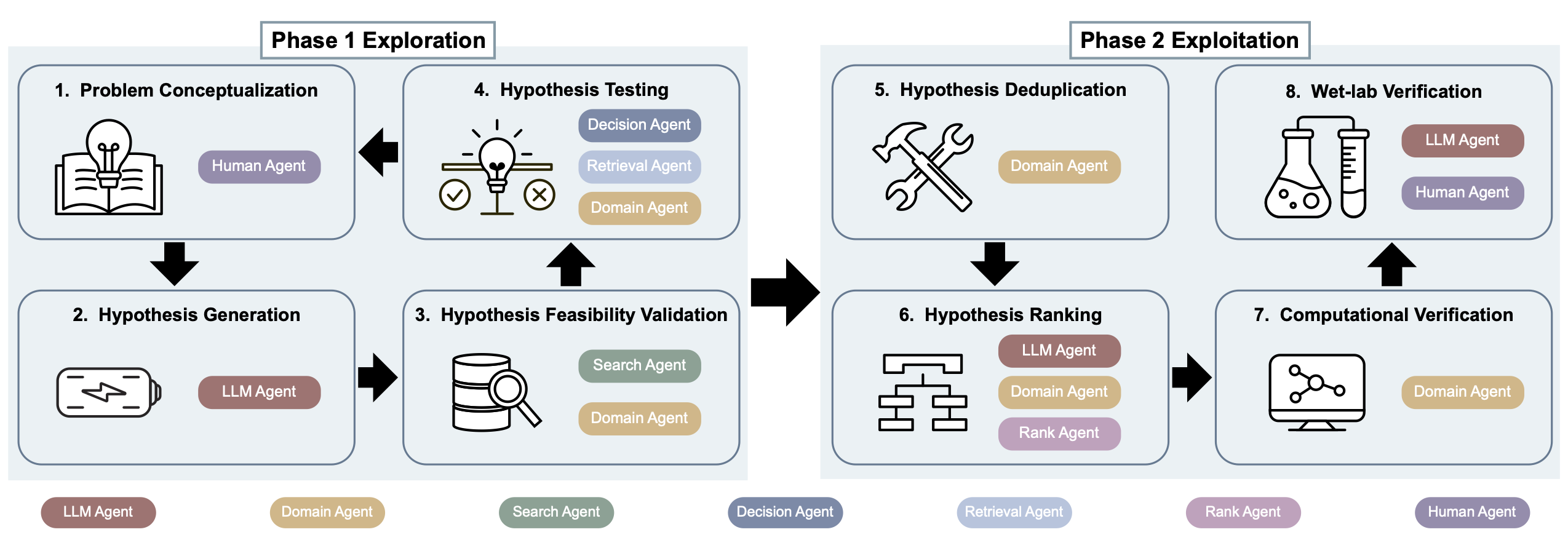
The ChatBattery workflow, divided into Exploration and Exploitation phases, showing the interaction between the seven agents.
Evaluation Highlights
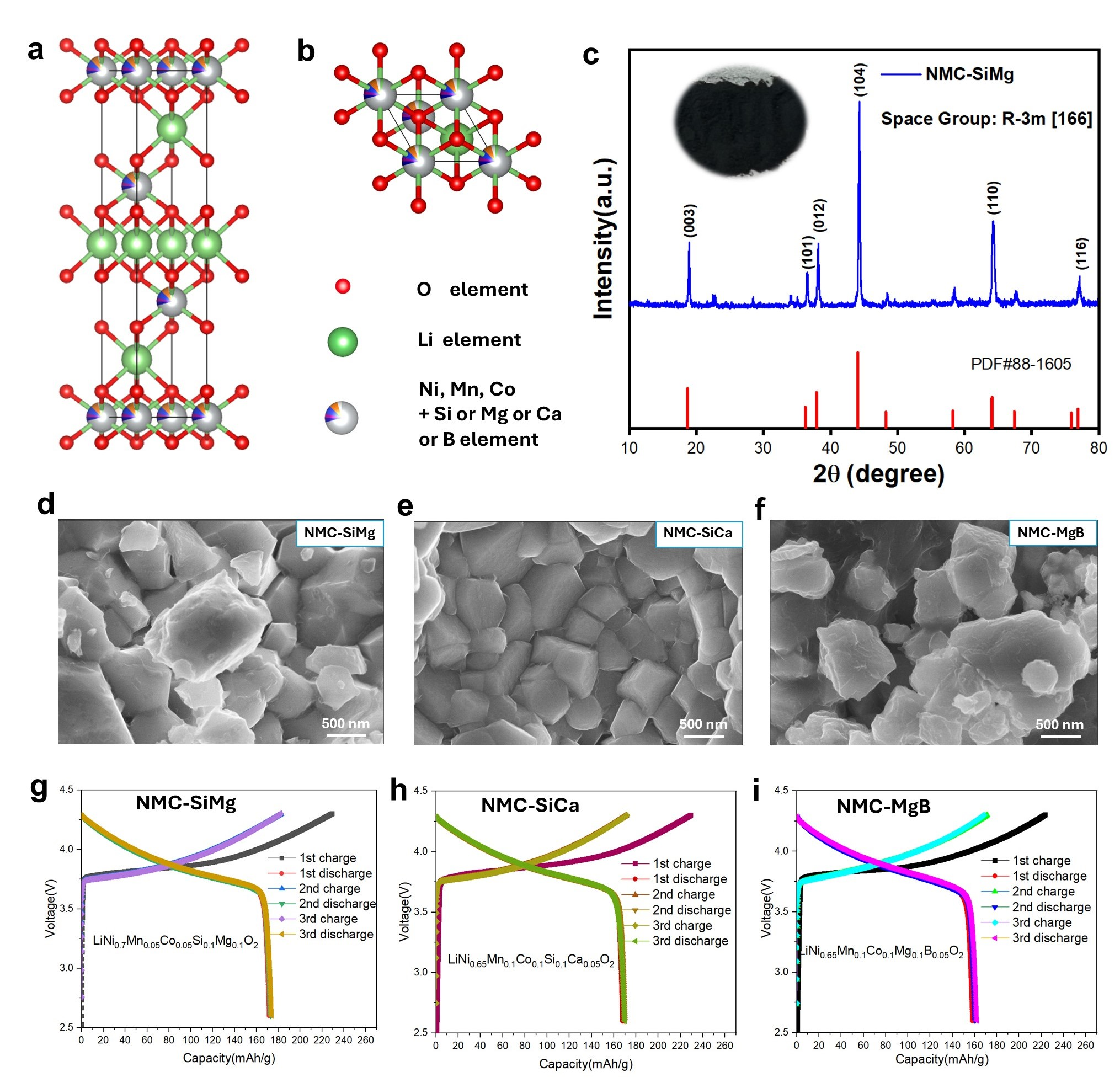
- Successfully synthesized three novel cathode materials (NMC-SiMg, NMC-SiCa, NMC-MgB) derived from the industry-standard NMC811
- Achieved a 28.8% capacity improvement with NMC-SiMg (174 mAh/g) compared to the NMC811 baseline (135 mAh/g) by the third cycle
- All three AI-designed candidates demonstrated higher average discharge voltage (~3.85 V) compared to conventional cathodes (3.4–3.7 V)
Breakthrough Assessment
9/10
Rare example of AI-driven scientific discovery that goes beyond simulation to actual wet-lab synthesis and verification of superior materials. Demonstrates real-world utility of reasoning agents.