📝 Paper Summary
Knowledge-aware Recommendation
Graph Neural Networks (GNNs)
Long-tail Recommendation
SPARK improves recommendation for long-tail items by denoising knowledge graphs via tensor decomposition and fusing representations from both Euclidean and Hyperbolic spaces based on item popularity.
Core Problem
Knowledge-enhanced recommender systems struggle with noisy knowledge graphs and fail to adequately represent sparse, long-tail items due to the limitations of Euclidean geometry.
Why it matters:
- Real-world knowledge graphs are inherently noisy and have power-law distributions, meaning most entities have few connections, leading to poor learning for the 'long tail'.
- Standard Euclidean models cannot effectively capture the hierarchical structures often found in user-item interactions and knowledge graphs.
- Existing methods lack mechanisms to adaptively balance collaborative signals (good for popular items) with semantic knowledge (crucial for rare items).
Concrete Example:
A rare book with few user interactions might be recommended poorly by standard collaborative filtering. Even with a KG, if the KG has noisy links, the book's embedding is corrupted. Furthermore, a Euclidean model might fail to capture the book's niche sub-genre hierarchy, treating it equidistantly to unrelated popular books.
Key Novelty
Multi-stage Hybrid Geometry Framework
- Uses low-rank Tucker tensor decomposition to 'clean' the Knowledge Graph before use, creating robust initial entity embeddings resistant to noise.
- Simultaneously learns item representations in both Euclidean space (for global popularity trends) and Hyperbolic space (for hierarchies and long-tail semantics).
- Dynamically weights these signals based on item popularity: popular items rely more on Euclidean/collaborative signals, while rare items rely more on Hyperbolic/KG signals.
Architecture
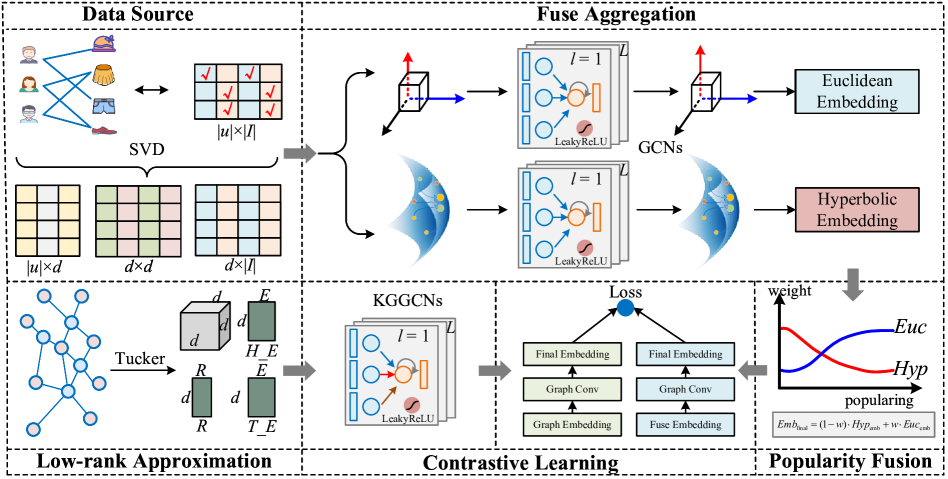
The overall SPARK framework, detailing the flow from KG preprocessing to the dual-space GNNs and final fusion.
Evaluation Highlights
- Outperforms state-of-the-art baselines on Amazon-Book by up to +10.8% in Recall@10.
- Achieves significant gains on Alibaba-iFashion and Yelp2018 datasets, particularly for long-tail item recommendation.
- Ablation studies confirm that removing the Hyperbolic pathway or the Tucker decomposition significantly degrades performance, validating their specific roles.
Breakthrough Assessment
7/10
Strong combination of existing advanced techniques (Tucker decomposition, Hyperbolic GNNs) into a cohesive, logically sound framework that effectively addresses a specific pain point (long-tail KG recommendation). While the components aren't individually new, their integration and the popularity-aware fusion are well-motivated.