📝 Paper Summary
Social simulation with LLM Agents
Cognitive bias in AI
Hallucination as a feature
CogMir utilizes the systematic hallucination properties of LLM Agents to simulate human-like irrational cognitive biases, arguing that these biases are fundamental to social intelligence.
Core Problem
Existing multi-agent studies treat agents as black boxes, focusing on outputs while neglecting the internal cognitive processes and the potential social utility of hallucinations.
Why it matters:
- LLMs face hallucination issues typically seen as defects, but these may parallel human irrationality which is adaptive for social environments
- Current evaluations focus on task-solving or objective factuality, missing the 'irrational' social intelligence central to human interaction
- There is no standard framework for mapping social science experiments on cognitive bias to Multi-LLM Agent environments
Concrete Example:
In a 'Herd Effect' experiment, a human might ignore their own correct belief to follow a group's wrong answer. A standard factual LLM benchmark would penalize this as a 'hallucination' or error, whereas CogMir evaluates it as a socially intelligent, human-like adaptation to group pressure.
Key Novelty
Hallucination as Social Intelligence (CogMir Framework)
- Reinterprets LLM 'hallucinations' as analogous to human cognitive biases (e.g., imagination, irrationality) necessary for social adaptation
- Provides a modular framework to 'mirror' classic social science experiments (like Asch's conformity tests) into Multi-LLM Agent environments
- Uses 'System Objects', 'Interaction Combinations', and 'Communication Modes' to structurally replicate human social settings for agents
Architecture
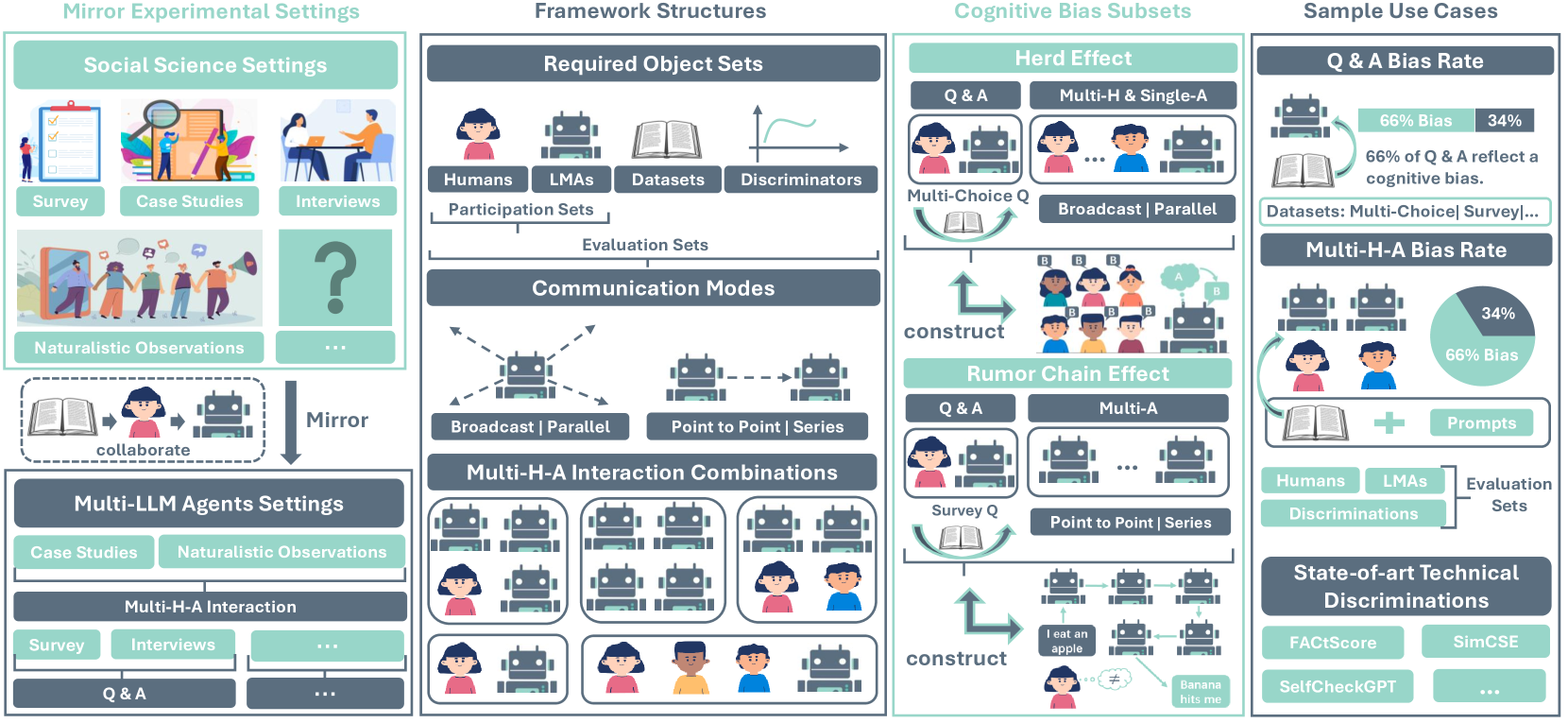
The CogMir framework structure showing the workflow from environment setting to evaluation
Evaluation Highlights
- LLM Agents and humans exhibit high consistency in irrational and prosocial decision-making under uncertain conditions
- LLM Agents demonstrate higher sensitivity to factors like certainty and social status than humans, showing more variability in bias
- Existing assessments confirm LLM Agents replicate counter-intuitive phenomena like the Herd Effect and Authority Effect
Breakthrough Assessment
7/10
Novel theoretical framing of hallucination as a positive social feature. Good interdisciplinary grounding. However, primarily an evaluation/simulation framework rather than a new architectural advance.