📝 Paper Summary
Hallucination suppression
Synthetic data for alignment
SYNTRA reduces hallucination on hard-to-evaluate realistic tasks by optimizing system message prompts on a synthetic retrieval task where hallucination is easy to measure.
Core Problem
Optimizing LLMs to reduce hallucination on realistic tasks (like clinical reporting) is intractable because evaluating hallucination during training is expensive, slow, and error-prone.
Why it matters:
- LLMs frequently fabricate entities and details even when necessary information is in context (e.g., medical reports, meeting summaries).
- Current methods cannot efficiently evaluate hallucination at every optimization step (gradient descent), making direct optimization against hallucination impossible for real-world tasks.
Concrete Example:
If an LLM generates the fictional term 'fixed liability response' while summarizing a meeting, rule-based verifiers cannot easily catch it, and human checking is too slow for training loops.
Key Novelty
SYNTRA (Synthetic Transfer)
- Designs a synthetic task (retrieving names from a list) where hallucination is mechanically easy to detect (is the output name in the input list?).
- Optimizes the LLM's system message (via prefix-tuning) on this synthetic task to reduce hallucination.
- Transfers the learned system message to realistic, hard-to-optimize tasks like clinical report generation.
Architecture
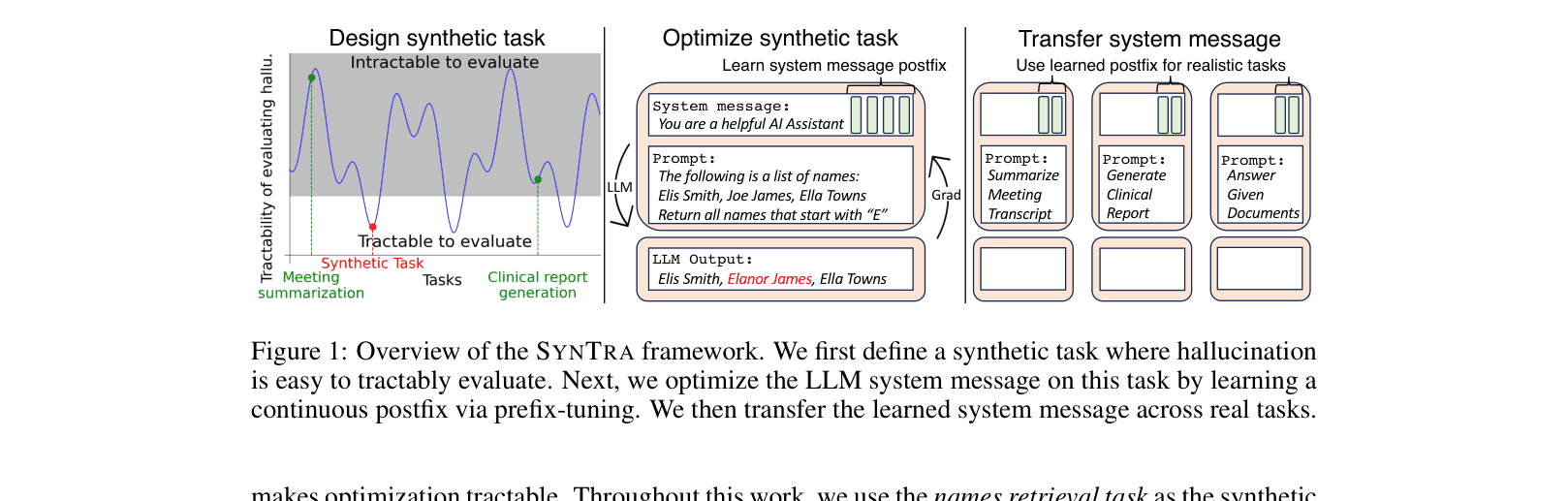
Overview of the SYNTRA framework pipeline.
Evaluation Highlights
- Reduces hallucination rate by over 16 percentage points on the ACI-Bench clinical report task using Orca 13B.
- Reduces ungrounded entities by 36.5% on ACI-Bench using Vicuna 13B, while preserving grounded entities.
- Outperforms full model fine-tuning on the synthetic task, which counterintuitively increases hallucination on Orca.
Breakthrough Assessment
7/10
Novel approach using synthetic tasks as a proxy for transferable anti-hallucination behavior. Strong empirical results on specific tasks, but relies on the assumption that 'hallucination behavior' transfers universally.