📝 Paper Summary
Hallucination Detection
Internal State Analysis
MIND is an unsupervised framework that detects hallucinations in real-time by training a simple classifier on the LLM's internal hidden states, using automatically generated pseudo-labels from Wikipedia truncations.
Core Problem
Existing hallucination detection methods rely on computationally expensive post-processing or require extensive human-annotated data, making them unsuitable for real-time applications or rapid model updates.
Why it matters:
- Post-processing methods (like checking consistency or using a second LLM) add significant latency and cost, often doubling inference time
- Supervised methods require expensive manual annotations that become obsolete as LLMs evolve rapidly
- Current benchmarks often lack the internal state data needed to analyze *why* hallucinations occur during generation
Concrete Example:
When an LLM is asked to complete a truncated Wikipedia article about a specific entity, it might generate a coherent but factually wrong continuation. Post-processing methods would need to retrieve external evidence or re-query the model to catch this, whereas MIND detects it instantly from the hidden states of the generated tokens.
Key Novelty
Unsupervised Modeling of Internal States (MIND)
- Generates pseudo-labeled training data automatically by truncating Wikipedia articles and checking if the LLM can correctly reproduce the known next entity
- trains a lightweight Multi-Layer Perceptron (MLP) directly on the LLM's contextualized embeddings (hidden states) to classify generation steps as hallucination or not
- Operates in real-time during the inference process without needing external reference documents or separate verification models
Architecture
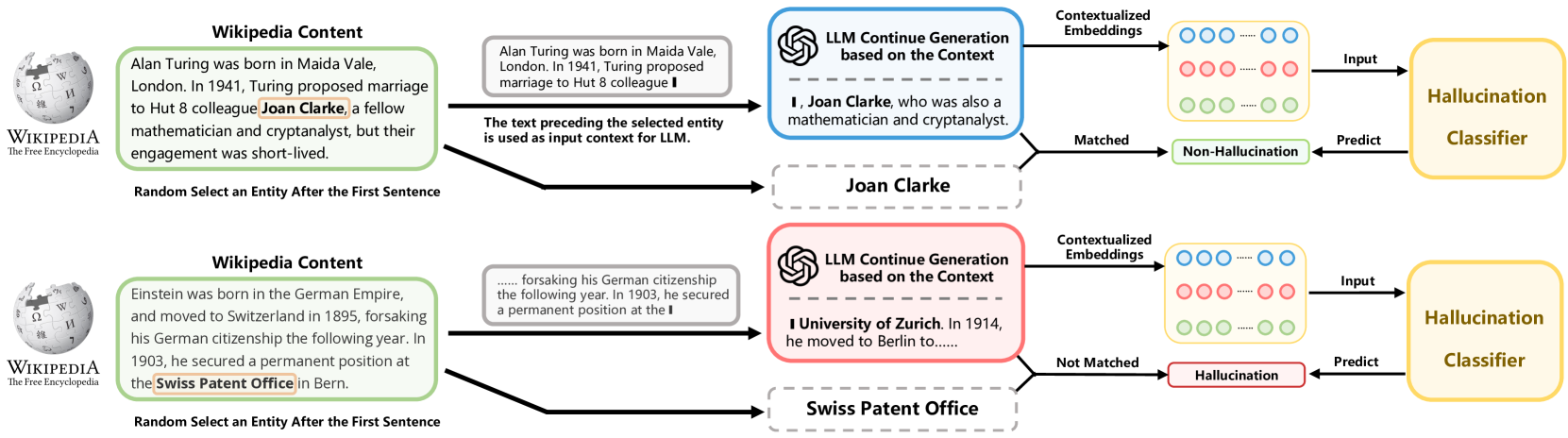
The automatic data generation and training pipeline for MIND.
Evaluation Highlights
- MIND outperforms existing state-of-the-art methods in hallucination detection accuracy (specific metric values not in snippet, but qualitative claim is explicit)
- Proves that a simple MLP using only the last token's embedding from the final layer is sufficient to distinguish hallucinations
- Introduces HELM, a benchmark providing internal states (embeddings, attentions) for six different LLMs alongside human-annotated outputs
Breakthrough Assessment
7/10
Offers a practical, unsupervised solution to a major LLM reliability problem. The shift from post-hoc verification to real-time internal state monitoring is significant, though reliance on Wikipedia for training data is a common heuristic.