📝 Paper Summary
Multi-agent
Agentic RAG pipeline
MedAide is a medical collaboration framework that combines syntactic regularization for query decomposition, dynamic intent matching, and a rotating multi-agent mechanism to improve clinical reasoning.
Core Problem
General LLMs struggle with complex medical queries involving multiple intents and specialized terminology, often leading to hallucinations, information redundancy, and coupling when processing heterogeneous clinical data.
Why it matters:
- Current LLM-based medical assistants lack the sophisticated reasoning needed for real-world diagnosis where integrating diverse information sources is critical
- Existing multi-agent frameworks often focus on limited intents (e.g., education or simple QA) and fail to handle composite medical scenarios requiring systematic recommendations across specialties
Concrete Example:
A patient query might mix symptoms, medication history, and request for rehabilitation advice. Standard LLMs might address only the most obvious symptom or provide generic advice, failing to cross-reference the medication history with the new symptoms to detect potential contraindications.
Key Novelty
Regularization-guided Multi-Agent Collaboration
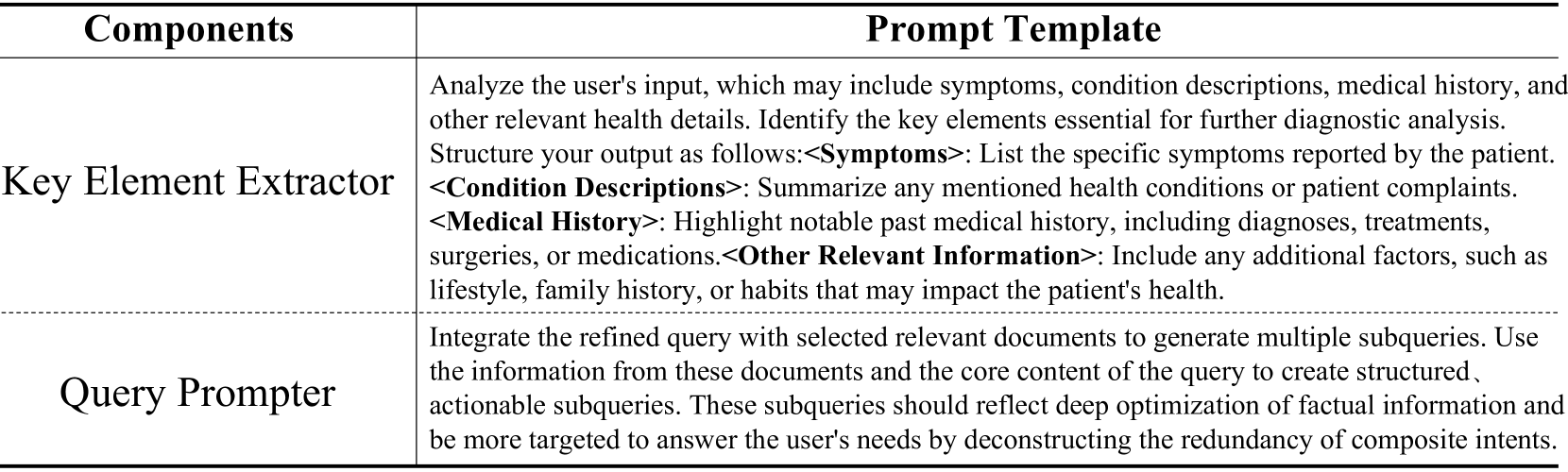
- Uses a syntactic regularization module (Regularization-guided Information Extraction) to decompose complex queries into structured representations before processing
- employs a dynamic Intent Prototype Matching (IPM) system that matches queries to medical intent embeddings to activate the correct specialized agent
- Introduces a Rotation Agent Collaboration (RAC) mechanism where agents (diagnosis, medication, etc.) take turns as the 'main contact' to fuse information via a polling protocol
Architecture
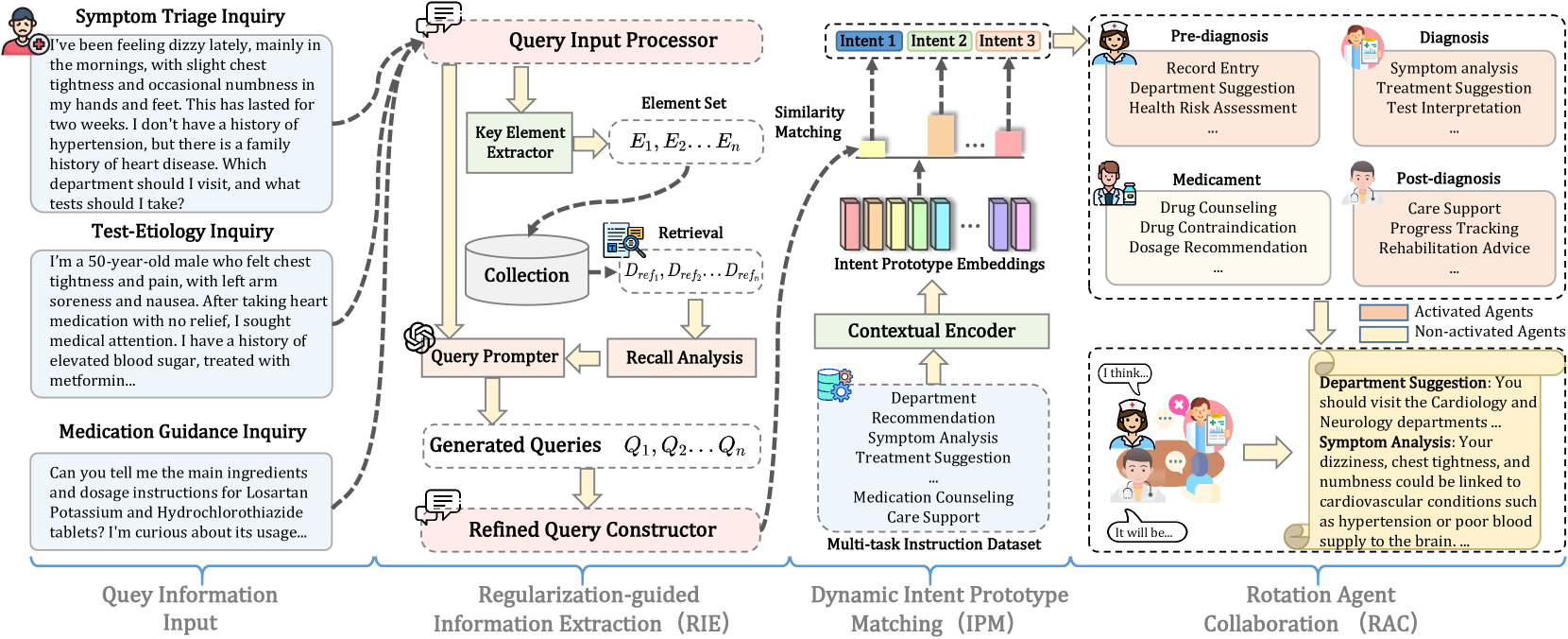
The overall architecture of MedAide, displaying the three main stages: Regularization-guided Information Extraction (RIE), Intent Prototype Matching (IPM), and Rotation Agent Collaboration (RAC).
Evaluation Highlights
- Achieves 87.41% Accuracy on CMD benchmark, outperforming GPT-4 (84.18%) and specialized medical LLMs like HuatuoGPT-II (77.85%)
- Improves BLEU-1 score to 51.64 on the MedDialog dataset, surpassing ChatGPT (48.12%) and Llama-3-70B-Instruct (49.85%)
- Expert evaluation by physicians shows MedAide generates more professional and safer responses compared to baselines (Win/Tie rate of 92% vs HuatuoGPT-II)
Breakthrough Assessment
7/10
Strong structural innovation with the rotation mechanism and regularization module. Demonstrates significant gains over strong baselines like GPT-4 in specialized medical contexts.