📝 Paper Summary
Hallucination suppression
Factuality
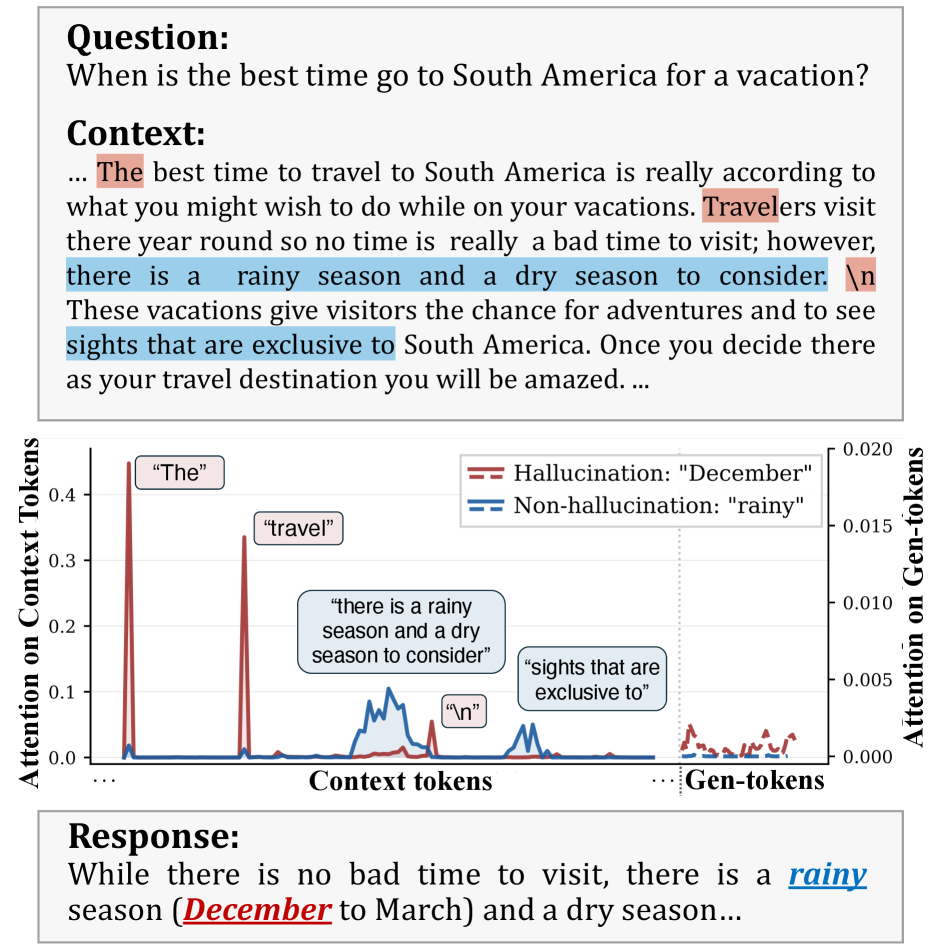
Hallucinated tokens in LLMs exhibit rapid, high-frequency fluctuations in attention weights, which can be detected by treating attention as a discrete signal and extracting high-frequency energy components.
Core Problem
Existing attention-based hallucination detectors rely on coarse summary statistics (like entropy or total mass) that fail to capture the fine-grained sequential instability characteristic of ungrounded generation.
Why it matters:
- Hallucinations in context-based generation (like RAG or summarization) undermine trust in LLM systems expected to be grounded in source material
- Post-hoc verification methods are computationally expensive and do not reflect the model's internal generation dynamics
- Current internal metrics miss the structural 'jaggedness' of attention that signals when a model is confused or ungrounded
Concrete Example:
When LLaMA-2-7B-Chat hallucinates 'December' (not in context), its attention distribution shows sharp, rapid peaks and drops across token positions. A standard entropy metric might look normal, but the signal oscillates wildly compared to the smooth attention of a grounded token.
Key Novelty
Frequency-Aware Attention Analysis
- Treats the sequence of attention weights over context tokens as a discrete time-series signal indexed by token position
- Applies signal processing operators (Fourier Transform, Wavelets, Laplacian) to isolate high-frequency components that represent rapid local changes
- Uses the energy (L2 norm) of these high-frequency components as a feature vector to classify tokens as hallucinated or grounded
Architecture
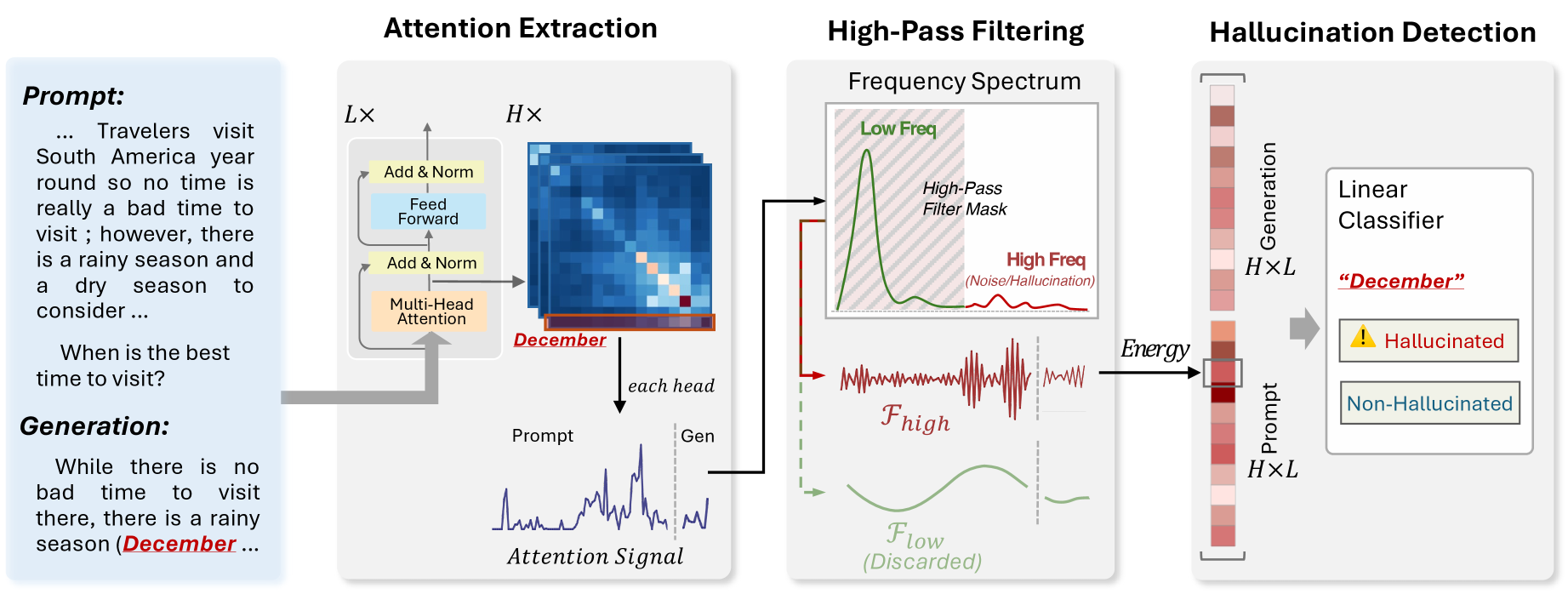
The Frequency-Aware Attention framework pipeline.
Evaluation Highlights
- Fourier-high features improve AUROC by 6.6% over Lookback-Lens on the RAGTruth summarization task with LLaMA-13B
- Consistent gains achieved across 3 models (LLaMA-7B, LLaMA-13B, Mistral-7B) and 2 benchmarks (RAGTruth, HalluRAG)
- Span-level detection improves AUROC by 10.1% on summarization tasks (LLaMA-7B) compared to the strong attention-based baseline Lookback-Lens
Breakthrough Assessment
7/10
Offers a novel, theoretically grounded perspective (signal processing) on attention analysis. While the method is a feature engineering step for a classifier rather than a new architecture, the consistent empirical gains and cross-task robustness are significant.