📝 Paper Summary
Agent Safety and Reliability
Hallucination Detection and Mitigation
This survey proposes a comprehensive taxonomy for hallucinations in LLM-based agents, identifying five distinct types across the agent workflow (Reasoning, Execution, Perception, Memorization, Communication) and reviewing mitigation strategies.
Core Problem
LLM-based agents suffer from hallucinations that are more complex than simple text generation errors, involving multi-step reasoning failures, tool misuse, and incorrect environmental perception.
Why it matters:
- Unlike static LLM hallucinations, agent hallucinations involve 'physically consequential' errors where incorrect actions directly affect real-world task execution and system devices
- Existing surveys focus on Natural Language Generation (NLG) hallucinations (factuality/faithfulness), overlooking the compound errors arising from agent modules like perception, memory, and tool use
- Errors propagate through long chains: a hallucination in reasoning can cascade into execution and memory, compounding over time
Concrete Example:
In a tool-use scenario, an agent might hallucinate a tool call by inventing parameter values that don't exist (Execution Hallucination), or it might correctly select a tool but fail to decompose the user's intent into the necessary sub-steps due to logical fallacies (Reasoning Hallucination).
Key Novelty
Internal-External Decomposition Taxonomy
- Decomposes agent architecture into 'Internal State' (Belief State) and 'External Behaviors' (Reasoning, Execution, Perception, Memorization, Communication)
- Maps specific hallucination types to these workflow stages, distinguishing between cognitive errors (internal) and action/sensory errors (external)
- Identifies 18 specific triggering causes underlying these hallucination types, such as 'Tool Documentation Limitation' or 'Sub-intention Disorder'
Architecture
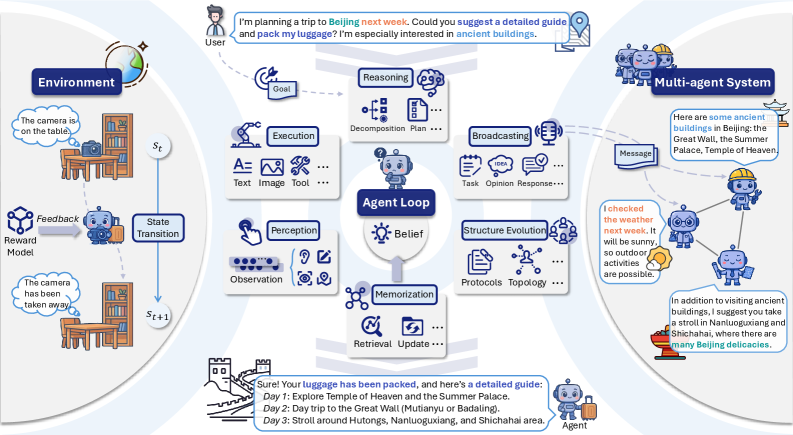
Fig 1 shows the agent interaction loop (POMDP). Fig 2 illustrates the taxonomy of 5 hallucination types mapped to this loop.
Evaluation Highlights
- Identifies 5 major categories of agent hallucinations: Reasoning, Execution, Perception, Memorization, and Communication
- Catalogs 18 distinct triggering causes, including 'Inadequate Subjective Comprehension' and 'Deficient Dependency Modeling'
- Reviews over 200 related papers to summarize mitigation strategies across the agent lifecycle
Breakthrough Assessment
9/10
The first comprehensive survey specifically targeting hallucinations in agents (vs. general LLMs). It provides a crucial structural framework (taxonomy) that will likely define future research in agent safety.