📝 Paper Summary
Code Generation Security
Factuality and Hallucination
The paper characterizes 'package hallucinations'—where code-generating LLMs recommend non-existent software packages—as a critical security threat enabling supply chain attacks, and demonstrates effective mitigation via RAG and fine-tuning.
Core Problem
Code-generating LLMs frequently hallucinate non-existent package names in their output. Attackers can exploit this by publishing malicious packages with these exact names to open-source repositories.
Why it matters:
- Creates a direct vector for 'package confusion attacks' where developers inadvertently install malware recommended by trusted AI tools
- Traditional typosquatting defenses fail because the 'typo' is generated by the user's own tool (the LLM), not the attacker
- Existing research focuses on natural language hallucinations, leaving the specific security implications of code dependency hallucinations underexplored
Concrete Example:
A user asks an LLM for Python code to solve a specific task. The LLM generates code importing a fictitious library `ar-python-tools`. An attacker, having predicted this hallucination, has already published a malicious package named `ar-python-tools` on PyPI. The user runs `pip install ar-python-tools`, compromising their system.
Key Novelty
Systematic Characterization and Mitigation of Package Hallucinations
- Conducts the first large-scale measurement study (576,000 code samples) of package hallucinations across 16 commercial and open-source models
- Identifies specific hallucination behaviors, such as 'cross-language hallucinations' (recommending a JS package for Python code) and the impact of 'deleted packages'
- Evaluates mitigation strategies specifically for this threat model, finding that Retrieval-Augmented Generation (RAG) significantly outperforms self-correction methods
Architecture
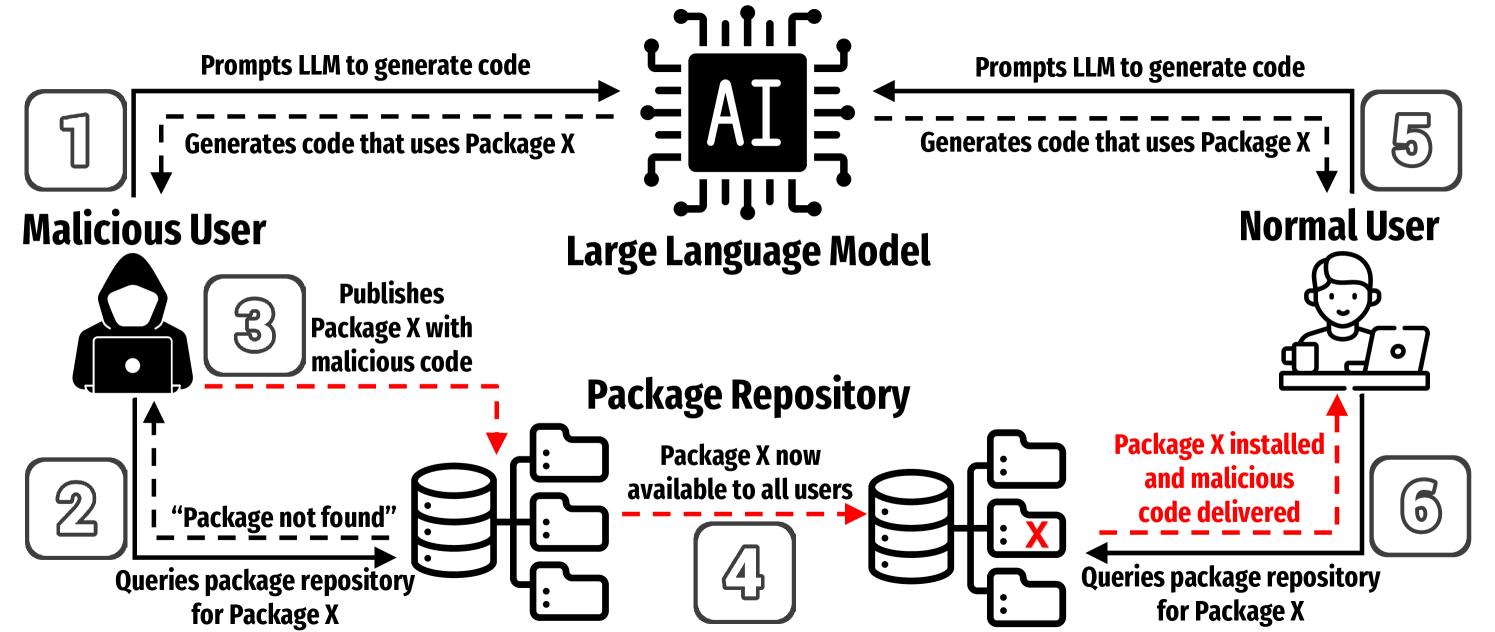
Overview of the Package Hallucination Attack Scenario
Evaluation Highlights
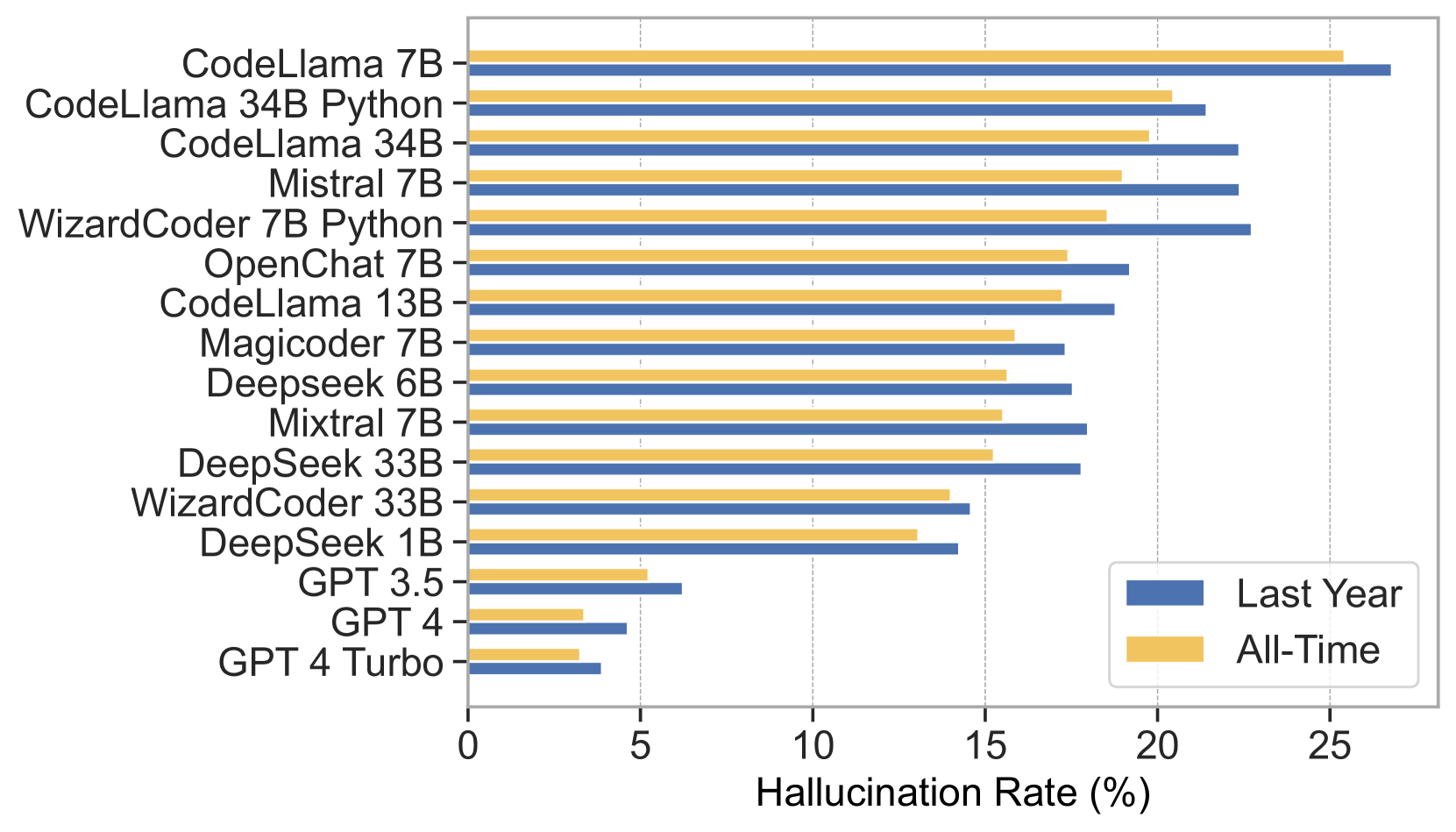
- Commercial models hallucinate packages in at least 5.2% of generated code, while open-source models hallucinate in 21.7% of cases on average
- Identified a staggering 205,474 unique examples of hallucinated package names across the study
- RAG mitigation reduces package hallucinations by 64.9% (relative improvement) while maintaining code quality, outperforming supervised fine-tuning and self-detection
Breakthrough Assessment
7/10
While the concept of package hallucination was previously known, this is the first rigorous, large-scale empirical study quantifying the threat across many models and evaluating specific mitigations. It establishes a critical baseline for code generation security.