📝 Paper Summary
Hallucination suppression
TOHA detects hallucinations in RAG systems by analyzing the topological divergence between prompt and response subgraphs within specific 'hallucination-aware' attention heads.
Core Problem
Existing hallucination detection methods are either computationally expensive (requiring multiple generations) or require large annotated datasets for supervised training, which are often scarce.
Why it matters:
- Hallucinations undermine user trust in sensitive applications, necessitating reliable detection mechanisms for safe deployment
- Computational overhead of sampling-based methods (like SelfCheckGPT) limits real-time applicability
- Supervised methods struggle with domain transfer due to the scarcity of high-quality annotated hallucination datasets
Concrete Example:
In a RAG scenario, if a model hallucinates an answer not present in the retrieved context, standard probability metrics might still be high. TOHA detects this because the topological structure of the attention graph shows a high divergence (novelty) between the prompt and the generated response in specific attention heads, signaling that the response is not grounded in the prompt.
Key Novelty
TOpology-based HAllucination detector (TOHA)
- Adapts Manifold Topology Divergence to graph structures (MTop-Div) to measure the topological dissimilarity between prompt and response tokens in attention maps
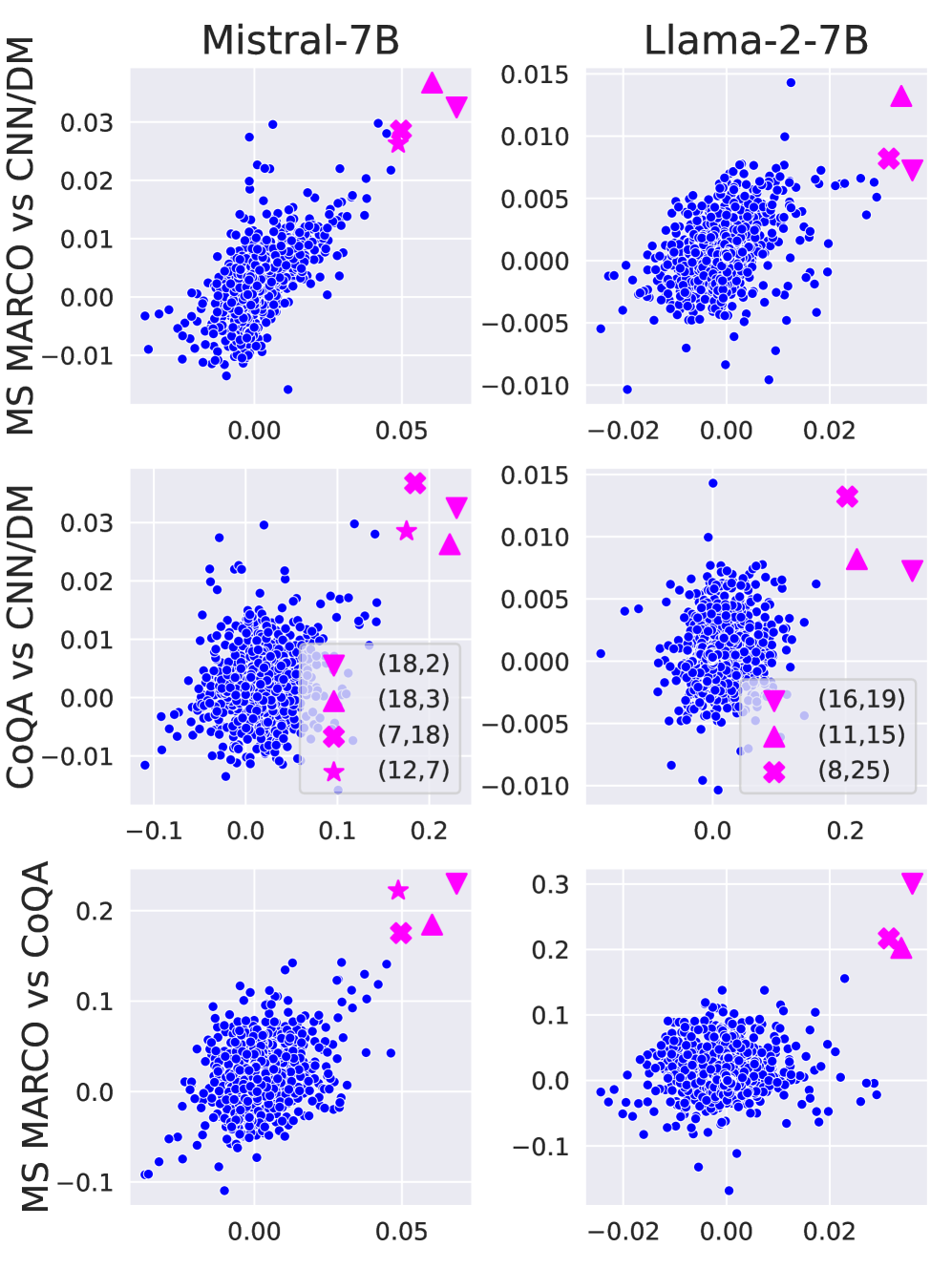
- Identifies a small set of 'hallucination-aware' attention heads that consistently show higher divergence for hallucinations, regardless of the dataset
- Interpret the divergence score as a measure of informational novelty: high divergence implies the response introduces information not topologically grounded in the prompt
Architecture
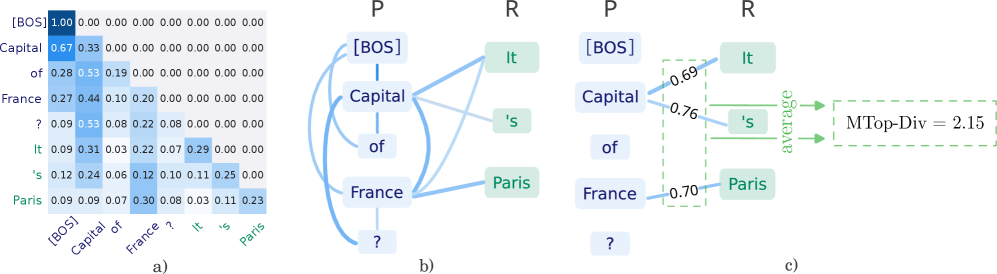
Conceptual illustration of Attention Graph construction and MTop-Div calculation.
Evaluation Highlights
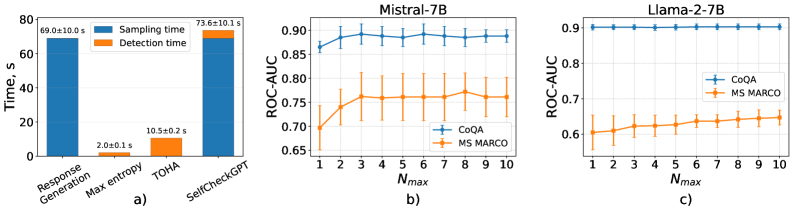
- +11.7% improvement on MS MARCO (long-form QA) for Mistral-7B compared to state-of-the-art baselines
- +21.6% improvement on CoQA (conversational QA) for LLaMA-2-7B compared to baselines
- Operates ~7x faster than SelfCheckGPT (with 1 additional sample) and >70x faster than standard sampling-based configurations
Breakthrough Assessment
8/10
Offers a highly efficient, training-free method that matches or beats computationally expensive baselines. The application of TDA to attention graphs for this purpose is novel and theoretically grounded.