📝 Paper Summary
Knowledge Graph (KG) Recommendation
LLM-Augmented Recommendation
Cold-Start Recommendation
IKGR constructs an intent-centric knowledge graph by using a RAG-guided LLM to extract explicit intent nodes, densifying connections between users and long-tail items without requiring cross-graph fusion.
Core Problem
Existing methods either rely on coarse category-level commonsense that misses fine-grained user intents or use latent vector representations that are non-auditable and bounded by sparse base graphs.
Why it matters:
- Enterprise search systems struggle with heterogeneous vocabularies and domain jargon, making standard retrieval ineffective for long-tail content
- Cross-graph fusion methods (aligning LLM graphs with interaction graphs) introduce structural noise and entity resolution errors that are hard to debug
- Pure LLM-as-recommender approaches introduce high inference latency and often hallucinate or drift, making them unstable for production service-level agreements
Concrete Example:
Two users clicking the same 'camera' page may have different intents: 'low-light astrophotography' vs. 'lightweight travel kit'. Category-level edges fail to capture this, while latent methods struggle to connect these users to relevant niche items if the interaction graph is sparse.
Key Novelty
Intent-Centric Knowledge Graph Recommender (IKGR)
- Treats 'intent' as a first-class explicit node in the graph, extracted via a tuning-free RAG-guided LLM pipeline that normalizes noisy text into canonical entities
- Densifies the graph through a 'mutual-intent' strategy that connects users and items to shared intent nodes, creating paths for information flow even when direct user-item interactions are missing
Architecture
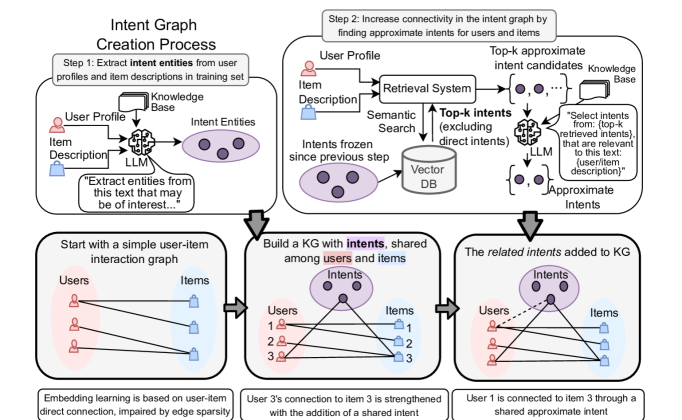
The IKGR framework: Intent Extraction, Graph Construction, and Inference.
Evaluation Highlights
- +22% MRR improvement (0.0125 to 0.0153) on the Enterprise Search dataset by adding intent edges
- Consistently outperforms strong baselines (KGIN, LLMRec) across public datasets (Books, Beauty, Steam, Yelp), particularly on cold-start slices
- Achieves state-of-the-art performance on long-tail edge sets (users/items with ≤3 interactions) in the Books dataset
Breakthrough Assessment
7/10
Solid practical contribution for enterprise/cold-start scenarios. While the GNN component is standard, the explicit grounding of intent via RAG to solve graph sparsity without cross-graph fusion is a smart architectural choice.