📊 Experiments & Results
Evaluation Setup
Open-domain Question Answering (QA) on Chinese and English datasets.
Benchmarks:
- CSQA (Commonsense QA (Chinese))
- TriviaQA (Factoid QA (English))
Metrics:
- AUROC (Area Under ROC)
- AUPR (Area Under Precision-Recall)
- FPR@95 (False Positive Rate at 95% Recall)
- Statistical methodology: Not explicitly reported in the paper
Key Results
| Benchmark | Metric | Baseline | This Paper | Δ |
|---|---|---|---|---|
| Performance comparison on standard QA benchmarks showing Semantic Energy consistently outperforming Semantic Entropy. | ||||
| CSQA | AUROC | 71.6 | 76.1 | +4.5 |
| CSQA | AUROC | 77.4 | 80.2 | +2.8 |
| Performance in specific failure scenarios where Semantic Entropy predicts zero uncertainty (single semantic cluster) but the answer is wrong. | ||||
| Specific subset (Single Semantic Cluster) | AUROC | 50.0 | 63.0 | +13.0 |
Experiment Figures
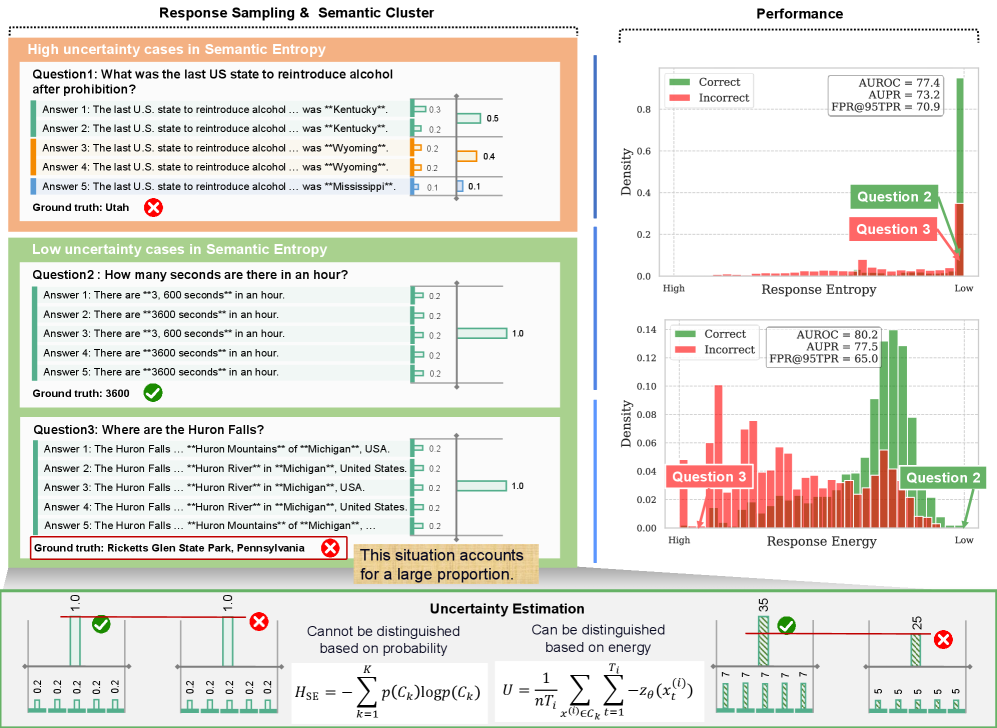
A motivating example comparing high-confidence correct answers vs. low-confidence incorrect answers where Semantic Entropy fails.
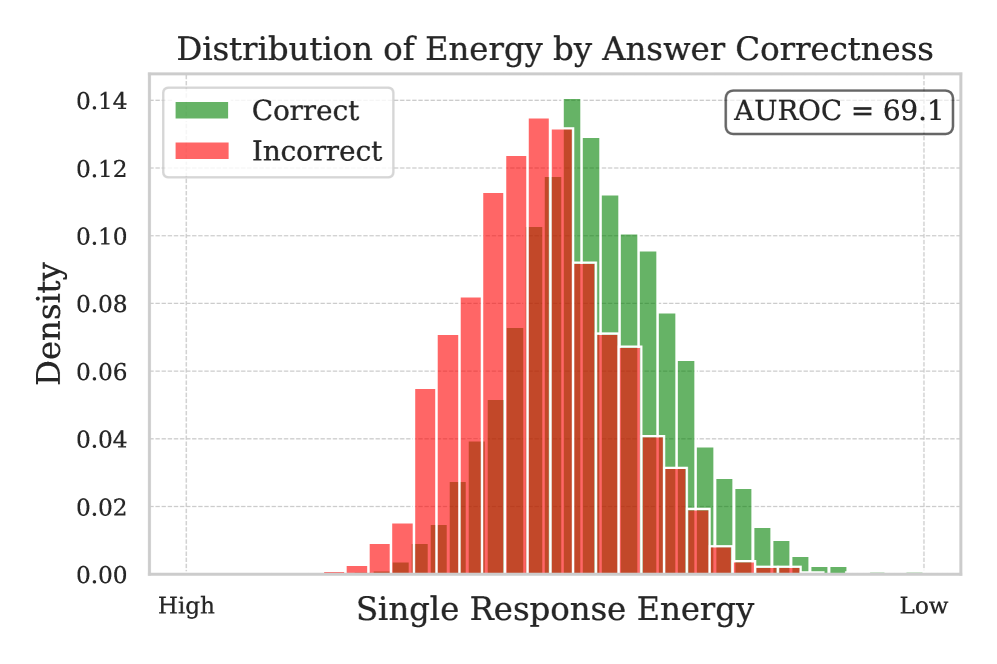
Ablation study on the impact of incorporating semantics into energy calculation.
Main Takeaways
- Semantic Energy significantly outperforms Semantic Entropy in detecting hallucinations, especially when the model is consistently wrong (low aleatoric, high epistemic uncertainty).
- Logits contain crucial confidence information lost during softmax normalization, making them better indicators of correctness than probabilities alone.
- Combining semantic clustering with energy metrics is essential; ablation studies show removing semantic grouping (like LogTokU) degrades performance.